
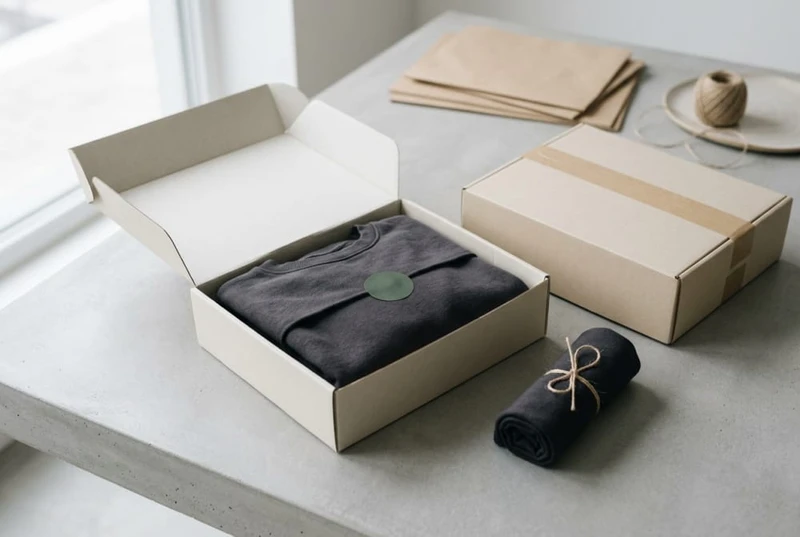
For apparel brands in the United Kingdom, packaging is no longer a final wrapping step. It is part of merchandising, fulfilment, transport protection, customer reassurance and long-term brand memory. A garment sold from a boutique rail in Chelsea, a case-packed order sent to a department store in Manchester, and an online parcel shipped through a Midlands fulfilment centre all need different structural choices, labelling logic and presentation standards. The right packaging system helps products arrive clean, folded well, easy to identify, simple to return and consistent with brand positioning.
For that reason, successful clothing businesses do not treat boxes, wraps and labels as isolated items. They build a packaging programme that links in-store display, warehouse handling and direct-to-consumer delivery. That programme usually combines transit-safe outer cartons, branded inner boxes, fold-support inserts, stickers for size and campaign control, and optional gift elements for premium launches. When done well, the result is stronger shelf presence, smoother stock movement and a more polished unboxing experience.
In the UK market, this matters across London boutiques, Birmingham distributors, Leicester garment suppliers, Leeds online fashion operations and Glasgow seasonal gifting campaigns. Brands serving both wholesale buyers and end customers need packaging that can scale from low-volume capsule drops to large replenishment runs without losing quality. Our workshop supports this with advanced equipment, precise finishing control and adaptable production planning, so brands can move between small custom runs and larger repeat orders with a consistent visual standard. Businesses looking for tailored custom apparel box solutions often begin by mapping their channels first and choosing structures second.
This guide explains what changes between retail, wholesale and e-commerce packaging, how to choose box and insert formats for different apparel categories, where gift packaging adds value, how stickers support operations, and how packaging choices influence returns, reviews and repeat purchase behaviour in the United Kingdom.
What changes between boutique packaging, wholesale packaging, and online order packaging
Boutique packaging is primarily seen before it is shipped. It supports display, tactile quality and immediate brand perception. In a fashion boutique, a customer notices board thickness, lid fit, ribbon pulls, tissue quality, foil details and whether the box feels worth keeping. Packaging here works as part of the brand’s physical environment. It should look refined on shelves, under counters and in changing-room handover moments. It often includes more visible branding and a calmer, more deliberate opening experience.
Wholesale packaging is different. A wholesale buyer usually values count accuracy, size visibility, efficient stacking, fast receipt and low damage rates. Cartons and internal packs need to support distribution to stores, concessions and stockrooms. In this channel, over-decoration can become a cost burden without adding operational value. A strong wholesale format therefore uses clear item coding, practical barcode placement, stable case dimensions and inserts that keep folded garments flat across transport. In ports and logistics routes serving Felixstowe, Southampton and Liverpool, the packaging must also withstand movement through pallets, cross-docking and mixed freight handling.
Online order packaging sits between brand theatre and transport function. Customers expect a clean arrival, easy opening, protective structure and a presentation that feels social-media ready without being wasteful. Since many UK apparel deliveries pass through courier networks with repeated scanning and sorting, e-commerce packaging must resist corner crushing, moisture exposure and internal shifting. It should also support returns, because poorly designed packaging often leads to repacking frustration, damaged folds and missing labels.
The biggest mistake is assuming one box style can do everything equally well. A premium magnetic rigid box might look superb in a Mayfair boutique but prove too costly and bulky for routine e-commerce dispatch. A plain corrugated transit carton may suit wholesale replenishment but weaken perceived value for direct-to-consumer premium knitwear. The best solution is a family system: shared colours, fonts, logo treatment and stickers across channels, but different board grades, inserts and closure methods for each route to market.
| Channel | Main purpose | Best box style | Key insert need | Sticker priority | Main risk if wrong |
|---|---|---|---|---|---|
| Boutique retail | Presentation and giftability | Rigid or premium folding box | Tissue, garment card, neck support | Brand seal and collection theme | Brand looks ordinary |
| Department store supply | Efficient handling | Durable folding cartons and case packs | Size dividers and count cards | SKU and size control | Receiving errors |
| Independent wholesale | Multi-store distribution | Stackable corrugated outers | Bundle separators | Route and assortment labels | Damaged or mixed stock |
| Online standard orders | Protection and brand impression | Mailer box or reinforced paper box | Fold board and tissue | Seal and returns guidance | Poor unboxing and creasing |
| Online premium orders | Memorable delivery | Branded rigid mailer set | Layered presentation insert | Campaign sticker set | Low perceived value |
| Seasonal gifting | Occasion-led appeal | Gift box with decorative sleeve | Message card and tray | Seasonal motif sticker | Missed upsell |
The table shows that each sales route asks packaging to perform a different job first. The strongest UK apparel brands standardise the visual language while adjusting structure, board strength and labelling according to how the goods move.
The growth trend reflected above is realistic for the United Kingdom as fashion brands push harder on own-brand presentation, sustainability compliance and channel-specific fulfilment. By 2026, packaging is expected to carry even more operational responsibility through traceability labels, recycled-content declarations and improved return-readiness.
Box and insert ideas for folded garments, accessories, and coordinated sets
Folded garments need packaging that preserves shape while avoiding unnecessary bulk. Shirts, knitwear, trousers and sweatshirts benefit from a fold card that keeps edges sharp and reduces movement. For lighter products, a folding carton with tissue and a branded closure sticker may be enough. For higher-value pieces, a rigid lift-off box or book-style box creates a more elevated feel and protects folds during delivery. Inserts should not be decorative only; they should stop collar collapse, support sleeves and keep front panels flat.
Accessories require a different insert strategy. Scarves, belts, caps, wallets and small leather items often shift more inside oversized packaging than garments do. That makes die-cut trays, card bridges, paper bands and shaped recesses useful. A scarf set, for example, can be rolled into a shallow tray with a belly band and a brand card. A belt may need a wrapped channel insert to prevent buckle marks. Jewellery-adjacent accessories should use soft contact materials if metal hardware could scratch coated surfaces.
Coordinated sets such as matching loungewear, shirt-and-short combinations, twin knit sets or gift-ready accessories benefit from tiered or compartmental packaging. Separate product areas help buyers recognise the value of the bundle immediately. This is especially useful for online orders where the customer cannot handle the set before purchase. In a UK gifting context, coordinated sets perform well during Christmas, Mother’s Day and wedding-party seasons when presentation can influence conversion.
Brands often reduce damage and improve visual consistency by creating one insert system in multiple sizes rather than starting fresh for every product. For example, one fold-board specification can support shirts, blouses and lightweight knitwear with only minor dimensional changes. This is where precise production matters. Our machinery supports accurate cutting, scoring and finishing so inserts, trays and outer boxes match closely, which helps garments sit neatly and repeat consistently across production runs.
| Product type | Recommended box | Recommended insert | Why it works | Typical finish | Best channel |
|---|---|---|---|---|---|
| Folded shirts | Folding carton or rigid shirt box | Fold board and collar support | Keeps front panel crisp | Matt lamination | Boutique and online |
| Knitwear | Mailer box with depth | Flat support board and tissue | Reduces bunching | Soft-touch coating | Online premium |
| Trousers | Rectangular corrugated paper box | Wrap band and fold card | Holds folds in transit | Uncoated kraft look | E-commerce and wholesale |
| Scarves | Shallow rigid box | Tray or paper cradle | Stops sliding | Textured paper | Gift and boutique |
| Belts | Slim presentation box | Channel insert | Protects buckle and strap | Spot UV logo | Retail and gifting |
| Matching sets | Compartment gift box | Divider tray | Shows bundle value clearly | Foil plus sleeve | Launches and premium sales |
The comparison above shows how the structure should match garment behaviour. Soft items need fold discipline, hard accessories need movement control, and coordinated sets need visual separation. Brands searching for more refined gift packaging for apparel collections often use these same foundations and then layer in occasion-led details such as sleeves, cards or ribbons.
This demand pattern is typical of the UK market, where womenswear, accessories and gifting campaigns often invest more visibly in packaging differentiation. Premium gifting is especially strong around London, Edinburgh and Bath, where tourism, occasion shopping and premium retail overlap.
Gift-packaging options for premium collections, launches, and seasonal promotions
Gift packaging works best when it amplifies a product story rather than masking a weak product. For premium collections, the most effective options include rigid two-piece boxes, magnetic closure boxes, drawer boxes with ribbon pulls, and decorative sleeves around simpler carton structures. These formats create a slower opening sequence that feels intentional. In fashion, that pause matters. It tells the customer the item is special before they even touch the garment.
Launch packaging should reflect the campaign mood. A new tailoring line may use restrained colours, embossed logos and precise fold layouts. A summer resort capsule might suit lighter boards, printed liners and bright sticker cues. Seasonal promotions can be more flexible, but the best executions still stay recognisable as part of the parent brand. The goal is not to redesign everything for every event. It is to add a seasonal layer while protecting core brand consistency.
For UK gifting periods, practical add-ons include message cards, removable belly bands, printed tissue, branded seals and reusable outer boxes. Christmas and year-end gifting often support deeper colours and tactile papers, while spring launches and wedding-season edits perform better with cleaner palettes and lighter textures. Brands supplying both stores and e-commerce usually reserve the full gift set for selected SKUs or paid upgrades, which controls cost and inventory complexity.
Our production approach supports this kind of scaling. We can move from short-run premium launch boxes to larger seasonal volumes without changing the visual identity unnecessarily. That flexibility is important when collections are tested in London first, then rolled out through regional stores or online warehouses once demand is proven. It allows brands to keep a polished presentation while managing lead times and stock risk more carefully.
| Gift format | Best use | Cost level | Perceived value | Operational complexity | UK seasonal fit |
|---|---|---|---|---|---|
| Rigid lift-off box | Premium garments | High | Very high | Medium | Christmas and launches |
| Magnetic box | VIP sets and press gifting | High | Very high | Medium | Brand events |
| Drawer box | Accessories and smaller sets | Medium to high | High | Medium | Luxury gifting |
| Sleeved folding carton | Seasonal campaigns | Medium | Good | Low | Broad promotional use |
| Tissue plus sticker set | Paid gift wrap option | Low to medium | Good | Low | Online orders |
| Box plus message card | Direct gifting | Medium | High | Low | Mother’s Day and birthdays |
The most cost-efficient gift packaging often combines a standard box with one or two interchangeable elements, such as a campaign sleeve and a seasonal seal. This keeps base packaging stable while allowing premium collections and limited drops to feel distinct.
Sticker uses for sizing, campaign themes, brand seals, and drop management
Stickers are often underestimated in apparel packaging, yet they solve both branding and logistics problems. In retail stockrooms, size stickers improve picking speed and visual sorting. On boutique presentation packs, they can act as subtle brand seals that finish tissue wraps neatly. In seasonal campaigns, they carry colour, motif and launch language without forcing a full box redesign. In drop-based fashion, stickers can even separate limited runs, influencer seeding packs and market-specific allocations.
For sizing, clarity matters more than decoration. A size sticker should be legible from a distance, resistant to rubbing and consistent across all products. For wholesale packs, stickers need to help receiving teams identify contents quickly, especially when cartons are opened in busy store back rooms. For online fulfilment, stickers can support pick accuracy, especially for boxed sets and variant-heavy assortments.
Campaign stickers give brands agility. Instead of printing entirely new boxes for every capsule, a business can use neutral core packaging and apply campaign-specific stickers for spring launches, summer edits, autumn layering messages or festive gifting. This approach is cost-effective for growing labels and private-label suppliers serving multiple retailers. It also helps reduce obsolete stock if a campaign changes late.
Brand seals add perceived care. A simple round seal over folded tissue can make a direct-to-consumer delivery feel finished. It also subtly reassures the buyer that the item has not been tampered with. For labels working across wholesale and online routes, sticker systems can be standardised with different data layers: one family for size, one for campaign theme, one for shipping or drop management. That keeps operations clean. Brands wanting reliable custom stickers for fashion packaging usually benefit from setting these categories early in the packaging plan.
| Sticker type | Main function | Best placement | Who benefits most | Design priority | Common mistake |
|---|---|---|---|---|---|
| Size sticker | Variant identification | Outer box corner | Wholesale and stockroom teams | Legibility | Text too small |
| Brand seal | Presentation finish | Tissue closure | Boutique and online customers | Clean logo use | Poor adhesive strength |
| Campaign sticker | Seasonal or launch message | Lid or sleeve | Marketing teams | Visual theme | Too many design variants |
| Drop code sticker | Limited release control | Inner box side | Fulfilment teams | Tracking clarity | Inconsistent coding |
| Barcode sticker | Scanning and stock movement | Back or base panel | Warehouses and retailers | Scan contrast | Placed over seams |
| Returns guide sticker | Customer instruction | Mailer interior | Online shoppers | Simplicity | Too much text |
Sticker strategy becomes more important as brands grow. In the UK, where retail, concession, marketplace and own-site sales often run side by side, stickers bridge the gap between polished presentation and practical inventory control.
The area chart shows a realistic trend shift toward flexible packaging systems in the UK. By 2026, more brands are expected to favour base boxes plus variable stickers, sleeves and inserts instead of fully separate packaging ranges for every campaign.
How packaging affects returns, product reviews, and repeat customer perception
Packaging has a direct effect on how customers judge apparel before they even try it on. A crushed corner, sloppy fold or unclear label can make a perfectly good garment feel lower in quality. This perception influences reviews, especially in e-commerce where buyers often mention presentation, cleanliness and fit confidence together. If the packaging suggests carelessness, customers may inspect the product more critically and become quicker to return it.
Returns are strongly linked to repackability. If a box tears while opening, if the customer cannot understand how to refold the item, or if there is nowhere obvious to place the return label, the process feels inconvenient. Some buyers then use unsuitable replacement packaging, increasing damage risk. Others blame the brand for making returns difficult. A better system uses easy-open but not fragile closures, clear inner organisation and enough structural integrity for one return journey.
Repeat customer perception is more cumulative. One order in a plain but tidy box may be acceptable. Three orders in inconsistent packaging with varying sticker quality and shifting colours can make the brand feel fragmented. Consistency across time builds trust. Customers begin to expect a familiar standard and associate that standard with reliability. This is especially important for subscription-like buying behaviour in basics, childrenswear, activewear and repeat gifting.
Brands in the United Kingdom also need to consider reviews in a social context. Unboxings on Instagram, TikTok and customer review galleries often highlight packaging almost as much as the clothing itself. Premium touches do not always need to be expensive, but they do need to feel deliberate. Straight folds, quality tissue, balanced print and clear labels matter more than oversized decorative extras.
| Packaging factor | Effect on returns | Effect on reviews | Effect on repeat purchase | Priority level | Recommended action |
|---|---|---|---|---|---|
| Protective structure | Lower transit damage returns | Improves first impression | Builds trust | Very high | Match board strength to route |
| Clear sizing labels | Reduces picking errors | Lowers complaints | Improves confidence | High | Standardise sticker system |
| Neat fold presentation | Reduces perceived defects | Raises quality ratings | Encourages repeat orders | High | Use fold cards and inserts |
| Easy return reuse | Simplifies returns process | Improves service comments | Less friction for future orders | High | Add simple reopening guidance |
| Consistent branding | No direct effect | Supports premium perception | Strengthens loyalty | Medium to high | Keep colours and finishes stable |
| Gift-ready details | Minimal direct effect | Boosts delight and sharing | Encourages premium reorders | Medium | Offer as optional upgrade |
The explanation from this table is simple: packaging reduces practical return triggers while also shaping emotional judgement. Better structure lowers damage and picking errors, while better presentation improves how customers talk about the brand afterwards.
Material and finish choices that reflect different fashion positioning
Materials and finishes communicate price point, design philosophy and environmental intent. A minimalist contemporary label may choose uncoated boards with sharp black print, giving a clean studio feel. A luxury eveningwear brand may use rigid boxes with textured wraps, foil stamping and soft-touch lamination. A heritage-inspired outerwear company may favour kraft-based materials, muted colours and understated embossing. Each decision changes how the customer reads the garment before wearing it.
For mainstream e-commerce apparel, corrugated paper-based structures with good print quality often offer the best balance of protection and cost. For boutique and premium gifting, rigid set-up boxes provide stronger perceived value and better shelf presence. Finishes such as embossing, debossing, foil, spot UV, fabric pulls and speciality papers should be used with restraint. Too many features can make the packaging look generic rather than premium.
In the UK market, sustainability claims are now part of brand positioning as well. Customers increasingly notice recycled board content, unnecessary plastic and excessive layering. Retailers and public-facing brands are also watching policy developments and 2026 expectations around clearer material disclosures, responsible sourcing and waste reduction. This means finish choices need to work with sustainability messaging, not against it. A box that claims environmental care but uses avoidable mixed-material construction can undermine credibility.
From a manufacturing perspective, material selection must also support repeatability. Our workshop places strong emphasis on material inspection, print control and final checking so visual tone, structural fit and finishing quality remain stable from one batch to the next. That matters for UK brands that reorder in phases across spring and autumn collections and cannot afford noticeable shifts between deliveries.
| Material or finish | Brand position it suits | Main advantage | Main caution | Typical use | 2026 outlook |
|---|---|---|---|---|---|
| Uncoated paper board | Modern minimal and eco-led | Natural feel | Marks more easily | Shirts and basics | Strong demand |
| Rigid greyboard box | Premium and luxury | High perceived value | Higher cost and volume | Gift sets and launches | Selective use |
| Corrugated paper mailer | E-commerce practical | Transit protection | Needs good print planning | Online orders | Core format |
| Soft-touch lamination | Premium contemporary | Smooth tactile effect | May conflict with eco messaging | Fashion boxes | Used more carefully |
| Foil stamping | Luxury and occasion-led | Strong visual accent | Can look excessive | Holiday and eveningwear | More selective accents |
| Emboss or deboss | Refined brand systems | Quiet sophistication | Requires precise board choice | Logo detailing | Increasing popularity |
These choices help position fashion products correctly. The right finish should feel like an extension of the garment range, not a disconnected decoration layer.
Mistakes that make private-label apparel packaging look inconsistent
Private-label apparel often suffers from inconsistency because packaging decisions are made too late or too separately. One supplier chooses a warm white board, another uses bright white. One sticker set uses bold sans serif type, another uses narrow condensed text. Box sizes vary unnecessarily, tissue shades drift, and logo placement changes from run to run. Individually, each issue looks small. Together, they make the brand appear less established.
Another frequent mistake is treating wholesale and direct-to-consumer packaging as unrelated worlds. If a customer buys a brand in-store and later orders online, they should still recognise the same identity. The structures can differ, but key visual signals should remain stable: logo scale, colour family, tone of voice, sticker logic and finish hierarchy. Without that continuity, the brand feels improvised.
Overcomplication is another risk. Too many box formats, too many sticker versions and too many seasonal exceptions create confusion in production and fulfilment. This often leads to last-minute substitutions that weaken consistency further. A better approach is to define a core packaging toolkit with controlled variation: for instance, three outer box sizes, two insert families, a standard size sticker system and a limited set of campaign overlays.
Quality control is equally important. Inconsistent creasing, poor glue application, misaligned foil or weak adhesive seals quickly undermine a private-label programme. This is why detailed checking matters from material selection through final inspection. Reliable production workflows help packaging look coherent even when order quantities change or multiple SKUs are packed across different windows.
How to keep packaging aligned across clothing, accessories, and boxed sets
Alignment starts with a packaging architecture, not with individual items. Brands should define their base visual system first: logo usage, primary colours, secondary campaign colours, typography rules, sticker categories, tissue treatment and finish limits. Then they should map product families such as folded garments, accessories and gift sets onto that system. This keeps every package recognisable while allowing practical differences in size and structure.
One effective method is to create shared design anchors. For example, all boxes may use the same logo placement on the lid, the same interior print tone and the same shape language for stickers. Garment boxes can then use fold boards, accessory packs can use shaped inserts and gift sets can use compartment trays, but they still feel part of one brand world. This is especially valuable when collections are sold through boutiques, department stores and online channels at the same time.
Operational alignment matters too. Product coding, barcode areas, size identifiers and returns information should appear in predictable locations. Fulfilment teams in warehouses around the Midlands, and retail handlers in cities such as Bristol or Newcastle, work faster when they know where to find the information immediately. Consistency supports both aesthetics and efficiency.
Service capability also plays a major role here. Brands often need help balancing small-run customisation with larger production cycles, especially when they launch a new capsule alongside ongoing core lines. We support that process with flexible order planning, practical communication and packaging options that can scale without losing detail quality. That helps apparel brands keep one coherent look across clothing boxes, accessory packs and premium boxed sets, whether they are serving niche boutiques or broader UK distribution.
The comparison chart illustrates why a planned packaging system outperforms an ad-hoc approach. The gains are not only visual; they also improve sticker logic, production flexibility and protection performance across different product categories.
FAQ
Should one apparel brand use the same box for retail and e-commerce?
Usually no. The same visual identity can be used, but structure and board strength should change according to display needs and shipping demands.
Are rigid boxes always the best option for premium clothing?
Not always. They create strong perceived value, but for some online orders a well-designed folding or corrugated presentation box gives better cost control and shipping efficiency.
How many sticker types should a growing clothing brand have?
Most brands work well with four core types: size, barcode, brand seal and campaign sticker. Extra variants should be added only when operations genuinely need them.
What helps reduce apparel returns through packaging?
Protective structures, clear size identification, neat folding support and easy repacking features all help reduce avoidable returns and improve customer satisfaction.
What should UK apparel brands watch for in 2026?
Expect stronger focus on sustainable materials, clearer labelling, packaging efficiency, adaptable campaign systems and greater pressure to align premium presentation with responsible sourcing claims.
In practical terms, apparel packaging in the United Kingdom should do three things at once: represent the brand well, support product movement efficiently and stay coherent across channels. Boutique packs need display quality, wholesale packs need handling clarity and online packs need transit protection with a polished arrival experience. Boxes, inserts and stickers should therefore be planned as one connected system rather than bought separately. When the system is aligned, clothing, accessories and boxed sets all feel related, customers perceive more value, and operations run more smoothly from first packing to possible return.
