
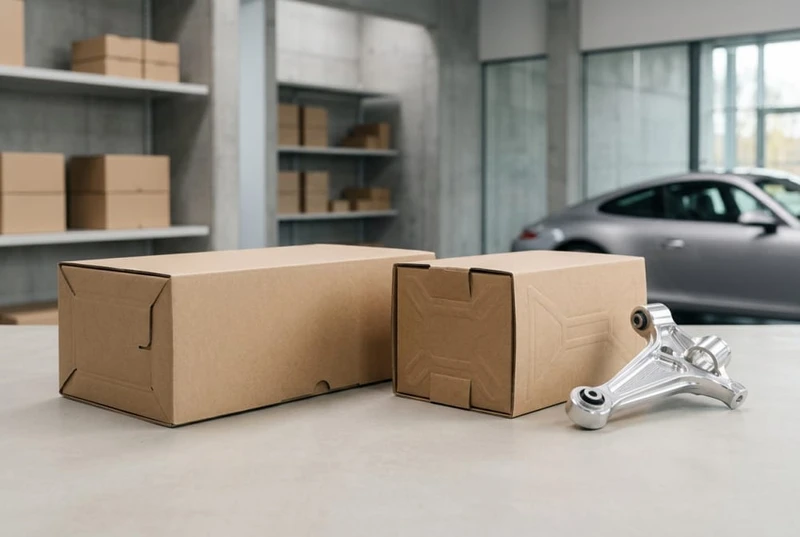
Automotive parts packaging in the United Kingdom has to do more than place a component inside a box. It has to protect delicate electronics, contain grease, keep repair kits complete, support warehouse picking, reduce returns, and help both aftermarket and OEM supply chains move stock efficiently from factory floor to distributor, workshop, retailer, and end user. For businesses handling parts through Birmingham, Coventry, Liverpool, Felixstowe, Southampton, and the wider Midlands automotive corridor, the right packaging structure directly affects stock accuracy, damage rates, labour time, and customer confidence.
A well-designed custom pack usually combines outer board strength, internal fitment, practical labelling, and a repeatable SKU system. That matters whether the product is a MAP sensor, a fuel filter, a brake pad set, a service kit, clips and seals, or a heavy metal component with sharp edges. In the UK market, where mixed orders, short lead times, and multi-channel fulfilment are common, packaging must work across e-commerce, trade counters, garages, national distributors, and palletised bulk delivery.
Our team supports this need with advanced converting equipment, precise box production, and controlled label application processes, allowing us to produce custom box solutions that match product geometry, handling risk, and storage requirements. We also develop practical packaging stickers for part numbers, compatibility notes, warehouse logic, and traceability, helping UK suppliers create packs that are easier to identify and harder to mis-pick.
Packaging needs for sensors, filters, repair kits, brake parts, and service components
Each automotive category places different demands on packaging. Sensors often include pins, housings, or calibration-sensitive elements that can be bent or affected by static, moisture, or impact. Filters may be lightweight yet crush-sensitive, while brake parts are heavier, dust-generating, and more likely to abrade surrounding surfaces. Repair kits present another issue altogether: they contain multiple small parts that must remain complete, visible, and correctly arranged. Service components such as seals, clips, gaskets, bulbs, or fasteners can be low in unit value but high in fulfilment complexity.
In UK supply chains, these differences matter because many orders are mixed cartons rather than full runs of identical items. A motor factor in Manchester may handle dozens of similar part references in one aisle. A workshop supplier in Leeds may require packs that can be opened quickly without losing small pieces. A national distributor moving stock via the M6 corridor may need stronger outers to withstand repeated manual handling. Packaging therefore has to reflect product behaviour, not just dimensions.
| Part type | Main packaging risk | Recommended box style | Internal protection | Labelling priority | Typical UK channel |
|---|---|---|---|---|---|
| Sensors | Pin damage and shock | Rigid tuck-end carton | Die-cut insert or pulp fitment | Compatibility and batch code | Aftermarket distributor |
| Filters | Crushing and contamination | Corrugated carton | Sleeve or wrap support | Part number and orientation | Retail and workshop |
| Brake pads | Weight, dust, edge wear | Double-wall carton | Partition or board brace | Axle position and kit contents | Trade and bulk supply |
| Repair kits | Missing small parts | Compartment box | Tray, sachets, or nested cavities | Contents checklist | E-commerce and service |
| Gaskets and seals | Bending and misidentification | Flat mailer or carton | Backing card | Size and fitment note | Workshop and retail |
| Clips and fasteners | Loss and count errors | Small carton or pouch in box | Segmented bagging | Quantity and vehicle range | Repair kit assembly |
The table shows why packaging should be built around risk profile rather than generic stock boxes. A brake pad set and a sensor may fit within similar outer dimensions, yet they need completely different internal management. Standardisation is useful, but only when it is controlled and category-specific.
Insert solutions that reduce movement, scratches, and avoidable return issues
Returns are not always caused by faulty parts. In many cases, they begin with preventable movement inside the pack. A sensor rattles and arrives with bent terminals. A painted bracket rubs against hardware in the same box. A service kit opens in transit and one washer disappears into the outer carton. These are packaging failures that create commercial losses long before any warranty investigation begins.
Insert design is one of the most effective ways to control this problem. Die-cut card inserts are cost-efficient for many UK aftermarket products because they can immobilise a part, separate accessories, and still support efficient flat shipping before assembly. Moulded pulp works well where a more contoured fit is needed and sustainability targets are becoming more important. Corrugated partitions are practical for bulk workshop orders. For high-value electronics, layered board structures can create crush zones while keeping the part elevated from the outer wall.
Scratch prevention matters particularly for coated metal parts, machined surfaces, and branded presentation packs sold through retail channels. Grease-proof wraps, paper sleeves, or soft contact barriers can prevent cosmetic damage without increasing pack complexity too much. For bulk trade packs, edge retention and weight distribution may matter more than retail appearance, but the principle is the same: stop internal movement before it becomes customer dissatisfaction.
| Insert type | Best for | Protection benefit | Cost level | Assembly speed | Return reduction impact |
|---|---|---|---|---|---|
| Die-cut board insert | Sensors, valves, small housings | Locks part in place | Moderate | Fast | High |
| Moulded pulp tray | Fragile shapes, eco-focused ranges | Shock absorption | Moderate | Medium | High |
| Corrugated partition | Bulk brake or hardware packs | Separates heavy items | Low | Fast | Medium |
| Paper wrap and sleeve | Greasy or coated surfaces | Scratch and stain control | Low | Fast | Medium |
| Blister or formed tray | Retail display components | Visual control and retention | Higher | Medium | Medium |
| Multi-cavity kit insert | Repair kits | Keeps all components complete | Moderate | Medium | Very high |
This comparison makes clear that insert selection should balance cost, assembly time, and likely return savings. In practice, even a modest insert can be cheaper than one damaged return, one re-pick, and one customer support interaction.
Sticker uses for part numbers, compatibility, storage logic, and warehouse accuracy
Stickers are often treated as a finishing detail, but in automotive packaging they are an operational tool. A clear label helps warehouse staff pick the right SKU quickly, allows workshop teams to confirm vehicle fitment before opening, supports stock counts, and reduces the chance of near-identical parts being mixed together. In the UK aftermarket, where one product family can cover many cross-references, strong label discipline is essential.
Part number stickers should be readable at shelf distance and remain legible after transport through trade networks from London and Bristol to Glasgow and Belfast. Compatibility stickers can highlight engine code, axle position, left or right orientation, or model-year limits. Storage logic stickers can identify bin location, rotation rules, or whether a box should be stored upright. For multi-component service kits, labels can also list kit contents so receiving teams can verify completeness without opening every pack.
We apply close process control to sticker production so printed data, adhesive choice, and material finish match the intended handling conditions. That is especially useful where packs may face oily environments, temperature swings, or repeated barcode scanning. On growing product lines, a standard label architecture helps procurement, packing, and warehouse teams work from the same visual logic.
| Sticker function | Typical information | Operational benefit | Where used | Material option | Error reduction value |
|---|---|---|---|---|---|
| Primary identification | SKU, part number, barcode | Faster picking | All cartons | Coated paper or synthetic | Very high |
| Compatibility label | Vehicle range, engine code | Lower fitment confusion | Sensors, filters, kits | Matte permanent label | High |
| Storage instruction | Keep upright, dry store | Better stock condition | Fragile and fluid-sensitive parts | Warning label stock | Medium |
| Traceability label | Batch, date, shift code | Recall and QA support | OEM and regulated lines | Thermal transfer compatible | High |
| Kit contents label | Item count and list | Checks completeness | Repair kits | Large-format paper label | Very high |
| Warehouse routing label | Location code, zone, pallet ID | Improves internal flow | Distribution centres | Synthetic logistics label | High |
The practical lesson is simple: labels should not be an afterthought. They are part of the packaging system, especially where product variants are visually similar and the cost of a wrong pick is high.
Retail packaging compared with workshop, service, and bulk distribution packaging
Retail packaging and workshop packaging may use the same product, but they serve different priorities. Retail packs must look ordered, provide product information clearly, and offer confidence to the buyer standing at a counter or browsing online. Workshop packs focus more on opening speed, robustness, and practical handling. Bulk distribution packaging is built around pallet efficiency, stacking strength, and warehouse throughput.
For a UK retailer or e-commerce seller, the outer carton often becomes part of the customer experience. Clean printing, tidy inserts, tamper evidence, and compatibility guidance all matter. For a garage or service centre, however, less decorative but more functional packaging can be better. Technicians want packs that open quickly, release parts without damage, and keep all components visible. In bulk supply, the shipping carton itself becomes a handling unit, and the inner packs need to survive vibration, compression, and repeated loading across depots.
This is where flexible production capability becomes valuable. With modern cutting, creasing, printing, and finishing equipment, a packaging partner can adapt one product family into several channel-specific pack formats without losing brand consistency or part accuracy. That allows a supplier to support national retail chains, independent garages, fleet workshops, and central distribution centres with a more coherent packaging programme.
| Packaging channel | Main priority | Outer box style | Internal design focus | Print and label need | Typical order pattern |
|---|---|---|---|---|---|
| Retail shelf | Presentation and trust | Printed carton | Neat layout and visibility | High | Small mixed orders |
| E-commerce | Parcel resilience | Protective mailer carton | Shock protection | High | Single-unit dispatch |
| Workshop service | Fast access | Utility carton | Simple retention | Medium | Frequent repeat supply |
| Bulk trade | Stacking and count control | Corrugated shipper | Partitions and count packs | Medium | Case quantities |
| OEM supply | Traceability and consistency | Standardised transit pack | Repeatable fitment | Very high | Scheduled flow |
| Export distribution | Transit durability | Heavy-duty corrugated | Moisture and movement control | High | Pallet and container loads |
The table highlights that no single packaging format fits every channel. The strongest packaging strategy aligns pack structure with the point of use, not just the point of packing.
How custom boxes help multi-component repair kits stay complete in transit
Repair kits are among the most demanding automotive packaging formats because a single sale may include seals, washers, clips, springs, bolts, instructions, and a core component. If one small part escapes its position, the whole kit can become unsellable or trigger a field complaint. This is a common pain point for suspension kits, caliper kits, injector seal sets, sensor service kits, and maintenance packs intended for busy workshops.
Custom boxes solve this by assigning a clear location to every component. The most effective designs use compartmental trays, die-cut cavities, small internal cartons, or sealed sub-packs arranged inside one outer box. The result is better count control during assembly, better retention during transport, and easier checking at goods-in or point of use. For UK suppliers shipping through parcel networks or mixed pallet consignments, this matters because kits are especially vulnerable to vibration and rough handling.
From a manufacturing standpoint, structured kit packaging also improves assembly accuracy. When each part has a designated cavity, packers can visually confirm whether the kit is complete before sealing. Our workshop supports this through flexible production runs, allowing small-batch customised kits as well as larger-scale repeat programmes. That makes it practical for growing aftermarket brands, service specialists, and OEM support ranges to move from generic mixed packing to a more controlled packaging method.
A Midlands-based distributor, for example, might switch from loose bagged hardware inside a plain carton to a custom box with internal sections for clips, gaskets, fasteners, and the main component. The immediate benefit is fewer missing-part claims. The longer-term benefit is easier training for packing staff, better stock presentation, and fewer returns that are caused not by product quality but by packaging inconsistency.
Material choices for fragile, heavy, greasy, or oddly shaped auto parts
Material selection is central to successful automotive parts packaging. Fragile components often require stiffness and cushioning at the same time. Heavy metal parts need board grades that resist bursting and edge crush. Greasy parts need barriers that prevent oil migration into the carton. Oddly shaped components need packaging that accepts asymmetry without wasting too much space or creating dead zones that allow movement.
In the UK, where transport may include courier parcels, trade vans, and warehouse transfers in variable weather, material choice should reflect the real logistics journey. Single-wall board can work well for many service items, but brake hardware, steering parts, and dense kits may require double-wall corrugated. Coated liners or inner wraps help with oily surfaces. Recycled board grades can support sustainability goals, but they must still meet stacking and handling performance targets. Pulp, board, and paper-based inserts are increasingly attractive as businesses prepare for stronger 2026 sustainability expectations and customer scrutiny around plastics reduction.
Our production process starts with material assessment, because the correct substrate influences not only protection but also print quality, adhesive behaviour, and assembly efficiency. With careful material matching, a packaging programme can improve both product protection and unit economics.
| Material | Best suited to | Main strength | Limitation | Sustainability profile | Typical use case |
|---|---|---|---|---|---|
| Single-wall corrugated | Light to medium parts | Good all-round value | Lower compression strength | Strong | Filters and service parts |
| Double-wall corrugated | Heavy components | High stacking strength | Higher weight | Strong | Brake and steering parts |
| Solid board carton | Retail presentation | Clean print finish | Less suitable for heavy loads | Strong | Sensors and branded kits |
| Moulded pulp | Fragile irregular shapes | Shock absorption | Tooling and drying variables | Very strong | Electronic parts support |
| Grease-resistant paper wrap | Oily parts | Surface isolation | Limited structural support | Good | Machined and lubricated items |
| Synthetic label stock | Harsh handling environments | Durable printing | Higher cost | Variable | Warehouse and traceability labels |
This table shows why material choice should be made at system level. The strongest outer board alone will not fix a poor insert, and an elegant carton will fail if oil contamination or shape instability is ignored.
Catalogue and SKU confusion problems caused by weak packaging systems
One of the most expensive hidden costs in automotive distribution is SKU confusion. It happens when similar parts share near-identical cartons, weak labels, unclear descriptors, or inconsistent pack dimensions. Staff then rely on memory or partial codes, and errors spread from goods-in to picking and returns processing. This issue is common in product families such as filters, pads, bulbs, clips, and sensors, where visual similarity is high but fitment differences are critical.
Weak packaging systems make catalogue complexity worse. If one supplier changes carton size without updating storage logic, warehouse slotting becomes inconsistent. If a product range uses different label layouts by factory or batch, scanners and staff lose confidence. If repair kits do not show contents clearly, service teams may open packs to check them, increasing handling damage and mixed stock risk. In the UK market, where many brands sell through both online and physical trade channels, this confusion can quickly translate into poor reviews, extra transport cost, and avoidable customer service workload.
The answer is packaging governance. That means defined box families, consistent label placement, agreed naming logic, and a clear relationship between catalogue data and physical packaging. It also means designing for shelf and bin behaviour, not just for shipping. A supplier with hundreds or thousands of SKUs needs packaging standards that support scale.
A practical example would be a filter range sold through a distributor near Doncaster. If air, oil, and cabin filters all arrive in similar plain cartons with only small end labels, pick errors are predictable. If the range is redesigned with consistent colour bands, large face labels, barcode placement, and orientation guidance, warehouse accuracy typically improves because the packaging itself becomes part of the information system.
How to standardize packaging across a growing aftermarket or OEM product range
Standardisation does not mean using one box for everything. It means creating a controlled framework that allows a growing product range to stay organised, identifiable, and operationally efficient. For aftermarket and OEM suppliers in the United Kingdom, the best approach usually starts with box families based on size bands, weight classes, and risk categories. Labels, internal protections, print zones, and traceability fields can then be standardised within those families.
For example, a supplier may define one packaging standard for fragile electronics, one for medium-weight service parts, one for brake and chassis items, and one for multi-component kits. Within each class, part numbers, compatibility data, barcode placement, and storage instructions follow the same structure. This supports faster training, simpler procurement, clearer warehouse slotting, and more consistent customer presentation.
Technological capability is important here. Advanced machinery allows repeatable cutting, accurate folding, efficient print registration, and dependable sticker placement across both short and long runs. Manufacturing capability matters too, because a growing range often requires flexible output: prototype sampling, pilot batches, then full production once pack performance is proven. Service capability completes the system, especially when customers need support in selecting materials, refining inserts, coordinating artwork, or aligning packaging with market channel needs.
Looking towards 2026, UK automotive packaging will be shaped by three major trends. First, digital traceability will expand, with more use of scannable data for stock control and recall readiness. Second, sustainability requirements will push further adoption of recyclable fibre-based inserts, lower-plastic pack formats, and more efficient material use. Third, policy and procurement pressure will favour packaging systems that reduce waste, improve warehouse productivity, and support documented quality control. Suppliers that standardise now will be better prepared for all three shifts.
Market context in the United Kingdom
The UK remains a strong market for automotive parts packaging because of its mix of vehicle parc demand, active aftermarket channels, regional distribution hubs, and specialist manufacturing clusters. The West Midlands continues to play an important role in automotive engineering and parts movement. Ports such as Felixstowe, Southampton, and Liverpool support imported components and export flows. Greater London and the South East drive large volumes of retail and e-commerce activity, while cities such as Sheffield, Leeds, Newcastle, and Glasgow remain important for industrial supply and workshop networks.
These conditions create packaging requirements that are both local and national. A supplier serving fleet maintenance around Birmingham may need fast-opening workshop packs. An online seller shipping from Milton Keynes may need parcel-optimised protective cartons. A product brand supplying Scotland and Northern Ireland may place more emphasis on durable outers because of longer average transit routes. Good packaging strategy reflects this operational geography rather than treating the UK as one uniform channel.
Buying advice for procurement and product managers
When purchasing automotive packaging, buyers should begin with failure points, not only price per box. Ask which parts are most commonly returned, which SKUs are most often mis-picked, and which categories suffer from missing kit components. Then match packaging improvements to those costs. A lower unit packaging price can become expensive if it drives warehouse confusion or transit damage.
It is also wise to review pack assembly time. Some inserts offer excellent protection but slow down line packing. Others may be less elegant yet more efficient for high-volume service kits. Buyers should request transit logic, sample approval, and label hierarchy standards before scaling a new range. For UK operations, warehouse readability and mixed-order performance are especially important.
Industries and applications
Automotive packaging supports more than one segment. It serves independent aftermarket brands, OEM service parts programmes, fleet maintenance channels, motorsport support suppliers, agricultural vehicle distributors, and commercial vehicle operators. Applications range from shelf-ready retail packs to line-side replenishment boxes, export shippers, service kits, promotional box sets, and maintenance consumable packs.
In each case, the commercial purpose changes the pack design. Retail wants trust and recognition. Workshop supply wants speed and completeness. OEM wants consistency and traceability. Export wants resilience. The strongest packaging systems adapt to these differences while preserving a stable brand and SKU architecture.
Case examples from the field
A brake parts distributor in the North West reduced carton breakage after moving from light generic boxes to double-wall outers with internal bracing for denser sets. A service kit supplier near Coventry reduced missing-item claims by reorganising small components into designated insert cavities instead of loose polybags. An electronics-focused parts importer shipping through Southampton improved warehouse accuracy by adopting large-format compatibility labels and a fixed barcode placement rule across every sensor range. In each example, the product itself stayed the same; the packaging system changed, and operations improved.
Local supplier considerations
UK buyers often prefer packaging partners that understand local distribution conditions, can respond quickly to artwork changes, and support phased rollout across multiple SKUs. Local awareness helps with practical issues such as pallet footprints, courier handling patterns, trade packaging expectations, and stock fluctuations around peak service seasons. It also supports faster sampling and communication when a product family is expanding.
For many brands, the ideal supplier is not only a manufacturer but a packaging partner that can advise on structure, print, labels, insert logic, and production scaling. That is particularly useful when a business is transitioning from a handful of SKUs to a broader national catalogue.
Our approach for the UK market
For customers in the United Kingdom, we combine technological capability, manufacturing capability, and service capability to build practical packaging systems for automotive parts. On the technology side, our workshop uses advanced machinery to support accurate cutting, creasing, printing, and finishing, which helps us maintain consistency across cartons, labels, and kit formats. On the manufacturing side, we can support both small-batch customisation and larger production runs, making it easier for brands to test new ranges or standardise mature product lines. On the service side, we work closely on material selection, box structure, sticker planning, and final quality checks so each packaging solution matches the product, the channel, and the handling risk.
This approach is especially useful for UK aftermarket and OEM supply chains that need one supplier capable of producing paper boxes, packaging stickers, and coordinated packing formats without losing flexibility. Whether the requirement is a protective sensor carton, a workshop-ready filter pack, a complete repair kit box, or a clearer SKU labelling system, the focus stays on damage reduction, organisation, and operational clarity.
Frequently asked questions
| Question | Answer | Why it matters | Best practice | Relevant channel | Priority level |
|---|---|---|---|---|---|
| Do all parts need custom inserts? | No, but high-risk or multi-part items usually benefit most. | Avoids over-engineering | Use inserts where movement causes cost | All channels | High |
| Are stickers enough to solve SKU confusion? | Only when combined with consistent box families and data rules. | Labels alone cannot fix poor pack design | Standardise structure and label logic together | Warehouse and retail | High |
| What is best for greasy parts? | Barrier wraps or grease-resistant materials inside a robust carton. | Prevents staining and board failure | Separate surface control from structural support | Workshop and bulk | Medium |
| How can repair kits stay complete? | Use compartmented inserts, sub-packs, and contents labels. | Reduces missing-part claims | Assign every component a fixed location | Service kits | Very high |
| Can one packaging system cover aftermarket and OEM? | Yes, if standards are flexible by channel and risk level. | Protects consistency while allowing variation | Create controlled packaging families | Mixed supply chains | High |
| What should UK buyers prepare before ordering? | Part dimensions, weight, failure history, SKU data, and channel needs. | Improves quoting and design accuracy | Start with operational problems, not graphics alone | Procurement | High |
The FAQ table reinforces a practical point: packaging decisions are most effective when they are tied to measurable operational needs such as returns, picking accuracy, handling speed, and pack completeness.
In summary, automotive parts packaging in the UK works best when it is treated as a system rather than a box purchase. Sensors, filters, repair kits, brake parts, and service items each require different levels of protection and organisation. Inserts reduce movement, scratches, and returns. Stickers support identification, compatibility checks, storage logic, and warehouse discipline. Channel-specific structures distinguish retail, workshop, and bulk distribution needs. Custom boxes help kits remain complete. Material choice must reflect weight, shape, grease, and fragility. Standardisation then ties everything together so a growing aftermarket or OEM range stays manageable, scalable, and ready for 2026 expectations around traceability, sustainability, and operational efficiency.
