
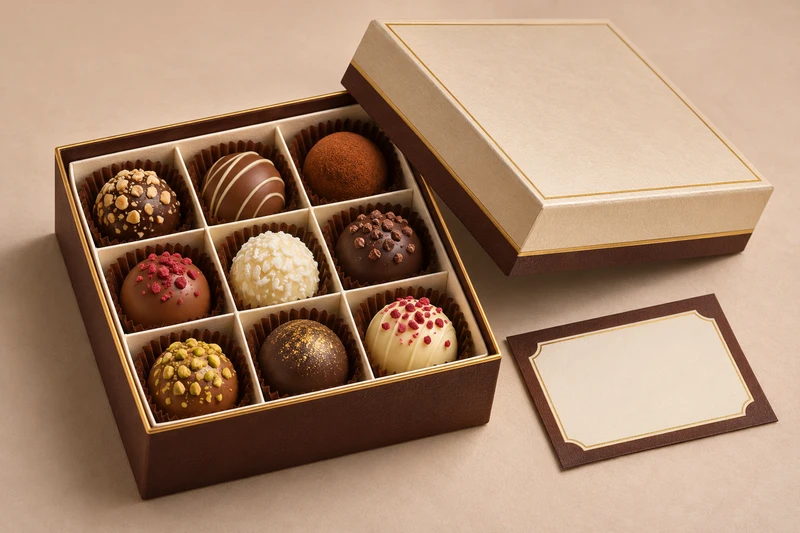
Chocolate truffle boxes should be planned around the individual chocolates first: their count, footprint, height, decoration and the way customers will select them. A well-designed box keeps a mixed assortment orderly, makes each flavour easy to identify and gives a gift set a considered opening experience without assuming every truffle has the same dimensions.
For chocolatiers, retailers and e-commerce teams in the United Kingdom, the brief should also cover how boxes will be filled, whether they will be displayed in shops or sent as gifts, and what information needs to appear on the outer packaging. XGolden Print designs and produces custom paper packaging for gift applications, including box structures, fitted inserts, printing and finishing. The food-contact components and final piece count must be confirmed for each chocolate truffle box project.
The assortment determines the truffle box
A mixed truffle assortment is not simply a collection of chocolates placed inside a standard box. The range may include round, square, domed or hand-finished pieces, with varying heights and surface decorations. These differences affect the internal layout, the amount of space required between chocolates and the presentation once the lid is lifted.
Start by defining the assortment rather than selecting a box solely by external dimensions. For each truffle, record:
- The maximum width, length and height
- Whether the chocolate has a delicate topping, transfer sheet, drizzle or decoration
- The flavour name and any flavour code used during packing
- Whether each piece is placed in a paper cup
- The intended number of pieces per box
- Whether the selection changes by season, event or retailer
- Whether the assortment will be sold as a fixed selection or a pick-and-mix arrangement
A fixed assortment generally benefits from a dedicated cavity pattern or divider plan. It gives the packing team a repeatable order and lets customers recognise the collection at a glance. A more flexible mixed selection may need compartments that accommodate a small size range, although excess room can allow chocolates to shift and weaken the presentation.
Chocolate truffle boxes can suit many commercial uses, including counter-ready confectionery, seasonal gift collections, corporate gifts, wedding favours and online orders. The same outer box may not be suitable for every purpose. A retail box may need clear flavour information and shelf-facing branding, while an event gift may prioritise a message, guest name or coordinated colour scheme. An online order may require a separate transport solution around the presentation box.
Match the layout to the assortment, not the other way round
It is tempting to begin with a neat grid, such as a row-and-column layout, then make the chocolates fit it. A more reliable approach is to map the actual product sizes first. This helps avoid cavities that are too tight for decorated truffles or too wide for smaller pieces.
Where an assortment includes a signature centrepiece, seasonal flavour or larger truffle, it may need a distinct position. This can be placed centrally, at the start of a tasting sequence or in a separate compartment. The choice should support the intended opening experience and make the packing routine clear.
Piece count and space around each chocolate
The number of truffles is a core decision for both presentation and internal construction. It shapes the box proportions, insert layout, filling process and how substantial the finished gift feels in the hand. However, a stated piece count alone does not establish that all pieces will fit. The dimensions, cup size and clearance around each chocolate all need review.
A useful way to brief a mixed-flavour box is to provide a physical sample set or accurate measurements for every truffle type. If a sample is unavailable, list the largest dimensions for each piece and identify any product expected to change.
| Truffle box use case | Key packaging requirement | Layout and presentation option | Detail to confirm |
|---|---|---|---|
| Fixed mixed-flavour retail selection | Consistent placement and straightforward packing | Repeating cavities or divided rows with a flavour guide | Actual truffle dimensions and final assortment |
| Seasonal or limited-edition gift set | Space for varied pieces and campaign artwork | Flexible divider arrangement with an outer sleeve or printed box | Whether seasonal recipes alter sizes or heights |
| Corporate chocolate gift | Orderly opening and room for branded messaging | Structured insert with a branded lid or message card area | Piece count, recipient information and packing workflow |
| Wedding or event truffle gift | Compact presentation and occasion-specific identification | Small-format box with a selected number of compartments | Individual name details, date artwork and quantity |
| E-commerce truffle gift | Retail-ready box plus suitable outer shipment planning | Presentation box with an agreed packing configuration | Delivery destination, outer packing and handling process |
Clearance is not wasted space when it protects the appearance of a finished truffle. It can help prevent pieces touching one another when the box is handled, particularly where shells have raised decoration. Yet too much clearance can make an assortment look sparse and may allow movement. The aim is a controlled fit, based on the actual products rather than a generic box capacity.
The arrangement should also support efficient filling. A simple, logical order helps staff place each flavour in the correct position. For example, a row can follow a flavour sequence, a colour system or a printed map. If multiple team members fill the boxes, include a packing reference that is easy to use at the point of assembly.
Do not finalise the cavity count from a visual mock-up alone. Check a physical sample with the intended chocolates, cups and contact layer before production. Product size, decoration, recipe changes and packing technique can all affect fit.
Cups, dividers and contact-layer requirements
Paper cups, dividers and contact layers perform different roles within chocolate truffle boxes. The outer box provides retail and gifting presentation; internal components help organise individual chocolates; and any component intended to touch the product requires separate suitability review for the specific project.
A paper cup can help maintain spacing, distinguish individual pieces and make chocolates easier to lift from the box. Its diameter, depth and shape need to work with both the truffle and the cavity or compartment below it. A cup that is too shallow may not adequately contain a rounded truffle, while an oversized cup can obscure the piece or make the layout appear uneven.
Dividers can separate rows or sections of an assortment. They are useful where truffles differ in size, where the packing team needs a clear layout, or where customers should see a defined flavour grouping. They may also support a more modular approach for a collection that varies through the year. Whether a divider is appropriate depends on the intended look, product dimensions and the way the box is packed.
Keep the packaging layers distinct
A useful chocolate packaging brief separates the following elements:
- Primary product layer – the immediate wrapping, cup or other component associated with each truffle.
- Contact layer – any surface that may touch the chocolates.
- Internal presentation layer – dividers, trays, inserts or partitions that organise the selection.
- Outer presentation box – the printed box customers see in retail or receive as a gift.
- Transport packaging – the separate protective packing used for shipping or bulk movement.
This distinction matters because a rigid or lid-and-base chocolate box should not be treated as a complete transport protection system. The outer gift box may create a strong presentation, but the full journey through storage, fulfilment and delivery needs its own packing plan. Similarly, the paper, board, cups, liners and any other food-contact components must be assessed and agreed for the actual project; they should not be assumed from a box style or a previous order.
Before specifying materials or finishes, identify where they will sit in relation to the chocolates. Material selection is a design decision linked to the packaging structure, printing requirements, contact-layer needs, visual identity and packing process. XGolden Print can support material selection and fitted inserts as part of a custom packaging brief, with the final suitability of all food-contact components confirmed against the project.
Two-piece truffle boxes and rigid chocolate presentations
A two-piece format can be particularly effective for chocolate truffle gifts because the separate lid creates a deliberate reveal. It can also give the lid a broad surface for brand artwork, flavour cues, seasonal graphics or a gift message. The base holds the internal layout, while the lid provides the first visual impression.
The LB-306 truffle lid-and-base box is a relevant style reference for a two-piece truffle presentation. Its suitability for a particular assortment still depends on the finished dimensions, number of chocolates, internal cups or dividers and agreed components. It should be evaluated against samples rather than assumed to fit a specified count.
For a more substantial presentation, a fine-chocolate rigid box style can provide a useful starting point when the gift is intended to feel more formal or when the assortment needs a more structured internal arrangement. A rigid format may suit premium gift collections, client gifts or event presentations, but it does not remove the need to confirm internal fit, handling requirements and the outer transport arrangement.
Choosing the right opening experience
The opening method influences how customers encounter the truffles:
- Lid-and-base boxes suit a traditional gift-box reveal and allow the lid to carry prominent artwork.
- Rigid boxes can support a more substantial presentation for curated assortments.
- Drawer boxes can suit a controlled reveal when a tray is pulled from an outer sleeve.
- Magnetic closure boxes may be considered where the presentation concept calls for a closing feature, subject to the actual box design and product arrangement.
The right structure should be selected for the chocolate assortment and purchase occasion, not just for its appearance in isolation. A compact box for wedding favours has different needs from a larger festive collection that contains multiple flavours and an explanatory card.
XGolden Print offers rigid boxes, magnetic closure boxes, drawer boxes and lid-and-base boxes, alongside structural design, artwork support, printing, finishing, fitted inserts and sample approval before production. These services allow the outer format and internal layout to be developed as one packaging system for the gift presentation.
Identifying mixed flavours in a gift set
Mixed flavours are a selling point only when recipients can identify what they are choosing. A chocolate truffle box should therefore include a clear way to distinguish flavours, particularly where pieces have similar shapes, coatings or colours.
An assortment guide can be presented inside the lid, on a separate card, on an outer sleeve or in a clearly designed printed area on the box. The best location depends on how the customer opens the box and whether the information needs to remain visible while they select a truffle.
For UK retail and gifting applications, prepare artwork in clear English and ensure the wording is checked against the final product information supplied by the chocolatier. The box can carry the brand story and selection names, while a flavour map can show the position of each truffle. If recipes or assortments vary, design the information system so it can be updated without confusing the packing process.
Useful identification approaches include:
- A numbered cavity map paired with a flavour list
- Coloured markers or icons that match each truffle position
- A tasting-order guide for curated collections
- A removable flavour card for assortments that change regularly
- A printed message inside the lid for a gift or corporate presentation
- Coordinated labels or stickers for short-run event names, gift messages or product variants
Labels and stickers can be specified for boxes and bags in custom shapes and dimensions, with agreed roll or sheet formats. For truffle gift sets, they can be useful where a limited-edition title, event detail or batch-specific message needs to sit on the outer package. Confirm the application surface, label placement, application method and the intended storage conditions before selecting the format.
A common mistake is making flavour identification too decorative to be practical. If the guide cannot be read without removing every truffle, or if it does not match the final packing order, it will not help the customer or fulfilment team. Treat the flavour guide as part of the packaging layout, not an afterthought.
Checking fit, packing and storage arrangements
A sample approval stage is essential for chocolate truffle boxes because a digitally approved design cannot confirm physical fit. Review the sample with the actual chocolates wherever possible, including cups, dividers, liners, flavour cards and any labels that will be applied during packing.
The fit check should consider more than whether the lid closes. It should review:
- Whether each truffle sits correctly in its intended position
- Whether cups remain upright and aligned
- Whether decorations are at risk of contact with the lid or adjacent pieces
- Whether dividers are easy to assemble and use
- Whether staff can fill the box efficiently and consistently
- Whether the flavour map matches the final arrangement
- Whether the box opens cleanly for the recipient
- Whether the packed gift needs additional protection for storage or dispatch
Storage and delivery arrangements should be discussed as part of the broader packing workflow. The presentation box is the customer-facing pack; it may need to be placed inside separate outer packaging for transit. The exact approach depends on the truffle products, their packaging layers, the route to market, handling stages and delivery destination. No assumptions should be made about preservation, temperature performance or transport protection from the outer box alone.
For retailers, consider how the box will sit on a shelf, counter or display stand. The front, lid or side panel may need to carry the most important product identification. For online gift orders, think about the unboxing sequence: outer shipping pack, presentation box, flavour guide and the appearance of the truffles when first opened. For corporate or event gifting, confirm whether branded inserts, recipient details or occasion messaging need to be incorporated early in the artwork process.
XGolden Print can help turn these requirements into a workable brief through structural design, material selection, artwork support, printing, finishing, fitted inserts and sample approval before production. Explore custom box options when the assortment requires a bespoke layout, or review gift packaging solutions for a wider gifting presentation brief.
To discuss chocolate truffle boxes with XGolden Print, provide the truffle dimensions and photographs or samples, final piece count, cup or divider requirements, artwork, quantity, required delivery date and destination. This gives the packaging brief a practical basis for confirming the structure, internal layout and production details.
