
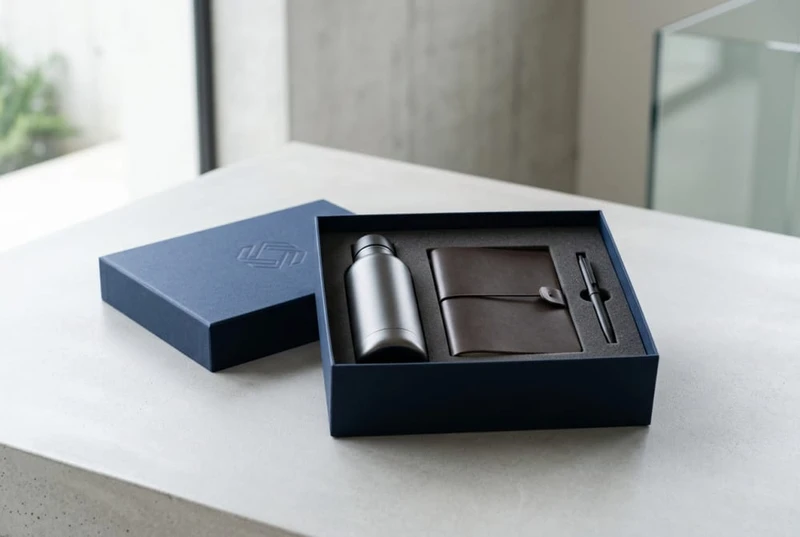
In the United Kingdom, corporate gifting has moved well beyond the plain transit carton. Buyers now expect gift packaging to do more than protect branded merchandise: it must shape first impressions, support account-based marketing, reinforce campaign quality, and help the recipient understand why the gift was chosen for them. For onboarding packs, festive mailers, executive thank-you gifts, conference kits, and retention campaigns, the box has become part of the message.
For B2B marketers, procurement teams, and brand managers, premium presentation matters because recipients often judge the value of a promotional set before they touch the products inside. A carefully engineered rigid box, a neatly partitioned paper insert, a personalised sticker seal, or a soft-touch finish can make a mixed-product kit feel coherent and deliberate. By contrast, weak folding cartons, loose-fill clutter, and generic labels can reduce perceived value even when the contents are expensive.
The UK market has particular practical demands. Many campaigns need packaging that can move efficiently through London, Birmingham, Manchester, Leeds, Glasgow, Bristol, and Edinburgh distribution networks, while also surviving courier handling from fulfilment centres near Felixstowe, Southampton, and the East Midlands logistics corridor. At the same time, businesses want formats suitable both for direct mail and for handover at trade exhibitions in venues such as ExCeL London, the NEC Birmingham, or Manchester Central.
Strong corporate gift packaging therefore balances appearance, cost control, fulfilment efficiency, and brand precision. Our workshop supports this with advanced production equipment, experienced box-making teams, and flexible service for both tailored short runs and larger campaign volumes. Across gift boxes, paper boxes, sticker applications, and broader packaging solutions, the focus stays on material choice, structural accuracy, finishing consistency, and final inspection so each order meets campaign expectations for the UK market.
Box concepts for onboarding kits, holiday gifts, event mailers, and promotional sets
Different B2B gifting objectives call for different box formats. Onboarding kits often need a clean, organised structure that introduces company culture and practical essentials in one reveal. A magnetic rigid box with layered inserts works well for notebooks, drinkware, badges, welcome letters, and tech accessories because it presents each item in a designated place. For HR teams and people operations managers, this format helps the package feel like part of the employee experience rather than a bundle of merchandise.
Holiday gifts usually favour a warmer presentation. In the UK, December gifting campaigns often combine edible items, branded accessories, and a message card. Here, book-style boxes, shoulder-neck rigid boxes, or premium corrugated cartons with decorative sleeves can create a strong festive effect without becoming impractical for shipping. Where alcohol, ceramics, or glassware are included, the internal fitment becomes as important as the outer shell.
Event mailers have a different function. They are frequently sent ahead of launches, webinars, private dinners, roadshows, or exhibitor meetings. Their job is to create anticipation and guide the recipient into a scheduled interaction. Slim presentation boxes, postal-friendly die-cut mailers, and shallow lift-off lid formats are useful because they preserve a premium feel while fitting courier constraints. Adding QR cards, agenda inserts, or product sample compartments turns the box into a pre-event briefing tool.
Promotional sets aimed at clients, distributors, or channel partners often contain mixed categories such as apparel, stationery, beverageware, printed collateral, and product samples. This is where custom paper-based packaging earns its place. The more varied the contents, the more the structure must manage the visual story. If the recipient opens the pack and sees each item framed properly, the brand feels organised and confident.
For teams exploring tailored formats, a strong starting point is to review custom box solutions for business gifting and map each box style against campaign objective, recipient tier, and product mix.
| Campaign type | Recommended box style | Typical contents | UK use case | Main advantage | Watchpoint |
|---|---|---|---|---|---|
| Employee onboarding | Magnetic rigid box | Notebook, mug, hoodie, card | Hybrid teams in London and Manchester | Strong first-day impression | Needs accurate insert sizing |
| Holiday gifting | Shoulder-neck gift box | Seasonal food, drinkware, message card | Client appreciation before year end | Elevated festive presentation | May increase courier weight |
| Event mailer | Postal corrugated mailer | Invitation pack, samples, leaflet | Trade events at NEC Birmingham | Ships efficiently | Exterior must still look premium |
| Executive thank-you | Drawer box with ribbon | Premium pen, leather item, card | ABM outreach in financial services | Refined opening experience | Higher unit cost |
| Product launch kit | Book-style presentation box | Sample, brochure, branded accessory | Media and buyer seeding | Supports storytelling | Needs clear hierarchy inside |
| Channel partner set | Partitioned paper box | Merchandise bundle, sales tools | Distributor enablement nationwide | Keeps varied items organised | Assembly planning is essential |
The table above shows why format selection should match the campaign’s purpose rather than follow a one-size-fits-all approach. In practice, the most effective UK B2B programmes choose a structure based on recipient expectations, transit risk, and how many branded items need to work together visually.
How custom structures make mixed-product gift kits feel more intentional
Mixed-product kits often fail when packaging is treated as a container rather than a designed system. A set containing a bottle, a folded garment, printed documents, and a desktop accessory can easily look random if everything is stacked without logic. Custom structures solve this by creating order. Inserts, risers, sleeves, partitions, trays, and layered reveals tell the recipient where to look first and which item carries the campaign message.
This is especially useful in account-based marketing, where the recipient may receive only one physical mailer in a quarter. If the package feels generic, the opportunity is diluted. If the structure clearly shows that the gift was assembled with care, the campaign has a better chance of starting a conversation. In practical terms, custom structure allows procurement and marketing teams to combine items from different suppliers into a single cohesive presentation.
Design choices should begin with product dimensions, weight, fragility, and brand hierarchy. Heavier merchandise should sit low and securely. Printed pieces should appear where they can frame the story. Premium items should be revealed with enough spacing to avoid visual clutter. Even cost-sensitive cartons can be made more intentional with die-cut platforms and neatly folded paper inserts instead of standard void fill.
At production level, our workshop’s technical capabilities support this stage through precision cutting, accurate board conversion, and reliable finishing alignment. That matters because a well-designed insert loses value if the tolerances are inconsistent. The aim is not simply to make a box fit, but to make every opening experience feel deliberate from the first lid lift to the last product removal.
| Structural element | What it does | Best for | Perceived effect | Cost impact | UK campaign example |
|---|---|---|---|---|---|
| Die-cut insert | Locks each item in position | Mixed-product kits | Neat and engineered | Moderate | Software onboarding packs |
| Layered tray | Creates staged reveal | Executive gifting | Premium and curated | High | Board-level hospitality gifts |
| Partition wall | Separates fragile items | Food and drink bundles | Orderly and safe | Moderate | Christmas client hampers |
| Document sleeve | Holds cards and brochures cleanly | Event mailers | Professional and informative | Low | Conference invitation packs |
| Fold-up platform | Raises hero product | Launch kits | Deliberate focal point | Low to moderate | Beauty and wellness seeding |
| Ribbon pull tray | Improves removal experience | Premium sets | Refined and tactile | Moderate | Luxury property gifting |
The comparison demonstrates that structural design is not only about protection. It is one of the most effective ways to convert a collection of items into a branded experience with a clear narrative and a stronger perceived value.
Sticker options for personalisation, campaign grouping, and account segmentation
Stickers are often underestimated in B2B gift packaging, yet they are one of the most flexible tools for campaign management. A well-produced sticker can seal tissue, label segments, personalise account names, mark language versions, distinguish territories, and support seasonal promotions without requiring separate box print runs for every variant. For UK campaigns running multiple account tiers or event groups, this flexibility can save time and reduce packaging waste.
There are several effective sticker approaches. Personalised name labels make executive outreach feel direct. Colour-coded campaign labels help fulfilment teams distinguish verticals such as fintech, legal, healthcare, or property. QR stickers can guide the recipient to a landing page, registration form, or welcome video. Tamper-evident seals are useful for mailers where presentation on arrival matters. Clear stickers with subtle white ink or foil elements can also add a premium branded touch.
Account segmentation becomes easier when sticker systems are planned at the packaging stage rather than added as an afterthought. For example, a base box can stay visually consistent across the campaign while outer labels identify gold-tier, silver-tier, and channel partner recipients. This is particularly useful when shipping from one fulfilment point to recipients across Bristol, Cardiff, Newcastle, Aberdeen, Belfast, and London.
For businesses seeking scalable labelling options, it helps to explore custom sticker formats for packaging and campaign segmentation and align adhesive type, finish, and data handling with the fulfilment workflow.
| Sticker type | Main use | Best finish | Operational benefit | Brand benefit | Typical campaign |
|---|---|---|---|---|---|
| Name label sticker | Recipient personalisation | Matte or soft-touch | Easy account customisation | Feels direct and considered | ABM outreach |
| Colour-coded segment sticker | Campaign grouping | Gloss or matte | Speeds warehouse sorting | Supports internal accuracy | Multi-sector mailers |
| QR code sticker | Digital follow-up | Matte with high contrast print | Tracks response | Connects physical and digital | Event invitations |
| Tamper seal | Transit assurance | Security stock | Shows if opened in transit | Protects presentation | Postal gifting |
| Foil logo sticker | Premium decoration | Gold or silver foil | Works on short runs | Elevates perceived value | Executive gift sets |
| Variable data label | Batch and route control | Thermal or coated paper | Supports fulfilment traceability | Keeps packs organised | Nationwide dispatch programmes |
The key point is that stickers are not merely decorative. When used strategically, they become a low-friction way to connect creative personalisation with operational discipline.
Premium finishing details that suit modern corporate gifting projects
Modern corporate gifting in the UK increasingly favours premium details that feel understated rather than flashy. Buyers want packaging that looks current in a boardroom, on a reception desk, or in a social post shared by the recipient. That usually means controlled use of texture, restrained colour palettes, and finishing that reflects brand positioning.
Soft-touch lamination remains popular because it immediately changes the tactile perception of the box. Spot UV is effective when used sparingly to highlight logos or patterns. Foil stamping in muted metallic shades can add authority for sectors such as law, finance, consulting, and property. Embossing and debossing work well for minimalist branding, especially where the box colour and paper wrap do much of the visual work. Textured papers, uncoated boards, and layered sleeve constructions are also useful for sustainable-looking premium projects.
Finishing should, however, fit the campaign objective. A luxury investor-relations gift may justify foil and rigid board. A sustainability-led client gift may perform better with uncoated paper, strong typography, and a neatly engineered paper insert. The best result is achieved when finish, structure, and contents reinforce the same brand message instead of competing with each other.
Our manufacturing capabilities help here by supporting both small-batch customisation and larger production volumes with consistent detail control. From material selection through inspection, the process is geared towards reliable colour, surface quality, clean wrap edges, and repeatable finishing performance, which is essential for multi-wave UK campaign rollouts.
| Finishing detail | Visual effect | Tactile effect | Best for | Potential drawback | Recommended UK use |
|---|---|---|---|---|---|
| Soft-touch lamination | Muted and premium | Velvety surface | Executive gifting | Can mark in rough transit | High-value account gifts |
| Spot UV | Contrast highlight | Smooth raised gloss | Logo emphasis | Overuse can look dated | Tech and media campaigns |
| Foil stamping | Metallic accent | Subtle edge definition | Formal brands | Higher tooling cost | Finance and legal sectors |
| Emboss or deboss | Low-key sophistication | Relief texture | Minimalist packaging | Needs sturdy board | Luxury property gifts |
| Textured paper wrap | Natural premium finish | Paper grain feel | Sustainability-led projects | May scuff if mishandled | Purpose-led brands |
| Printed belly band | Flexible visual layer | Light tactile break | Variant campaigns | Less durable alone | Event mailers and launches |
As the table suggests, finishing choices should be practical as well as aesthetic. The strongest packaging programmes combine premium cues with realistic handling expectations, especially where mailers move through courier depots before reaching clients.
Packaging methods for shipping branded merchandise or handing it out in person
A successful B2B gifting format should suit the handover method. Mailing a gift to a recipient’s office or home requires different design choices from presenting one at a client meeting or distributing it on a conference stand. In the UK, where many firms now work across hybrid environments, packaging often needs to perform in both contexts.
For shipping, robust corrugated outers, crush-resistant corners, clean address labelling areas, and secure internal retention are essential. Rigid gift boxes may still be used, but they usually need a secondary shipper carton to arrive in perfect condition. Protective paper fitments are often preferable to excessive plastic void fill, especially for brands that want a cleaner sustainability message. If the campaign includes mugs, bottles, glassware, candles, or tech devices, drop-risk and vibration should be considered from the start.
For hand-delivered gifts, the priorities shift towards visual presentation and ease of carry. Rope-handle bags, fold-flat premium cartons, magnetic boxes, and lidded paper boxes work well where there is no courier abrasion. Exhibition settings may also favour lighter formats that are easy to stack, transport, and store in limited stand space. This matters at major UK venues, where installation and breakdown schedules can be tight.
Many campaigns use a hybrid packaging system: a premium inner presentation box for the recipient experience, plus a plain or branded outer shipping carton for distribution. This approach can support national delivery from logistics nodes around Daventry, Milton Keynes, and the M25 while preserving a refined unboxing moment on arrival. Companies considering integrated solutions can review gift packaging options for branded merchandise and campaign kits as part of fulfilment planning.
| Distribution method | Recommended packaging | Main requirement | Common products | UK logistics context | Advice |
|---|---|---|---|---|---|
| Nationwide courier dispatch | Premium inner box plus shipper carton | Transit protection | Merchandise bundles | Multi-city delivery | Test drop performance |
| Direct office handover | Rigid gift box or rope-handle bag | Presentation impact | Executive gifts | Client meetings in London | Prioritise tactile finish |
| Trade show giveaway | Fold-flat carton or branded bag | Easy storage and carry | Light promotional items | ExCeL and NEC exhibitions | Keep pack weight low |
| Remote onboarding dispatch | Postal-friendly corrugated mailer | Cost-efficient shipping | Apparel and stationery | Home delivery nationwide | Use paper inserts for order |
| VIP event gifting | Drawer or magnetic box | High presentation value | Curated premium sets | Hospitality and dinners | Add personalised card |
| Distributor drop shipment | Segment-labelled cartons | Batch control | Multi-SKU kits | Warehouse-based routing | Use sticker coding |
This table highlights a crucial buying principle: the best packaging is the one that fits the distribution method without compromising the brand impression. A beautiful box that arrives damaged is not premium, and a durable shipper with no inner presentation rarely supports high-value B2B gifting goals.
Common packaging weaknesses that reduce the perceived value of promotional gifts
Many promotional campaigns lose impact because the packaging undermines the products. One of the most common weaknesses is poor fit. When items slide inside the box, recipients assume low planning quality. Another issue is thin board that flexes too easily, making even good merchandise feel inexpensive. Weak adhesive points, crushed corners, rough die-cut edges, and inconsistent print registration also signal low control.
Visual clutter is another frequent problem. Too many colours, too much copy, or unrelated inserts make the pack feel like a clearance bundle instead of a curated business gift. Likewise, overbranding can backfire. UK recipients, particularly in senior B2B roles, often respond better to subtle, intelligent presentation than to loud promotional graphics on every surface.
Fulfilment errors have an equally damaging effect. A premium box with the wrong sticker, missing message card, or badly applied shipping label can quickly erode perceived care. That is why final inspection matters. Our service capabilities are structured to help reduce such issues through flexible project handling, communication around campaign needs, and attention to consistency from material choice to finished pack review.
Businesses should also watch sustainability mismatches. If a brand communicates environmental responsibility but uses excessive plastic trays, oversized outer cartons, or unnecessary components, recipients notice the contradiction. In the UK market, where procurement and marketing teams are under growing ESG scrutiny, packaging credibility matters alongside aesthetics.
How gift packaging supports ABM, retention, and relationship-building campaigns
In B2B marketing, gift packaging is not just a finishing detail; it is a campaign device. In ABM, the aim is to show relevance and care to a specific account or buying committee. Packaging helps by turning a generic send into a tailored gesture. Personalised labels, inserts referencing the recipient’s industry, and a structure that highlights selected items all improve message alignment.
For retention campaigns, the packaging plays a different role. It should communicate appreciation and continuity rather than acquisition energy. Cleaner visuals, quality papers, and thoughtful compartments are often more effective than overt sales graphics. A customer success team sending annual thank-you packs to clients in Cambridge, Reading, and Leeds can use packaging to reinforce steadiness, competence, and attention to detail.
Relationship-building campaigns benefit from packaging because the physical experience creates memory. A recipient may forget an email within minutes, but a well-made gift box that opens smoothly and presents items beautifully tends to remain on desks and in conversations longer. This is especially relevant in sectors where trust and personal contact influence deal progression, such as consulting, finance, software, legal services, and premium manufacturing.
Case studies across the UK market often show the same pattern. A standard merch bundle may achieve delivery, but a curated presentation kit is more likely to generate replies, event attendance, social sharing, or internal circulation within the target account. The packaging increases the perceived seriousness of the outreach, which in turn can support the commercial purpose behind the gift.
| Campaign goal | Packaging role | Useful features | Success signal | Typical recipient | Notes |
|---|---|---|---|---|---|
| ABM prospecting | Shows account relevance | Name sticker, tailored insert, premium box | Reply or meeting booked | Target buying committee | Personalisation matters most |
| Client retention | Reinforces appreciation | Elegant structure, thank-you card | Renewal conversation uplift | Existing customers | Keep branding restrained |
| Employee advocacy | Builds internal pride | Onboarding kit layout | Positive internal feedback | Staff and recruits | Useful for employer brand |
| Event attendance | Creates anticipation | Agenda insert, QR sticker | Registration or turnout rise | Invite-only attendees | Mail timing is crucial |
| Partner engagement | Signals commitment | Segment labels, practical merchandise | Partner participation | Resellers and distributors | Operational clarity helps |
| Executive relationship building | Supports premium perception | Rigid box, subtle finish, personal note | Conversation extension | Senior stakeholders | Avoid overt promotional style |
The explanation here is simple: packaging supports campaign performance because it influences how seriously the gift is taken. In ABM and retention work, that shift in perception can be commercially meaningful.
When simple cartons are no longer enough for premium B2B gifting programmes
Simple cartons remain useful for low-cost distribution, internal sample handling, and basic merchandise fulfilment. However, they become insufficient when the campaign objective depends on presentation, differentiation, or perceived value. If the recipient is a senior stakeholder, a strategic account, a long-term client, or a high-value new hire, plain cartons often fail to convey the right level of care.
They also become inadequate when the gift set includes products with different sizes and materials. A notebook, water bottle, charger, snack pack, and message card placed together in a basic carton can look improvised. Without custom structure, the contents move, surfaces rub, and the unboxing lacks order. Once a programme reaches that level of complexity, a purpose-built box is not a luxury; it is a practical requirement.
By 2026, several trends are making this more relevant in the UK. First, sustainability expectations are encouraging better-designed mono-material paper solutions that replace excessive mixed plastics. Second, policy and procurement pressure are pushing buyers to demand clearer supply consistency, material transparency, and waste reduction. Third, technology is making variable print, QR-linked personalisation, and segmented labelling easier to integrate into packaging workflows. Finally, recipients themselves have become more packaging-aware, partly due to years of e-commerce and social sharing.
For buyers comparing suppliers, the decision should not rest solely on unit cost. It should include structural capability, finishing consistency, flexible batch sizes, and confidence in project handling. A supplier able to prototype efficiently, produce accurately, and support campaign variation can often create more commercial value than a cheaper vendor offering only standard cartons. That is particularly true for UK programmes operating across multiple cities, verticals, and recipient tiers.
UK market, industries, and buying advice for branded gift packaging
The UK market for premium B2B gift packaging is shaped by a mix of mature service industries, active event calendars, hybrid working patterns, and strong regional logistics infrastructure. London remains the largest centre for finance, media, technology, and professional services gifting. Manchester and Leeds contribute significant demand from digital, recruitment, healthcare, and property sectors. Birmingham continues to matter because of its exhibition economy and central distribution advantages. Glasgow, Edinburgh, Bristol, and Reading are also important nodes for technology, life sciences, and corporate services campaigns.
Industry demand varies by gifting objective. Technology firms often need onboarding kits, launch boxes, and ABM mailers. Financial and legal brands usually want refined executive gifting with discreet branding. Healthcare and life sciences campaigns may require stricter organisation, segmented labelling, and practical fulfilment support. Property developers and agencies often prioritise tactile finishes and presentation value for investor or buyer relations. Education and training providers tend to seek cost-controlled kits that still look organised and thoughtful.
Buying advice should begin with clarity on use case. Ask whether the pack is designed for acquisition, retention, events, onboarding, or partner relations. Then review product mix, shipping method, desired finish level, sustainability goals, and personalisation requirements. Buyers should request prototypes for complex structures, confirm packing sequence, and agree quality checkpoints before volume production. It is also wise to account for peak-season pressures, especially ahead of autumn events and year-end gifting waves.
Where local sourcing is concerned, UK buyers often compare domestic trade merchants, print houses, promotional product aggregators, and specialist custom packaging manufacturers. The right partner is usually the one that can combine technical box knowledge, dependable production control, and responsive service rather than only low headline pricing.
Our company for UK gifting programmes
For businesses serving the UK market, our role is to provide dependable custom packaging support for corporate gifting, branded merchandise presentation, and campaign mailers. Rather than offering only stock cartons, we focus on gift boxes, paper boxes, stickers, and coordinated packaging solutions that help buyers create a stronger perceived value at the point of opening.
From a technology perspective, the workshop is equipped with advanced machinery that supports precise conversion, consistent print-related execution, and accurate finishing across different box types and sticker requirements. This allows structural concepts to move from design into production with better repeatability, which is particularly important when campaign quality depends on neat inserts, clean wrap edges, and aligned decorative elements.
From a manufacturing standpoint, the team is set up to handle both small-batch customisation and larger production schedules. That flexibility is useful for UK customers who may begin with pilot ABM kits, then scale into wider retention campaigns, event mailers, or multi-office onboarding programmes. Material selection, workmanship, and final inspection are treated as central parts of production rather than add-ons, helping ensure that finished packaging matches the intended standard.
From a service perspective, the approach is built around responsiveness and practical delivery. Some clients need a concise premium box for a board-level gift; others need coordinated stickers, cartons, and inserts for a nationwide promotional rollout. By adapting around campaign size, product mix, and timing requirements, the service aims to remain efficient without losing attention to detail.
Case studies and practical applications
A SaaS company targeting enterprise accounts in London and Reading used a rigid magnetic box with a personalised sticker seal, a welcome note, a premium notebook, and a branded insulated bottle. The custom insert held each item in place and elevated the note as the first visible element. Compared with a previous plain mailer campaign, the marketing team reported more direct replies from target contacts because the package felt considered rather than mass-issued.
A property advisory firm sending holiday gifts to long-term clients in Manchester, Leeds, and Edinburgh chose a shoulder-neck box with textured paper wrap and a belly band carrying the seasonal message. Inside, partitioned sections separated artisan food items from branded desk accessories. The presentation aligned with the firm’s premium identity while still being practical for courier dispatch through regional fulfilment centres.
An employer brand team onboarding remote staff across the UK adopted a corrugated postal kit with printed internal messaging, paper inserts, and colour-coded stickers to segment departments. The format reduced delivery damage while still presenting apparel, stationery, and a welcome pack neatly. The project showed that even shipping-led boxes can feel organised and premium when structure and messaging are planned together.
A medical devices business preparing a product education event near Birmingham used slim event mailers containing agenda cards, sample tools, QR-linked registration stickers, and branded accessories. The packaging was sized to postal limits and arrived in strong condition, helping recipients engage with the event before attendance. In each case, the packaging was not decoration alone; it directly supported campaign performance.
FAQ
What is the best box style for UK B2B onboarding kits?
A magnetic rigid box or a sturdy postal mailer with custom inserts is usually best. The right choice depends on whether the kit is hand-delivered or couriered and how premium the welcome experience needs to feel.
Can stickers really improve corporate gift packaging?
Yes. Stickers are useful for personalisation, campaign grouping, fulfilment control, QR linking, and subtle decoration. They allow one core box format to support multiple account segments without separate print runs.
When should a company move beyond plain cartons?
Once the campaign targets key accounts, senior stakeholders, premium clients, or multi-item gift sets, plain cartons often stop communicating enough value. At that point, custom structure becomes a commercial tool rather than an optional upgrade.
Are premium finishes always necessary?
No. Premium does not always mean expensive decoration. In many UK campaigns, strong structure, clean materials, good print discipline, and subtle branding outperform more decorative approaches.
How can packaging support sustainability goals in 2026?
The main direction is toward smarter paper-based design, reduced unnecessary components, more efficient shipping formats, and better alignment between brand claims and packaging choices. Buyers should also look for practical durability so packs do not become waste through damage.
What should UK buyers ask a packaging supplier before ordering?
Ask about structural design support, prototype options, production flexibility, quality checks, finishing consistency, sticker integration, and experience handling both small bespoke runs and larger repeat campaigns.
