
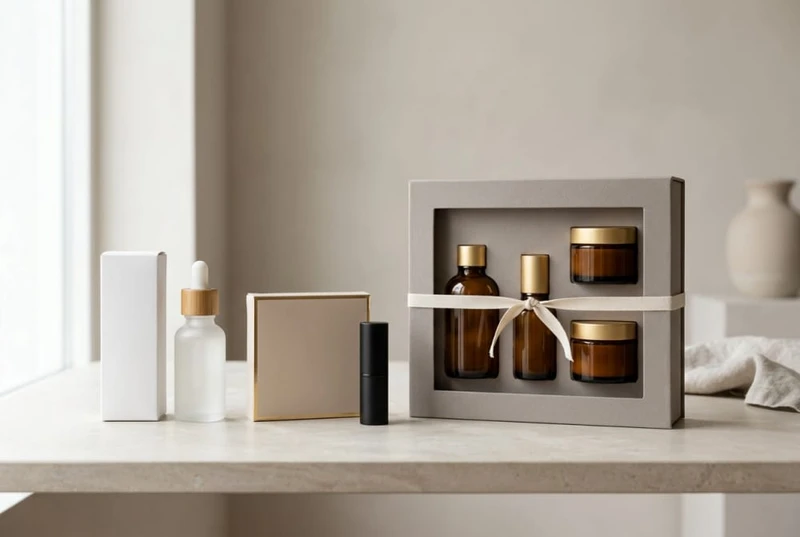
Cosmetic packaging stands out before a product is tested when it makes the product’s purpose, value and personality immediately clear. The best direction is not simply the most decorative box: it is a packaging system that protects the format, presents the brand consistently and gives customers the information they need to choose confidently.
For UK beauty brands, that means selecting box structures around the product first, then using finishes, colour, inserts and stickers to distinguish ranges and individual variants. These packaging directions help beauty products stand out before they are even tested, while keeping future launches and changing SKU counts manageable.
Packaging requirements for serums, creams, masks, palettes and daily skincare ranges
Each beauty format creates different protection, presentation and information needs. A carton that works well for a lightweight tube may not be suitable for a glass serum bottle or a multi-pan palette.
| Product type | Core packaging need | Suitable custom box direction | Points to check |
|---|---|---|---|
| Serums and facial oils | Protection against knocks and movement | Close-fitting folding carton with a shaped insert where needed | Bottle height, pipette or pump clearance, glass protection and leak risk |
| Creams and balms | Stable presentation for jars or tins | Tuck-end carton or rigid gift box for elevated lines | Jar diameter, lid profile, product weight and opening experience |
| Sheet masks and treatment sachets | Clear range navigation and compact storage | Flat sleeves, cartons or multi-pack folders | Sachet count, reseal requirements and product instructions |
| Makeup palettes | Corner and surface protection | Rigid box, sleeve-and-tray format or fitted folding carton | Palette thickness, mirror protection and closure security |
| Lip products | Efficient packing for small formats | Slim cartons, multi-unit sets or display-ready outer packs | Shade identification, orientation and barcodes |
| Cleansers, lotions and daily skincare | Shelf consistency across differing sizes | Coordinated carton family with scalable dimensions | Pump height, bottle shoulders, label visibility and range hierarchy |
For serums, build packaging around the full closure rather than the bottle alone. A dropper, pump or cap can create the highest point and may be vulnerable if the carton is too shallow. If the primary pack is glass, an insert can limit movement, but the insert material and fit should be assessed against the actual bottle rather than an outline drawing.
Cream cartons often need to balance a premium unboxing feel with practical assembly. A straight tuck-end carton is efficient for many jars and tubes, while a more substantial structure can suit a hero product, introductory kit or higher-value treatment. Avoid excessive empty space; it can make a small jar look underfilled and leaves more room for movement.
Face masks often depend on quick visual choice. Use the front panel to establish the range, then let colour, an icon or a product descriptor identify the treatment type. For multi-mask packs, make the quantity and contents easy to find without crowding the design.
Palettes require special attention to corners and hinges. A presentation sleeve may add a premium layer, but it should not make the pack difficult to remove or prone to scuffing. Confirm the assembled palette dimensions, including any closure or raised logo, before finalising internal tolerances.
For a daily skincare collection, create a family system rather than designing every carton independently. Shared logo positioning, type hierarchy and side-panel layouts help customers recognise cleanser, toner, serum and moisturiser as one routine. A controlled colour system can then distinguish steps without losing brand recognition.
Information requirements vary by product and selling channel. Before printing, verify the cosmetic labelling, ingredient, traceability, language and market requirements applicable to your product and route to market. Build sufficient space into the artwork from the outset rather than treating mandatory copy as a late addition.
Box formats that suit fragile, premium or gift-ready beauty products
The right format depends on product fragility, perceived value, order fulfilment method and how much of the product should be revealed at opening.
Folding cartons for routine retail and scalable product lines
Folding cartons are a versatile option for individual skincare, cosmetics and smaller beauty tools. They can be designed in a broad range of sizes and typically work well when the primary container already provides reasonable protection.
They are often appropriate for:
- Tubes, pumps and compact bottles
- Lipsticks, mascaras and single makeup items
- Skincare jars with stable bases
- Compact multi-product kits
- Products needing concise on-pack information
A tuck-end style is familiar and practical. However, a standard format still needs careful sizing. A loose carton can look poorly specified and may allow a product to shift during handling.
Rigid boxes for prestige products and lasting presentation
Rigid boxes bring more weight and structure to a premium launch, a limited edition or a giftable item. They can use lift-off lids, hinged lids, drawers or other opening formats, depending on the desired experience.
Use them selectively. A rigid box may suit a signature fragrance-free skincare set or premium palette, but it can be disproportionate for a low-value replenishment product. Consider what the customer is likely to retain, reuse or dispose of, and avoid adding layers that do not improve protection or presentation.
Sleeves, trays and inserts for controlled reveals
A sleeve can turn a standard carton into a more deliberate reveal, while trays help organise several products. Inserts can separate glass bottles, hold products upright or present a kit in a prescribed order.
Choose an insert only when it has a clear job:
- Stop fragile items touching
- Keep mixed-size products in position
- Protect a palette or applicator
- Create a tidy presentation for a gift set
- Support the sequence of a skincare routine
Ask for a physical sample or prototype before committing to a complex internal layout. It is important to check insertion, removal, closure and whether every component remains secure after ordinary handling.
For projects needing bespoke dimensions or structural options, explore custom cosmetic box formats after establishing the finished product measurements and protective requirements.
Surface finishes that influence perceived value in cosmetic packaging
Surface finish affects what a beauty box communicates at first touch and first glance. It should reinforce the brand position rather than compete with the product name, shade or ingredients story.
A matte finish often gives a restrained, contemporary appearance and can work well for clinical-looking skincare or understated premium makeup. Gloss may intensify bold colours and photographic artwork, making it useful for expressive makeup or youthful lines. Neither is inherently more luxurious; design, board choice and print contrast matter just as much.
Common finish directions include:
- Matte lamination: a soft, low-shine appearance suited to minimal designs.
- Gloss lamination: a reflective surface that can enhance saturated colour and image-led packaging.
- Soft-touch lamination: a tactile option for premium ranges, with suitability assessed for the expected handling environment.
- Foil details: useful for logos, borders or small highlights where a reflective accent supports the visual hierarchy.
- Embossing or debossing: adds relief to selected marks or patterns without adding more printed colour.
- Spot gloss or raised effects: creates contrast on a matte ground, particularly for logos, liquid imagery or graphic details.
- Uncoated or textured papers: can support a natural, craft-led or botanical direction, but may need additional testing for scuffing and print appearance.
Use finishes sparingly around the key decision areas. If the product name, shade name and usage claims all compete with foil, texture and gloss effects, the carton becomes harder to navigate. Premium packaging usually benefits from restraint: one strong tactile or reflective detail can be more effective than several.
Always check physical samples in the colours and materials proposed. On-screen artwork cannot reliably show texture, sheen, foil tone, small text legibility or how dark colours react to scuffing.
Gift-packaging opportunities for new collections, festive sets and launch campaigns
Gift packaging can introduce a collection, increase perceived completeness and make a beauty purchase easier to give. It works best when the grouping tells a coherent story, such as a morning routine, evening ritual, travel edit or discovery selection.
For a new collection, a set can help customers understand how products are used together. Arrange the products in intended sequence and include clear naming so that a recipient who is unfamiliar with the range can still use it confidently.
A gift-ready format may include:
- A rigid box with a lid for a premium set
- A folding carton with an internal tray for a lighter-weight bundle
- A sleeve around paired products for a simple gifting option
- A drawer box for discovery kits or shade collections
- A reusable pouch or outer wrap paired with a protective carton where appropriate
Seasonal packaging should remain recognisably part of the brand. Instead of redesigning everything, retain the central brand system and add a limited colourway, pattern, sleeve or message panel. This helps the set feel timely without making leftover packaging unusable after a campaign ends.
Plan the commercial structure early. Decide whether the set has a unique barcode, dedicated outer carton, separate instructions or different product quantities. If individual products can also be sold separately, their own labels and cartons should still function independently.
For formats intended to be given as presents or used in campaigns, custom gift packaging can provide a useful starting point for comparing box structures and presentation styles.
Sticker options for shades, fragrances, batch variation and rapid SKU growth
Stickers are a practical part of cosmetic packaging systems, particularly where one core carton serves several shades, scents, formulations or batch variations. They can reduce the need to create entirely new printed cartons whenever a small detail changes.
Common uses include:
- Shade names and shade codes on lip, complexion or nail products
- Fragrance identification for body care and home-beauty ranges
- Variant markers for different active ingredients or skin concerns
- Batch, date or production information where required
- Barcodes or retailer-specific identifiers
- Promotional or limited-edition over-stickers
- Sample, tester or bundle identification
For colour cosmetics, shade stickers should be easy to locate when products are stored upright, stacked or displayed in trays. A small label placed only on the base may suit some formats, but it can slow selection in a busy retail environment. Consider whether the shade needs to be identified from the front, end panel, top or base.
Where a sticker carries variable information, keep a defined label zone in the carton artwork. This prevents labels from covering important usage copy or disrupting the visual layout. Test adhesion on the intended coated, laminated or textured packaging material; labels that work on one surface may behave differently on another.
Custom product and shade stickers can be especially useful when a range is expanding quickly, but they should be treated as part of the full packaging specification, not an afterthought.
Retail packaging versus direct-to-consumer packaging in contemporary beauty sales
Retail and direct-to-consumer packaging have different jobs. Retail packaging must communicate quickly on shelf, while direct-to-consumer packaging must also cope with individual-order handling and an at-home opening experience.
| Consideration | Retail-led packaging | Direct-to-consumer-led packaging |
|---|---|---|
| Main priority | Fast recognition and easy comparison | Product protection and a considered delivery experience |
| Visibility | Front, side and top panels may all be seen | Outer shipping pack may hide the retail carton until unboxing |
| Product protection | May rely partly on store handling conditions | May need added protection within a shipping pack |
| Information | Clear format, benefit, shade and volume cues | Order notes, routine guidance or cross-sell inserts may be possible |
| Display | Must fit shelf, hook or counter requirements where relevant | Must pack efficiently with suitable void protection |
| Unboxing | Should remain clean and easy to open | Can include a reveal, tissue, card or bundled presentation where appropriate |
A single carton can often serve both channels, but it should be assessed in the complete journey. For example, a premium glass serum carton may look excellent on a shelf yet still need an appropriately designed outer shipping solution for direct orders.
Do not assume a decorative retail carton is transit protection. Test the product and its packaging configuration under the handling conditions relevant to your supply chain. The final shipping pack, void fill, bundling method and product orientation all matter.
For retail, clarity is often more valuable than extra messaging. Customers should be able to identify the product category, key variation and brand quickly. For online sales, product pages carry more detail, but the physical pack still needs to meet information obligations and establish confidence when opened.
Common packaging mistakes in private-label beauty programmes
Private-label programmes can move quickly, which makes early packaging discipline particularly important. The most common problems come from designing before specifications and range architecture are agreed.
Choosing a box before confirming the finished component
Packaging dimensions should be based on the actual supplied bottle, cap, pump, jar or palette—not an estimated measurement. Minor changes to a closure, label thickness or bottle shoulder can affect fit.
Treating every SKU as a separate design
Independent carton designs may look creative at launch but become difficult to manage as the range grows. Establish common panel positions, typography, icons and variant rules before adding more formulations or shades.
Overusing premium effects
Foil, soft-touch surfaces, embossing and complex inserts can be effective, but adding them to every SKU may obscure hierarchy and complicate procurement. Reserve high-impact treatments for hero products, gift sets or one clearly defined brand signature.
Leaving legal and operational copy until last
Ingredients, directions, warnings, traceability details, barcode placement and other required information need space. Requirements depend on the product and market, so verify them with the appropriate specialists before approving artwork.
Ignoring packing and fulfilment realities
A carton can look correct in a flat artwork file but be difficult to assemble, fill or pack. Confirm how the product enters the box, whether an insert is necessary, how it is sealed and how multiple items are packed for dispatch.
Letting shade identification become inconsistent
If one lipstick shade uses a coloured end label, another uses a code and a third relies on the carton name, merchandising becomes harder. Define a repeatable shade-marking convention from the first launch.
How to create a cosmetic packaging system that can expand with the range
A scalable system gives a brand room to add products without reworking its visual identity or packaging specification at every stage. Begin by defining repeatable rules, then make controlled exceptions for gift sets and hero products.
1. Establish a core pack architecture
List the likely product formats for the next stage of the range: bottles, jars, tubes, palettes, samples and bundles. Group them into sensible carton size families, allowing for different heights and widths while maintaining a shared appearance.
2. Define non-negotiable design elements
Set consistent rules for:
- Logo position and minimum clear space
- Product-name hierarchy
- Use of brand colours
- Placement of variant names and shade information
- Side-panel information layout
- Barcode and variable-data zones
- Finishes used across the core collection
This gives designers and buyers a framework that remains stable as new items are developed.
3. Create a clear variation code
Use one or two cues to differentiate product families: colour bands, symbols, ingredient illustrations, numbers or finish changes. Keep the system accessible and avoid relying on colour alone where it could create confusion.
For example, a skincare brand might use a neutral core design with a distinct colour band for cleanse, hydrate, treat and protect. A makeup range might retain one carton design while changing an end-panel shade marker and product descriptor.
4. Separate everyday packs from special editions
Keep the main collection commercially practical. Use sleeves, rigid boxes, unusual structures or enhanced finishes for launches, press kits, festive sets and premium editions rather than making every replenishment product elaborate.
5. Build an approval checklist
Before ordering a new SKU, check:
- Finished product dimensions and weight
- Carton fit, orientation and opening method
- Internal protection requirements
- Print artwork, colours and finish compatibility
- Variable-data and label locations
- Required information for the intended market
- Retail display and direct-to-consumer packing needs
- Consistency with the wider range
A well-specified packaging system can make beauty products easier to recognise, easier to buy and more credible before customers ever try the formula. Start with the product format and customer journey, then select the structure, finish and variable details that support the brand rather than distract from it.
When you are ready to develop the pack, prepare a product measurement sheet, an SKU list, artwork hierarchy and a note of any fragile or gift-set requirements. That creates a clearer basis for comparing custom packaging options with XGolden Print or any other suitable packaging supplier.
