
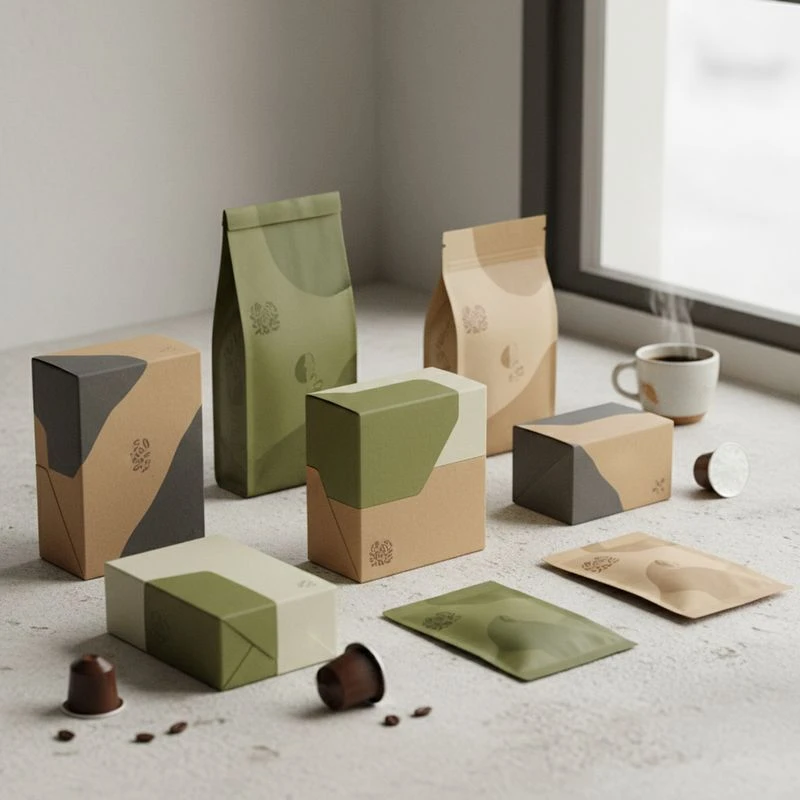
Custom packaging for coffee capsules and pods should protect the product from crushing, moisture and light while making the format easy to recognise, open, store and recycle. The right solution depends on whether you are packing loose capsules, retail multipacks, subscription orders, gift sets or pod machines with accessories.
For UK buyers, the most practical route is to start with the capsule format and sales channel, then specify the box structure, board, print finish and packing configuration around them. Packaging should support the coffee’s intended shelf life and brand positioning without making unverified freshness, recyclability or food-safety claims.
Coffee Capsule Packaging
Coffee capsule packaging is usually designed in layers. The capsule or pod provides the primary product enclosure, while printed cartons, sleeves, mailing packs or display-ready cases provide protection, information and shelf appeal. Each layer has a different job, so it is important not to ask one box to solve every issue.
A retail carton may need to hold a fixed pod count, prevent rattling and display flavour information clearly. An e-commerce pack may prioritise transit protection and efficient packing. A gift box can place greater emphasis on presentation, opening experience and compartmentalisation.
Common packaging formats
| Packaging format | Best suited to | Key considerations |
|---|---|---|
| Tuck-end carton | Standard retail pod multipacks | Accurate internal dimensions, easy shelf stacking, barcode placement |
| Sleeve and tray | Premium ranges and gift selections | Secure tray fit, smooth sliding action, efficient assembly |
| Folding carton with divider | Mixed flavour packs | Divider layout, pod orientation and minimising movement |
| Rigid box | Gifting, launch sets and higher-value collections | Storage space, board wrap, insert design and practical fulfilment |
| Display-ready case | Retail replenishment | Perforation design, shelf footprint and clear product identification |
| Postal box | Direct-to-consumer subscription or e-commerce orders | Capsule protection, external labelling area and void reduction |
The primary packaging used for the capsule itself affects the outer pack design. Capsules vary in diameter, height, rim shape and material, while pods can be flat, soft or individually wrapped. Never base a production specification solely on a nominal capsule count. Provide physical samples or verified drawings so the internal fit can be checked.
What a coffee pod box needs to do
A well-designed coffee pod box should balance five practical functions:
- Contain the stated quantity. The internal dimensions should accommodate the chosen number of capsules without excessive empty space or a tight fit that makes packing difficult.
- Protect the contents. Capsules should remain properly positioned during ordinary handling, storage and distribution.
- Communicate the product. Flavour, roast profile, pod count, compatibility information and preparation guidance need a clear hierarchy.
- Work in the sales channel. Shelf-ready retail packaging, online order packaging and gift packaging have different structural needs.
- Support responsible disposal information. Disposal instructions must reflect the actual materials and local collection arrangements, rather than broad assumptions.
For own-brand coffee products, include a clear distinction between the coffee brand, flavour variant and capsule system compatibility. If the capsules are compatible with a named machine system, any trademark use and compatibility wording should be reviewed carefully before printing.
Choose a structure before choosing finishes
It is tempting to begin with a premium finish or a bold visual concept. In practice, the carton structure should come first. A strong design cannot compensate for a pack that is difficult to fill, collapses under stacking, or does not protect capsules at the corners.
Ask for a structural sample or prototype before confirming bulk production. Check:
- Whether capsules can be packed consistently
- Whether the opening flap stays closed as intended
- How the carton looks when full and when partly empty
- Whether dividers or trays keep varieties separated
- Whether the pack can be opened without tearing key information
- How it performs inside the secondary shipping pack
- Whether it fits the intended shelf, display or storage position
For a broader range of options, review custom printed boxes for product packaging alongside the product’s dimensions and packing process.
Compact Design
Compact coffee capsule packaging reduces unnecessary material and can make storage, display and fulfilment easier. Compact does not simply mean making the box as small as possible. The aim is to create an efficient pack with enough tolerance for filling, handling and protection.
The most space-efficient design often comes from arranging capsules in stable rows, rather than filling a large square box with loose pods. However, the best orientation will depend on the specific capsule geometry. Some capsules stack neatly rim-to-base; others require a divider, a paperboard insert or an alternative layout to avoid movement.
Design around the internal pack layout
Start with the actual pod arrangement. Determine:
- The number of capsules in each selling unit
- The required orientation of each capsule
- Whether packs contain one flavour or several varieties
- Whether a leaflet, voucher or tasting card is included
- Whether individual pods are wrapped
- The tolerance needed for manual or automated packing
- Whether customers are likely to retain the box for storage
A compact layout can improve the visual impact of a smaller retail pack, but it must not make removal awkward. If customers need to shake or damage the carton to retrieve the final capsules, the format needs revision.
Board and insert choices
Paperboard cartons are commonly used for coffee capsule multipacks because they offer printable surfaces and can be die-cut into efficient shapes. The appropriate board grade, thickness and finish will vary with the pack size, stacking requirement, storage conditions and design.
An insert may be worthwhile when it prevents visible damage or keeps a premium selection orderly. It is less useful when it adds complexity without improving protection or presentation. In some formats, careful internal sizing removes the need for a separate insert altogether.
When comparing options, consider the complete pack rather than just the outer carton:
- Outer box material and print area
- Internal tray, divider or insert
- Any window material or adhesive
- Secondary transit packaging
- Ease of flat packing and assembly
- Disposal route for each component
Print design for small packs
Coffee capsule boxes often have limited printable space. Prioritise the information that buyers use when selecting a pack, then make the design work at shelf distance and close range.
A practical front panel may include:
- Brand and flavour name
- Coffee character or roast description, if substantiated
- Pod quantity
- Compatibility wording where applicable
- A simple visual identifier for the flavour variant
Reserve side or back panels for ingredients, mandatory product information, storage guidance, preparation instructions, recycling directions and barcode requirements as applicable. Keep sufficient clear space for variable data if batch coding or date marking is applied after printing.
Common design mistakes include using type that is too small, placing essential copy across folds, relying on metallic finishes for legibility, and using near-identical colourways for different flavours. These issues can be identified during artwork review and physical sampling.
B2B Manufacturing
Ordering custom packaging for coffee capsules and pods is a specification exercise, not just a print purchase. Buyers get better results when they provide clear product details early and separate fixed requirements from preferences.
A useful brief should state the capsule type, pod count, pack dimensions, filling method, sales channel, artwork status and desired finish. It should also identify any information that must appear on the finished pack and any requirements imposed by retailers or internal quality processes.
Information to prepare before requesting a quotation
Provide the following wherever available:
- Physical capsule or pod samples, or accurate technical dimensions
- The number of units per retail pack
- A preferred carton style, if known
- Artwork files and brand guidelines
- Required print colours and finish preferences
- Whether a divider, tray, insert or window is needed
- Expected order quantity and repeat-order pattern
- How the boxes will be filled and closed
- Outer case and pallet configuration requirements, if relevant
- Any required checks for food-contact suitability, traceability or recycling labelling
Do not assume that a previous box design can be reproduced without adjustment. A change in board, carton dimensions, filling process, capsule supplier or finish can alter the practical result. Confirm the dieline, dimensions and final artwork version before production.
Questions to ask a packaging supplier
A capable supplier should be able to discuss the structure and print specification in practical terms. Ask questions that help you compare like with like:
- Is the quotation based on the same carton style, board and finish?
- Does the specification include an insert, divider or glue application where required?
- What artwork format and bleed requirements are needed?
- Can a physical sample or mock-up be reviewed before committing to the full run?
- Which dimensions are internal, external and flat-pack?
- How will the cartons be supplied: flat-packed, assembled or in another agreed format?
- What tolerance should be allowed for packing and assembly?
- What information is needed to assess the intended food-contact use?
- Which components affect the final recycling guidance?
For a larger packaging programme, document approved materials, colours, dielines and artwork versions. This makes repeat ordering more consistent and reduces the risk of an older file being used by mistake.
XGolden Print provides custom packaging boxes and printing solutions. Its scale includes 27 years of experience, a 15,000 square metre factory, more than 500 employees and production capacity exceeding 10 million units; the right specification should still be confirmed against the particular coffee pod pack, order volume and finishing requirements.
Balance premium presentation with operational practicality
Premium packaging should remain practical throughout the supply chain. A complex rigid box may suit a limited gift set but be disproportionate for an everyday refill pack. Conversely, a simple folding carton can look considered and high quality when the structural proportions, artwork and finishes are well matched.
Before selecting embellishments such as foil, embossing, spot varnish or textured materials, assess:
- Whether the finish supports the brand’s positioning
- Whether it affects legibility of essential information
- Whether it complicates recycling guidance
- Whether it is durable enough for the intended handling
- Whether it works with the planned packing process
- Whether it remains appropriate across all flavour variants
Food Safety
Coffee capsules and pods are food products, so packaging decisions should be reviewed with food safety in mind. The required approach depends on whether the printed box directly contacts food, contacts the primary capsule or pod packaging, or serves only as a secondary pack.
A carton around sealed capsules is not automatically a food-contact pack simply because it contains a food product. Equally, an insert or liner may create a different contact scenario. Describe the actual pack configuration clearly when discussing material suitability.
Check the intended use, not just the material name
A material description alone does not establish suitability for your application. Confirm the intended use with the relevant suppliers and assess the complete packaging construction, including inks, coatings, varnishes, adhesives, inserts and any window materials.
Your review should cover:
- What component is in direct or indirect contact with food
- Whether capsules are fully sealed during filling, storage and sale
- The expected storage conditions
- Whether the packaging is exposed to heat, humidity or strong odours
- Whether printed surfaces could rub against a food-contact surface
- Whether there are migration, odour or taint concerns to investigate
- What declarations or supporting documentation your business needs to retain
For products placed on the UK market, verify the current applicable food-contact packaging requirements and any sector-specific customer requirements with competent compliance advisers or your internal regulatory team. Do not make statements such as “food safe”, “food grade” or “safe for direct contact” on packaging or marketing material unless they are supported for the final material and intended use.
Protect coffee quality without overstating claims
Coffee is sensitive to environmental conditions, but the outer carton alone is not usually the only barrier preserving its quality. The capsule or pod construction, seal, coffee processing and storage controls all play a role.
Avoid presenting outer packaging as the reason for a shelf-life outcome unless this has been properly assessed for the complete product. More reliable carton copy focuses on factual, supportable instructions, such as storage guidance supplied by the product owner.
Keep fragrance-heavy coatings and unsuitable materials away from situations where they could affect the product or primary pack. If aroma, taint or transfer is a concern, raise it during material selection and evaluate the final pack arrangement before launch.
Recycling
Recycling guidance for coffee capsule packaging should be specific, simple and based on the materials actually used. A paperboard carton, a plastic window, a foil detail, an adhesive label and the capsule itself may each have different disposal routes.
Do not assume that a pack is recyclable because its largest component is paperboard, or because a single component can theoretically be recycled. Collection systems and acceptance criteria can differ, so recycling claims and on-pack instructions need checking for the UK market and the final pack design.
Design for clearer disposal decisions
The simplest approach is often to reduce unnecessary mixed materials. A straightforward printed carton without a window, laminated film or difficult-to-separate attachments is generally easier to explain to the customer than a highly layered format.
When developing the pack, ask:
- Can the outer carton be made from one main material?
- Is a plastic window necessary for the purchase decision?
- Can an insert use the same material family as the carton?
- Will foil, lamination or heavy coatings affect the intended recycling route?
- Can components be separated easily by the consumer?
- Are disposal instructions accurate for each component?
- Does the capsule brand offer a separate collection or take-back arrangement that needs distinct messaging?
Capsules themselves should be considered separately from the box. Aluminium, plastic and compostable capsule formats can have very different disposal requirements. Compatibility with a coffee machine does not indicate anything about recyclability or compostability.
Avoid vague environmental wording
Terms such as “eco-friendly”, “green” and “sustainable” are too broad to help customers understand what to do with the pack. They can also create avoidable risk if the claim cannot be substantiated.
Instead, use precise language that reflects the finished product, for example:
- “Remove the insert before recycling the carton”, where applicable and verified
- “Check local recycling guidance”
- Material-identification wording where accurate
- Clear instructions for separately collected capsule components
Environmental claims should be reviewed against the final materials, inks, finishes and disposal instructions. If a product has compostability or recycling claims, confirm that the claim applies to the complete relevant component, under the conditions customers are likely to encounter.
A practical selection checklist
Before approving custom coffee pod packaging, confirm that you can answer these questions:
- Does the box fit the exact capsule or pod format?
- Is the number of capsules clear on the front panel?
- Are compatibility claims and trademarks approved?
- Does the structure protect capsules during normal handling?
- Is the box practical for filling, closing and packing?
- Is there enough room for required product information and coding?
- Have food-contact implications been reviewed for every relevant component?
- Are recycling instructions based on the final, complete pack?
- Has the physical sample been checked with actual capsules?
- Are the approved dieline, artwork and materials recorded for repeat orders?
FAQ
What is the best box style for coffee capsules?
A tuck-end folding carton is often a practical choice for regular retail multipacks because it is compact, printable and can be supplied flat. Gift selections or mixed flavour packs may benefit from a sleeve-and-tray format, rigid box or carton with internal dividers. The best option depends on the capsule shape, pack count and sales channel.
Should coffee capsules fit tightly inside the carton?
They should fit securely, but not so tightly that filling becomes difficult or customers damage the carton when removing pods. Use real samples to establish a sensible packing tolerance and check the pack when full, partly used and closed.
Can a coffee pod box have a window?
Yes, but a window adds another material and may affect costs, assembly and recycling guidance. It is worth using only when customers genuinely need to see the capsules or when it materially improves the design.
Is outer packaging suitable for direct food contact?
That cannot be assumed. Suitability depends on the intended contact, materials and full pack construction. Confirm the use case with relevant suppliers and verify applicable UK requirements before approving production.
Start by creating a one-page packaging brief with capsule samples, pack count, preferred structure, artwork requirements and intended disposal guidance. This gives your design, procurement and packaging teams a sound basis for comparing custom packaging options.
