
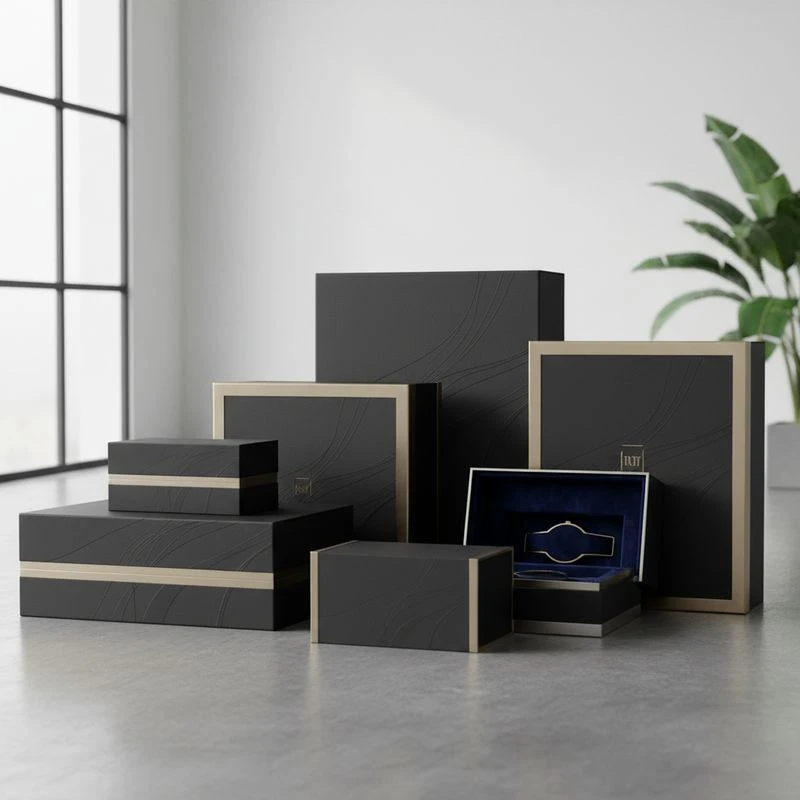
Custom rigid boxes for high end product lines are designed to make a product feel considered before it is even handled. Their thick board construction, precise fit and premium finishing make them suitable for products where presentation, protection and gifting all matter.
The right box is not simply the most decorative option. It should fit the product securely, support the unboxing experience, survive the intended retail or delivery journey, and reflect the price point without adding unnecessary complexity. Start with the product, its handling requirements and the customer’s opening sequence; then choose the structure, insert and finish.
Rigid Packaging
Rigid packaging is made from dense paperboard that retains its shape rather than folding flat like a standard carton. The board is usually wrapped in printed paper, coloured paper or a specialist covering material to create a clean, substantial outer surface.
For premium ranges, this format can be particularly effective for:
- Fragrance, skincare and cosmetics sets
- Jewellery, watches and accessories
- Premium food and drink gifts
- Technology accessories and small electronics
- Stationery, books and collector editions
- Corporate gifts and presentation packs
- Homeware, candles and lifestyle products
A rigid box adds value most effectively when it performs a clear role. It may protect a delicate item, keep a multi-piece set organised, provide an attractive gift-ready presentation or create a reusable storage box. If none of these benefits is important to the buyer, a lighter folding carton may be the more proportionate choice.
Common rigid box styles
The opening style affects both perceived quality and practical use. The main structures are straightforward, but each has different implications for filling, storage and customer handling.
| Box style | How it opens | Best suited to | Points to consider |
|---|---|---|---|
| Lid and base | Separate lid lifts from the base | Gift sets, candles, apparel and general premium goods | Reliable and versatile; lid depth and fit need careful specification |
| Shoulder and neck | Lid sits over a raised inner neck | Fragrance, cosmetics and presentation boxes | Creates a layered reveal; requires accurate dimensions |
| Magnetic closure | Hinged lid closes against concealed magnets | Press kits, premium gifting and multi-product sets | Offers a dramatic opening; assess storage and transit needs |
| Drawer box | Inner tray slides from an outer sleeve | Jewellery, accessories and compact sets | Useful for controlled presentation; ribbon pulls may improve access |
| Book-style box | Hinged cover opens like a book | Technology, promotional kits and collector products | Provides a broad branding surface; closure design matters |
| Two-piece telescopic box | Deep lid slides over the base | Taller or heavier products | Gives strong coverage; may need a pull ribbon for easy opening |
The phrase “custom rigid boxes” should mean more than putting a logo on a standard format. True customisation can include dimensions, opening method, wrapped material, artwork placement, internal fitments and finishing choices. However, every added feature introduces another production and assembly consideration. A focused specification normally produces a stronger result than trying to include every premium feature at once.
Decide whether rigid packaging is appropriate
Rigid boxes are not automatically best for every high-end product. They use more material than lightweight cartons and usually occupy more space before filling. They can also require additional hand assembly, depending on the construction and insert.
Choose rigid packaging where one or more of the following is true:
- The product needs meaningful protection from knocks, compression or movement.
- The packaging forms part of a gifting or launch experience.
- The product is sold at a price point where a more substantial presentation is expected.
- Multiple components need to be kept together in an orderly layout.
- Reuse is desirable, such as storage for accessories, keepsakes or product refills.
Consider a folding carton, corrugated mailer or other alternative where the product is low-risk, high-volume, strongly cost-sensitive or primarily shipped in a separate transit pack. The external presentation box and the protective delivery packaging do not need to be the same item.
Sturdy Design
A sturdy box starts with appropriate dimensions and a well-designed internal layout. Thick board alone cannot prevent damage if the product has room to move, is difficult to remove or places stress on the lid and corners.
Build around the product, not nominal dimensions
Provide the packed product’s real measurements, including caps, labels, cables, protective sleeves and any components that sit outside the main body. If several items are included, determine the order in which the customer should see and remove them.
Allowances are needed for the chosen insert, wrapped board thickness and tolerances. A box that is specified to the product’s exact external size may be too tight after materials are applied. Conversely, too much spare space makes a premium product feel insecure.
A useful packaging brief includes:
- Product length, width, height and approximate weight
- Fragile, sharp, liquid or surface-sensitive areas
- Number of components and preferred layout
- Whether the product is packed by hand or as part of a repeatable process
- Desired orientation when the box is opened
- Any leaflets, authenticity cards, care guides or accessories
- Whether an outer delivery pack will be used
- Storage conditions that may affect material choices
Select the right insert
An insert holds the product in position, controls the reveal and helps prevent contact between components. It should be designed as part of the box, not selected at the end.
Common insert approaches include:
- Folded card inserts: A practical option for holding lighter products and creating compartments. They can be printed or covered to coordinate with the box.
- Paper pulp inserts: Suitable where a moulded, protective internal form is needed. Surface appearance and dimensional detail should be assessed for the product.
- Foam inserts: Useful for precise retention and cushioning, particularly for delicate or technical items. Confirm the appearance, density and any material compatibility with the product.
- Fabric-covered inserts: Chosen where a soft, gift-like feel is important, such as jewellery or special accessories. They require attention to lint, colour transfer and long-term contact.
- Paper or card cradles: Can create a layered presentation with a lower material footprint than some alternatives, depending on the design.
If the item has a polished, coated or otherwise sensitive surface, check that the insert material will not mark, abrade or react with it over the expected storage period. This is a product-specific compatibility check, not an assumption to make from appearance alone.
Test the opening experience and the practical journey
A premium unboxing sequence should still be easy to use. Customers should not have to shake the box, dig under a product or pull aggressively on a tight-fitting lid.
Before committing to production, assess a physical sample for:
- Ease of opening and closing
- Product removal without damage or excessive force
- Alignment of the lid, base and wrapped edges
- Stability when displayed on a shelf or photographed
- Insert fit with actual packed product
- Performance when the box is placed into its intended outer pack
- Scuffing, corner wear and print marking during normal handling
If the product will be sold online, plan the transit system separately. A rigid box can provide presentation and local protection, but it may still need an appropriately sized outer pack and void control. Avoid treating a luxury presentation box as a substitute for an engineered delivery solution.
Avoid these structural mistakes
Common problems are often visible only once the first sample arrives:
- Choosing a magnetic closure without considering how the box will be packed or opened repeatedly
- Making the lid too tight, so the customer cannot remove it comfortably
- Specifying an insert from drawings without trialling the actual product
- Leaving insufficient finger access around the product
- Adding a ribbon pull that tangles, stains or interferes with product placement
- Designing a very large box for a small item solely for visual impact
- Forgetting the additional thickness of wrapped edges and internal coverings
- Using dark, unprotected surfaces where handling marks will be highly visible
Luxury Appeal
Luxury appeal comes from coherence: the structure, tactile finish, colours, typography and internal presentation should all feel like parts of the same product story. A heavy box with crowded artwork or an awkward insert can undermine the effect.
Use design restraint to create distinction
Premium packaging does not require every available embellishment. A minimal design with well-chosen materials can look more considered than a surface covered with effects.
Start by deciding what customers should notice first:
- A distinctive brand colour or carefully chosen paper texture
- A logo with subtle foil or embossing
- An illustrated wrap that reflects the product’s origin or ingredients
- A reveal message under the lid
- A precisely arranged product and accessory layout
Keep type legible at the intended viewing distance. Very fine lines, small reversed text and detailed graphics may not reproduce consistently across every material and finishing process. Ask to review artwork requirements and proofing expectations before finalising a design.
Make unboxing purposeful
For a high-end product line, the opening sequence can reinforce quality and reduce uncertainty. The customer might see a branded lid interior, then a protective layer, then the product in a carefully shaped insert. This should add clarity rather than delay access.
Useful elements may include:
- A printed inner lid with concise brand or care messaging
- Tissue, a protective card or a reveal sheet
- An insert that presents components in a logical order
- A card explaining product use, care or contents
- A discreet pull tab that improves removal
Be mindful of excess layers. If each component needs a separate wrap, tie or sleeve merely to appear premium, packing time and material use can rise without improving the customer experience. Consider whether every element has a functional or meaningful presentation role.
Align packaging with the product range
For a product line, create a packaging system rather than treating every SKU as a separate project. A shared box structure with controlled variations can establish brand recognition while making ordering and stock management simpler.
For example, a collection may use one lid-and-base format in several sizes, with a consistent logo position and colour system. Different product variants can then be distinguished through a label, sleeve, coloured interior, product name or secondary graphic.
This approach is especially useful where the range may expand. Leave enough design flexibility for future products, limited editions or seasonal gifting without needing to rebuild the entire box concept.
B2B Manufacturing
For procurement teams, a custom rigid box project should be managed as a specification exercise. Clear inputs reduce avoidable revisions and make it easier to compare like-for-like supplier proposals.
What to include in a manufacturing enquiry
A useful enquiry should cover both visual intent and operational requirements. Include:
- Box style and finished internal dimensions
- Product samples, drawings or accurate packed-product measurements
- Board, wrap and insert preferences where known
- Artwork files and required branding locations
- Colour references and critical visual features
- Finishes such as foil, embossing, lamination or spot effects
- Quantity required and whether this is a trial, launch or repeat programme
- Assembly and packing method
- Outer packaging requirements, if applicable
- Target date, delivery format and any storage restrictions
If certain details are not decided, identify them as open choices rather than guessing. A supplier can then quote or sample sensible alternatives, such as two insert concepts or a practical variation in closure style.
When sourcing custom printed packaging boxes, compare the full specification rather than only the headline unit cost. Differences in board construction, insert material, finishing scope, assembly, packing configuration and proofing can make apparently similar quotations materially different.
Sampling is a decision tool, not a formality
A sample is the point at which dimensions, appearance and usability become tangible. It should be assessed by the people who will approve the brand presentation and those responsible for product packing.
Ask what the sample represents. Some samples are intended to confirm construction and fit, while others are intended to show finished print and decoration. The proofing route, material substitutions, expected finish and approval process should all be confirmed in writing.
Use an approval checklist:
- Are the finished dimensions correct for the product?
- Does the product sit securely and remove easily?
- Is the artwork positioned and readable as intended?
- Does the colour meet the required reference under suitable viewing conditions?
- Are foil, embossing or other effects in the expected position?
- Are seams, corners and wrapped edges acceptable for the design?
- Is the selected insert appropriate for the product and its surface?
- Does the pack work with the intended packing and dispatch process?
Confirm commercial and technical details
Before placing a production order, clarify the points that most commonly create misunderstandings:
- Minimum order quantity and any quantity breaks
- Tooling, setup or sampling charges where applicable
- Tolerance expectations for dimensions, colour and finishing
- Responsibility for final artwork approval
- Packing format and quantities per outer pack
- Lead times at the point of order, rather than assumed timescales
- Payment and change-control terms
- Replacement, reprint or issue-resolution process
- Material declarations, recycling information or relevant compliance evidence required for the intended UK market
Requirements around product safety, labelling, food contact, recycling claims and restricted substances vary by product and intended use. Confirm what applies to your specific packaging, product category and sales route rather than relying on generic statements.
XGolden Print has 27 years of experience in custom packaging and printing, with a 15,000 square metre factory, more than 500 employees and production capacity exceeding 10 million units. These scale indicators may be relevant when evaluating a manufacturing partner, but the box specification, samples and agreed commercial terms remain the basis for a suitable purchasing decision.
Finishing
Finishing choices affect how a rigid box looks, feels and holds up to handling. They should enhance the design and support the customer’s perception of the product, not conceal weak artwork or unsuitable structure.
Popular finishing options
| Finish | Visual or tactile effect | Suitable uses | Check before specifying |
|---|---|---|---|
| Matte lamination | Smooth, understated surface | Minimal branding, soft colour palettes | Potential for visible handling marks on some dark colours |
| Gloss lamination | Reflective, high-contrast appearance | Bold graphics and vibrant designs | Reflections can reduce the subtlety of fine detail |
| Soft-touch coating | Velvety tactile feel | Premium gifting and presentation packs | Resistance to scuffing and suitability for the intended handling |
| Hot foil stamping | Metallic or coloured detail | Logos, borders and focal graphics | Fine detail, placement and colour options |
| Embossing | Raised design detail | Logos, monograms and simple motifs | Board, wrap and artwork must support the required depth |
| Debossing | Recessed design detail | Refined, restrained branding | Readability on detailed or small artwork |
| Spot UV | Gloss contrast on selected areas | Patterns, logos and graphic highlights | Visibility on the chosen base surface and alignment tolerance |
| Textured paper wrap | Natural or tactile character | Heritage, craft or design-led ranges | Print reproduction, scuffing and edge-wrapping behaviour |
A combination such as matte wrap with a restrained foil logo can be effective because it creates contrast without crowding the design. On the other hand, foil, embossing, spot effects and textured papers all in one layout may compete with each other.
Choose finishes for real handling conditions
The finish will be touched, opened, stacked and potentially photographed. Consider where the box will be used: a beauty counter, a gift display, a direct-to-consumer parcel or a corporate presentation.
Dark, solid-colour boxes can look striking but may reveal fingerprints, dust or abrasion more readily than lighter or patterned wraps. Very pale wraps may show marks from handling. Textured paper can create a distinctive feel, though it may alter how fine graphics reproduce.
Request samples on the proposed material whenever a finish is central to the visual identity. A digital screen proof cannot fully demonstrate the texture, sheen, edge wrap or tactile effect of the completed box.
Keep sustainability claims precise
Material reduction, reuse and recycled-content options may be relevant to a rigid packaging brief, but environmental performance depends on the complete construction. Laminations, mixed materials, magnets, foam and decorative additions can affect how a pack is separated, reused or recycled.
Avoid broad environmental claims unless they can be supported for the exact finished specification and relevant market requirements. Instead, ask practical questions:
- Can the box be reduced in size without compromising protection?
- Can the insert be simplified or made from a compatible material?
- Is a reusable structure genuinely useful to the customer?
- Can unnecessary decorative layers be removed?
- What disposal guidance is appropriate for the final pack?
Choosing a Custom Rigid Box: Final Checklist
Use this checklist before approving a design or placing an order:
- Define the job of the box. Is it mainly for gifting, protection, display, product organisation or repeat storage?
- Measure the final packed product. Include all accessories, protective elements and variable components.
- Choose an opening style that customers can use easily.
- Design the insert around the real item, not an estimated outline.
- Select only finishes that reinforce the brand and work for expected handling.
- Plan the outer transit pack separately if products are delivered.
- Review a physical sample with the actual product.
- Confirm tolerances, proofing, packing and commercial terms before production.
- Verify product-specific compliance, labelling and material requirements for the intended UK market.
- Create a repeatable system if the range includes several product sizes or variants.
Custom rigid boxes for high end product lines are most successful when structural protection and visual presentation are developed together. Start with a clear product brief, test a practical sample and keep the final specification focused on the customer experience you want to deliver.
