
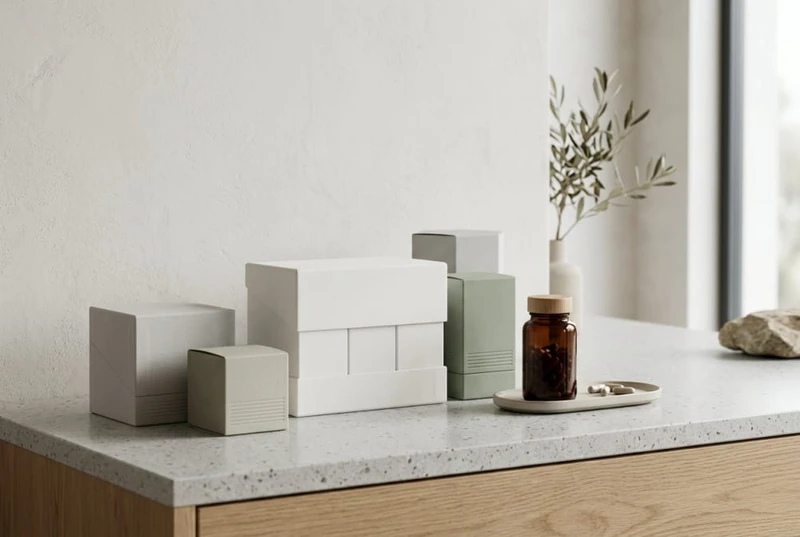
A good supplement packaging system makes every product easy to identify, easy to pack and straightforward to expand. It should give mandatory product information enough space, protect the format inside and create a recognisable range on shelf and online—without forcing a full redesign whenever a flavour, formula or pack size changes.
For UK brand teams, packaging systems that help supplement brands look credible and stay organised are built around a clear hierarchy: one consistent master design, defined space for variable information and packaging formats chosen for the product’s physical needs. This approach reduces avoidable artwork changes while helping buyers understand the range quickly.
Outer packaging needs for capsules, gummies, powders, sachets and bundled kits
The outer box should be specified around the product format first, then the desired customer experience. A visually consistent carton is useful, but a carton that is poorly matched to its contents can lead to excessive empty space, difficult packing or a weak first impression.
Different supplement formats raise different packaging questions.
| Product format | Key outer-packaging considerations | Useful design approach |
|---|---|---|
| Capsules and tablets | Container dimensions, closure clearance, rattle, pack orientation and tamper-evident features where used | A close-fitting carton with enough room for the container and any required insert |
| Gummies | Jar or pouch shape, heat and handling sensitivity, product settling and visible pack size | Use sturdy board and avoid a box size that exaggerates the product quantity |
| Powders | Tub, pouch or refill format, scoop storage, panel space and weight distribution | Prioritise a stable base and generous information panels |
| Individual sachets | Sachet count, easy dispensing, tear-open access and stock control | Consider a dispenser-style opening or a compact carton that keeps sachets ordered |
| Bundled kits | Multiple components, picking accuracy, presentation order and replacement items | Use dividers, trays or compartments only where they genuinely improve organisation |
Begin with a physical sample or accurate dimensions for every component: primary pack, lid, scoop, leaflet, sachet, insert and any protective material. The box must accommodate all of them in the intended packed orientation. A slightly larger box may be necessary for practical assembly, but unnecessary void space can make a product feel poorly considered and increase the need for filler.
Material selection also needs to reflect the journey from packing bench to customer. Folding cartons can suit many retail-ready products, while stronger corrugated outers may be needed for transport cases. For a premium presentation, a printed carton can be paired with an internal card insert. However, added components should only be used where they solve a real problem, such as keeping a glass jar centred or separating several items in a kit.
Where a box contributes to preserving the product, confirm its suitability with the relevant product, packing and storage teams. Printed outer packaging is only one part of product protection; it should not be assumed to replace the protection offered by the primary container.
How box design can improve shelf impact without complicating compliance panels
Shelf impact comes from fast recognition, not from filling every surface with visual elements. A shopper should be able to identify the brand, product type, key differentiator and format from the front panel at a glance. The information needed elsewhere should remain legible and properly organised.
A practical panel hierarchy is:
- Front panel: brand, product name, format, flavour or variant where relevant, and a restrained set of approved product descriptors.
- Side panels: directions, ingredients or composition information, storage details, warnings and other information required for the intended market.
- Back panel: a fuller product explanation, usage context, brand story if appropriate, barcode area and contact details.
- Top, base and flaps: batch, date or variable-print areas where needed, plus practical opening or recycling information where applicable.
The exact information and presentation requirements depend on the product and market. Before approving artwork, verify the current rules that apply to your supplement category, the claims you intend to make, ingredient declarations, warnings, quantities and traceability information. Leave enough clear space to accommodate this information at a readable size rather than treating it as an afterthought.
Build a visible design system
The strongest ranges tend to use a small number of repeatable design signals:
- a fixed logo position;
- a dependable typographic hierarchy;
- a consistent placement for format and quantity;
- a controlled colour system for categories, flavours or strengths;
- recurring graphic elements, such as a band, grid or illustration style;
- standard locations for variable data and barcodes.
This allows the core layout to remain familiar even as individual products vary. For example, a daily vitamin, electrolyte powder and collagen sachet carton can look like one range without pretending that the products are interchangeable.
Avoid effects that undermine legibility
Finishes such as foil, embossing, spot effects or textured stocks can add distinction, but they must not make essential information harder to read. Fine reversed-out type, low-contrast colours and highly reflective areas can cause problems on both shelf and screen. Use special finishes selectively—usually on a logo, border or simple motif—and keep variable information on a plain, scannable surface.
Sticker solutions for small batches, formula changes and private-label production
Stickers offer flexibility when printed cartons are not the most sensible starting point. They can work well for early-stage ranges, short runs, testing revised artwork, changing flavours or private-label programmes with shared pack formats.
A common approach is to use a neutral bottle, jar, pouch or carton with a well-designed label. This can lower the amount of packaging artwork that must change when product information changes, provided the label has sufficient room and adheres reliably to its chosen surface.
Sticker labels are particularly useful for:
- pilot quantities and seasonal variants;
- changing product names or formula details;
- customer-specific private-label artwork;
- batch-specific details;
- applying variable information to a standard carton;
- adding a seal or promotional sticker without reprinting the full pack.
However, a sticker is not automatically the best choice. Curved jars, textured pouches, chilled surfaces and frequently handled packs can all affect application and appearance. Test the label material, adhesive and finish on the final substrate under realistic handling conditions. Check that labels do not crease around curves, cover required information, lift at edges or interfere with a lid, seam or opening point.
For a label-led range, define a standard label zone on every primary pack. This makes production more repeatable and prevents each SKU from becoming a separate layout problem. Explore custom stickers and labels where flexible variant identification is a priority.
Packaging differences between single-product launches and growing supplement lines
A single-product launch benefits from focus. It may need one carton size, one label layout and one concise product story. The risk is designing it so specifically that every later addition requires a new visual language or a new production setup.
A growing line needs a framework, not just an attractive pack. It should accommodate different formats, quantities and categories while retaining a clear family resemblance.
| Decision area | Single-product launch | Growing product line |
|---|---|---|
| Artwork | Can be tailored closely to one product | Needs reusable templates and controlled variable areas |
| Colour | May centre on one distinctive colour | Requires a scalable palette and clear category rules |
| Box dimensions | Can be selected around one container | Benefits from a rational range of standard footprints where practical |
| Product information | One panel plan may be sufficient | Needs space allowances for different formats and claims |
| Inventory | Fewer components to manage | Requires clear SKU naming, version control and stock discipline |
| E-commerce imagery | One pack view may be enough initially | Needs repeatable photography and image conventions across the range |
For an initial launch, it is still worth deciding which elements will remain fixed. These might include the logo area, master typeface, quality of imagery, barcode location and placement of product format information. Treat these as non-negotiable components of the brand system.
Then define what can change: colour, flavour name, product benefit category, container size and product-specific copy. A clear distinction between fixed and variable elements lets designers and production teams work faster as the range grows.
Case-pack and distribution details that matter in wholesale supplement sales
Retail-ready individual cartons are only part of the specification. Wholesale sales also depend on how products are grouped, identified and handled beyond the primary pack.
A case-pack specification should address:
- the number of saleable units per outer case;
- the arrangement and orientation of cartons within that case;
- internal protection where required;
- outer case dimensions and board strength appropriate to the contents;
- visible SKU, quantity, batch and handling information;
- barcode requirements for both the individual unit and outer case, where applicable;
- the stacking and storage conditions expected in the supply chain;
- whether mixed cases, display-ready cases or single-SKU cases are needed.
The most suitable pack quantity is not always the largest that physically fits. Buyers and retail teams may need quantities that are easy to count, replenish and store. A case that is awkward to open, contains unclear product identifiers or mixes visually similar variants can create avoidable picking mistakes.
Plan for product recognition at three levels:
- Consumer unit: clear product and variant identification.
- Shelf-ready or inner pack: a fast way for staff to recognise contents when replenishing.
- Outer case: unambiguous information for warehouse receiving and order picking.
Keep item codes, artwork versions and product names consistent across those levels. If the consumer-facing name changes, assess whether the case labels, stock records and online listings need corresponding updates. Packaging consistency is as much an operational matter as a branding one.
Before producing volume, confirm the requirements of each intended sales channel. These may affect unit dimensions, barcode placement, case configuration, labelling and display format.
Simple ways to keep line extensions consistent across multiple SKUs
Line extensions often become inconsistent because they are treated as isolated design projects. The solution is to create a short, usable packaging rulebook before the number of SKUs becomes difficult to manage.
Your rulebook does not need to be elaborate. It should set out:
- approved box sizes and corresponding dielines;
- logo clear space and positioning;
- typefaces, minimum sizes and hierarchy;
- colour codes and how they are assigned;
- image or illustration rules;
- front-panel layout;
- fixed locations for variable information;
- barcode and batch-area placement;
- approved print finishes;
- naming conventions for artwork files and SKUs;
- an artwork approval process and version record.
Use colour with a second identifier
Colour is helpful for navigation, but should not be the sole means of distinguishing products. Similar shades can be confused in poor lighting, online thumbnails or monochrome printouts. Pair colour with a prominent format name, flavour, category label or icon system.
For example, a mineral range might use a colour family while retaining a large, consistent product name. A powder range may add a clearly labelled flavour field in the same position on every carton. This gives customers and warehouse teams two ways to identify the item.
Standardise where it is commercially sensible
A limited family of box footprints can simplify storage, photography, shelf planning and repeat orders. It can also make a range feel more deliberate. Yet standardisation should not lead to oversized cartons or inappropriate protection simply to force every product into one format.
The aim is controlled variation: standard formats for products that genuinely fit them, with defined exceptions for products that need different treatment.
Packaging choices that can weaken trust even when the product is strong
A carefully developed supplement can lose credibility if the packaging looks unclear, inconsistent or difficult to use. Trust is influenced by the small signals customers encounter before they experience the product.
Common weaknesses include:
- Overcrowded front panels. Too many messages compete for attention and make the product difficult to understand.
- Unreadable essential information. Small type, poor contrast and clutter can appear careless.
- Inconsistent variant naming. A flavour, strength or format described differently across the box, label and online listing creates confusion.
- Mismatched box and contents. Excessive empty space can make a pack feel wasteful or misleading.
- Low-quality images or graphics. Blurred photography, generic-looking icons and inconsistent illustrations undermine a polished brand identity.
- Weak structural fit. A carton that opens unintentionally, scuffs easily or fails to hold its contents securely affects perceived quality.
- Uncontrolled artwork versions. Older labels or cartons left in circulation can lead to conflicting product information.
- Decorative claims treatment. Emphasising claims more strongly than product identity or essential information can make the design feel less balanced and may create review issues.
Do not assume a premium finish will solve a weak layout. Clear wording, accurate information, coherent spacing and an appropriate box structure normally have more impact than adding multiple decorative processes.
It is also important to review digital presentation. Most product packs are seen online at a small size before they are handled in person. Test whether the product name, format and key visual cues are identifiable in a thumbnail image, not only in a high-resolution artwork file.
How to create a supplement packaging framework that is easy to expand
An expandable framework starts with decisions that are documented, not merely remembered by the original designer. The following process is a practical foundation.
1. Map the present and likely future range
List existing and planned products by format, pack size, flavour, category and sales channel. Identify likely additions over the next development cycle, such as refill pouches, travel sizes, bundles or subscription packs. You do not need to predict every product; the purpose is to spot foreseeable variation before locking in a rigid system.
2. Define a packaging architecture
Choose which packaging layers apply to each product:
- primary container or pouch;
- product label;
- individual retail carton;
- insert, tray or divider;
- bundle or gift pack;
- shelf-ready pack;
- transit case.
Not every item needs every layer. A simple pouch may only require a label and transport case, while a giftable bundle may need an outer presentation box and internal organisation. Select the layers based on protection, information, retail presentation and fulfilment needs.
For products needing a more developed carton structure, review the available options for custom packaging boxes and prepare a written brief covering dimensions, board preference, finish, contents and intended use.
3. Separate fixed artwork from variable content
Create a master artwork template that identifies locked brand elements and editable zones. Typical variable zones include:
- product name;
- flavour;
- quantity;
- ingredient or composition information;
- directions;
- warning text;
- barcode;
- batch and date-print area;
- language or channel-specific details where relevant.
This approach makes changes easier to review. It also reduces the chance that a routine update accidentally moves a logo, changes a type style or disrupts the established information hierarchy.
4. Specify physical prototypes before a full run
Review the actual assembled pack, not only a flat artwork proof. Check product fit, opening experience, flap alignment, label placement, visibility of key information and performance through ordinary handling. Where multiple components are packed together, confirm that the intended order is intuitive and that the contents do not shift unnecessarily.
Any product-specific testing or compliance checks should be planned and verified by the responsible teams. A visual sample is valuable, but it does not establish suitability for every storage, transport or regulatory condition.
5. Set up version control
Assign a clear file name and revision number to every approved item of artwork. Record what changed, why it changed, who approved it and which stock should no longer be used. Keep the same discipline for cartons, labels, inserts and case markings.
This is especially important when formulas, allergen information, pack counts or product instructions change. Good version control protects operational clarity as much as brand consistency.
6. Review the system at each new launch
Before adding a SKU, ask:
- Does it fit an existing box size or need a justified exception?
- Does it follow the established front-panel hierarchy?
- Is its variant distinction clear without breaking the range?
- Is there adequate room for all required product information?
- Can warehouse and retail teams distinguish it from similar items?
- Do the unit, inner pack and outer case use matching identifiers?
- Has the latest artwork version been approved for every packaging layer?
A packaging framework should make these questions quicker to answer over time. That is the real value of a system: it turns expansion from a series of one-off fixes into a controlled process.
A useful next step is to audit one current SKU against this framework, then use the findings to create a reusable artwork, box and label specification for the rest of the range.
