
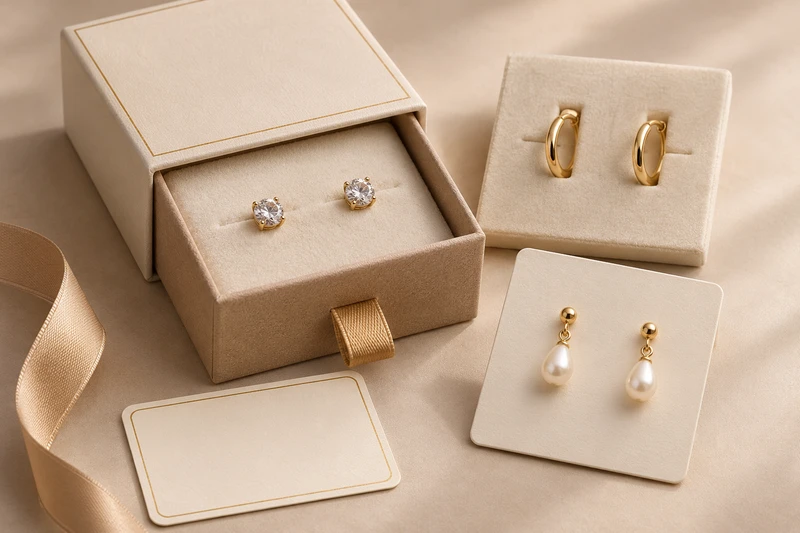
Matched earring pairs need packaging that keeps both pieces clearly presented, easy to remove and correctly spaced for their shape. The most useful earring packaging ideas start with the earring itself: measure the post, backing, hoop diameter or drop length before choosing a card, insert or gift box.
For jewellery brands, retailers and e-commerce teams in the United Kingdom, the same packaging may need to work for shelf display, a gift purchase, event favours and an online order. XGolden Print designs and produces custom paper packaging boxes, gift packaging, labels and stickers, with structural design, material selection, artwork support, printing, finishing, fitted inserts and sample approval available for the individual project.
One earring layout does not suit every shape
Studs, hoops and drop earrings place different demands on the presentation layout. A standard pair of holes may work for compact studs but can look crowded, unstable or awkward to remove when used for larger hoops or long drops.
The starting point is to define how the pair should sit when a customer opens the packaging:
- Stud earrings usually suit a compact, centred pair layout where the decorative front is the focus.
- Hoop earrings need enough horizontal and vertical clearance for the circular form, including the fastening or post arrangement.
- Drop earrings need a layout that supports their length without allowing the decorative element to overlap the card edge, box base or the second earring.
- Asymmetrical pairs may require a deliberately offset layout so the pair still reads as a considered set.
- Multi-part earrings, such as designs with removable elements, may need separate positions so each component is identifiable at first glance.
The display position affects more than appearance. It determines the card size, insert depth, box footprint and the amount of room required around each piece during loading and removal. It also influences where a retailer can place product information, a barcode label or a small collection message without obstructing the jewellery.
For ranges with several earring shapes, decide early whether every SKU will share one outer box size. A common box can simplify a coordinated collection, but the internal insert should still be designed around the smallest and largest applicable pair. A one-size insert may leave a compact stud pair looking lost or make larger earrings difficult to position.
| Earring type | Main layout requirement | Useful packaging option | Key check before approval |
|---|---|---|---|
| Studs | Even post spacing and room behind the display face | Compact display card or fitted insert | Backs can be fitted without distorting the layout |
| Small hoops | Clear area around the hoop and fastening | Larger card area or recessed insert | Hoop diameter does not collide with the card or box edges |
| Large hoops | More width and depth around the circular form | Deeper fitted insert within a rigid gift box | Both hoops sit separately and can be lifted out easily |
| Drop earrings | Vertical support and visible hanging length | Tall card or shaped insert in a deeper box | Drops do not overlap, bend or rest awkwardly on the base |
| Mixed earring gift set | Clear separation between pairs or components | Divided insert or multiple card positions | Every item has a defined place and the set remains easy to identify |
These are planning options rather than fixed specifications. Final dimensions, materials and insert construction should be confirmed against the actual earrings and intended presentation.
Stud spacing and room for the backs
Stud earring packaging should allow the fronts to sit evenly while leaving sufficient space behind the card or insert for the posts and backs. Buyers sometimes focus only on the visible face of a display card, then find that the backs make the assembled pair too deep for the chosen box.
Measure the complete assembled earring, not only the decorative top. Include:
- The distance between the two posts.
- The post length extending behind the card.
- The dimensions and shape of the earring backs.
- Any raised setting, stone, motif or metal edge at the front.
- The overall depth once the pair is mounted.
Hole spacing should make the pair look balanced while avoiding contact between the stud fronts. If the earrings are intended to be sold with a branded card, leave a calm area around the product rather than placing holes too close to a logo, care message or product name.
A card can present stud earrings directly, while an insert can place the card within a box. For gift-led ranges, the outer box may add a more deliberate opening sequence: the customer sees the box artwork first, then the interior presentation, followed by the pair. That does not eliminate the need for a suitable outer parcel solution for online orders; retail and gift packaging is not a complete transport-protection system.
For paper-based cards and inserts, confirm the material and construction against the jewellery’s surface, posts, backs and any intended contact points. If the design includes a protective sleeve, tissue or other contact layer, its suitability should be agreed for the particular product.
Giving hoops and drops enough depth
Hoops and drops benefit from packaging that accounts for their three-dimensional shape. A flat card placed in a shallow box can make removal difficult, particularly where the fastening, post or hanging element projects behind the display face.
Hoop earrings: account for the full circle
For hoops, begin with the outer diameter, then add space for the clasp, post and any charm attached to the hoop. The positioning should avoid forcing the pair too close together, where the circles can overlap visually or physically.
A larger hoop may suit a recessed insert that creates a defined position inside a rigid box. The insert can help establish the display position, but the depth needs checking with the complete pair fitted. If the hoop sits proud of the insert, the lid or drawer clearance becomes an essential sample-stage check.
Drop earrings: support length and movement
Drops require vertical room as well as depth. Their length should be visible, with both earrings aligned at the same height unless the product design calls for another arrangement. A card that is too short can cause drops to project below its edge; a box that is too shallow can leave the earrings pressed against the opening.
For long, articulated or delicate-looking drops, consider whether the lower element needs an additional retaining point rather than relying only on the post holes. The objective is a consistent presentation position during loading, retail handling and gifting—not a claim that the packaging alone will protect every product through every shipping condition.
A useful practical check is to place the real pair in the proposed orientation, turn the packaged product through normal handling positions and assess whether the earrings remain visually organised. This is different from assuming an insert is suitable simply because its dimensions look correct on a drawing.
Display cards and inserts inside a box
Display cards and fitted inserts perform different roles, and many earring packaging concepts use both. The card normally provides the immediate product display and small-format branding. The insert supports the card or jewellery inside the outer box, helping the contents occupy a considered position when opened.
A display card may be appropriate when:
- Earrings need to be visible at point of sale.
- The range uses several compact styles with similar mounting needs.
- Product names, collection details or care information need a visible position.
- The card will be placed in a pouch, box or another outer presentation format.
A fitted insert may be more useful when:
- A gift box needs a defined interior layout.
- The earring pair includes larger hoops, drops or several components.
- The packaging contains more than one product, such as earrings paired with another jewellery item.
- The opening experience needs the jewellery to appear at a specific level within the box.
For a coordinated jewellery gift set, consider the whole composition before approving the box. The insert may need separate areas for earrings, a message card or another customer product. It should also allow the recipient to grasp and remove each item without pulling at delicate components.
Artwork should be planned around actual display areas. On a card, leave room for the earring holes before finalising typography or illustration. On a box, consider which panel is shelf-facing, which surface is visible first when gifted and where variable SKU information will be applied. For United Kingdom retail, ensure customer-facing copy, product naming and any required information supplied by the brand are correct in the artwork before approval.
XGolden Print can support artwork and printing as part of a custom packaging project. Labels and stickers can also be specified for boxes and bags in custom dimensions and agreed roll or sheet formats, where identification or product-variant information is needed. They should be planned for the actual application surface and packing method rather than treated as an afterthought.
An earring drawer-box style from XGolden
A drawer box can create a layered unboxing sequence for earrings: the outer sleeve is handled first, then the inner tray is drawn out to reveal the pair. This format can suit gift purchases, premium retail presentation, corporate gifts, weddings and special events where the packaging is part of the occasion.
The DB-307 earring drawer-box style is a relevant XGolden Print product example for buyers considering this structure. Its suitability still depends on the specific earring dimensions, the selected insert, the depth required for backs or fastenings, and the intended internal layout. It should not be assumed to fit every stud, hoop or drop style without a project-specific check.
A drawer-box brief should clarify:
- Whether the inner tray holds one pair, multiple pairs or a wider gift set.
- The desired reveal position when the drawer is opened.
- Whether a display card sits on top of, within or separately from the insert.
- The space needed to grip and remove the tray.
- The outer sleeve panels available for branding and product identification.
- Whether the box will be presented in-store, included in an event gift or packed within a separate outer shipment.
Rigid boxes, magnetic closure boxes, drawer boxes and lid-and-base boxes are all among the packaging formats XGolden Print can produce. The most suitable format is a presentation and access decision: a drawer box emphasises a sliding reveal; a lid-and-base box offers a lift-off opening; a magnetic closure box gives a hinged opening experience. The earring layout should lead that decision rather than decoration alone.
Where the box is intended for a gift set, custom gift packaging can be planned around multiple customer products, coordinated branding and the intended opening experience. This is especially useful when earrings form part of a set for a retail promotion, a wedding party or a corporate gifting programme.
Loading and removal checks with the real pair
The strongest earring packaging ideas are tested with the real jewellery, its backs, any cards and the proposed box structure. A digital layout is valuable, but it cannot fully show whether an earring is easy to mount, whether a drop rests naturally, or whether a customer can remove the pair without disrupting the presentation.
Before approving production, assess the following:
Packing workflow
Ask the person loading the earrings to follow the intended assembly sequence. Confirm whether the card is loaded before or after the backs are fitted, whether the card enters the insert easily and whether the box can be closed without forcing the contents. For e-commerce fulfilment or retail packing, a simple, repeatable sequence is often as important as the finished visual.
Product access
Open the box as a customer would. Can they see the full pair immediately? Is there enough finger room to lift the card or insert? Does the drawer or lid open without catching on a protruding part of the earring? A high-positioned insert can improve the reveal, but it must not make removal impractical.
Pair alignment
Check that left and right earrings sit at the same height and spacing. This matters particularly for drops, where a small difference in mounting position can make a matched pair appear inconsistent. For hoops, inspect whether the circles face forward as intended rather than twisting during assembly.
Clearance inside the box
Close the selected box with the real, mounted pair inside. Consider the highest points: stud settings, earring backs, hoop closures and drop elements. The relevant question is not simply whether the box closes, but whether the interior layout is appropriate for the earring construction and presentation.
Outer packing needs
A jewellery box or gift box provides retail and gifting presentation. If products will be sent through an online-order fulfilment process, plan a separate outer packaging system suitable for the wider packing and delivery journey. This may include the outer box, void management and handling process selected by the brand or its fulfilment partner. Do not rely on the display card or presentation box as the whole transport solution.
Sample approval
XGolden Print offers sample approval before production. This stage is the opportunity to validate structural choices, material selection, artwork positioning, fitted insert layout and the opening experience with the actual pair. It is also the point to identify adjustments to box dimensions, hole positions, retaining features or clearance.
Preparing an earring packaging brief
A specific brief speeds up useful packaging discussions and reduces the risk of choosing a visually attractive layout that is unsuitable for the jewellery. Include photographs as well as measurements, particularly for unusual closures, curved shapes and multi-part earrings.
Your brief can include:
- Earring type: studs, hoops, drops or a mixed set.
- Measurements of the complete assembled pair, including backs and projections.
- Approximate weight of each item and the full set.
- Preferred display orientation and whether the earrings need to sit on a card, insert or both.
- Number of pairs or additional customer products in each box.
- Intended use: retail shelf, gift purchase, online order presentation, event favour or corporate gifting.
- Required branding, product information and variant identification.
- Artwork files or the level of artwork support required.
- Preferred box format, if known, or the desired opening experience.
- Estimated quantity, required delivery date and delivery destination.
- Any material, finish, insert, sampling or commercial requirements that need confirmation.
For buyers developing a new structure rather than selecting a known format, custom box design provides a relevant starting point. XGolden Print can work through structural design, material selection, artwork, printing, finishing, fitted inserts and sample approval in relation to the actual earring packaging brief. Material suitability, finishes, insert details, quantities, sample terms, pricing and schedules should be confirmed for the individual project.
To discuss earring packaging with XGolden Print, share the real product dimensions for the pair and backs, required quantity, artwork, preferred box or gift presentation, required delivery date and destination.
