
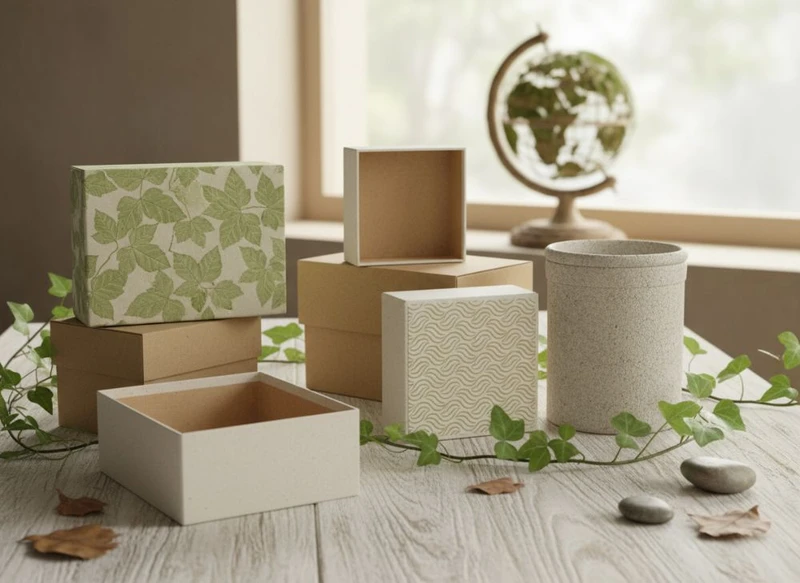
Eco-friendly paper box packaging can reduce reliance on plastic and make a product easier for customers to understand, recycle or dispose of appropriately—but only when the whole specification supports that aim. Paper fibres alone do not make a box sustainable if it includes hard-to-separate plastic films, excessive material, unsuitable inks or unclear disposal information.
For UK brands, the most practical approach is to specify the box around the product’s protection needs first, then minimise material, choose responsibly sourced or recycled fibre where suitable, limit incompatible finishes and make environmental claims that can be substantiated. This guide explains how to make those decisions for retail boxes, postal packaging and gift packaging.
The Business Case for Biodegradable Custom Packaging
Biodegradable custom packaging can support a brand’s environmental objectives, particularly where a product does not require long-term moisture barriers, grease resistance or unusually high protection. However, “biodegradable” should be treated as a specific material property to verify—not a catch-all description for every paper box.
Paper and board are fibre-based materials that may break down under appropriate conditions, but coatings, adhesives, laminations, inks and labels can affect the result. A practical procurement brief should therefore state the complete pack construction rather than simply asking for a biodegradable box.
The business value of more considered paper packaging usually comes from four areas:
- Clearer material choices: A largely fibre-based format may be easier for customers to recognise than a mixed-material pack.
- Brand presentation: Natural textures, uncoated board and restrained printing can reinforce a considered, lower-waste position.
- Efficient pack design: Reducing unnecessary void space and components can simplify the packaging bill of materials.
- More credible communications: A well-documented material specification gives marketing teams a firmer basis for customer-facing claims.
There are trade-offs. A lighter or less coated board may offer less resistance to scuffing, moisture or oil. Recycled fibres can have a different surface appearance from virgin-fibre board. A box designed to be readily recyclable may not provide the barrier properties needed for every product.
Before choosing biodegradable custom packaging, define:
- The product’s weight, shape and fragility.
- Exposure to moisture, grease, abrasion, heat or light.
- Whether the pack is for a shop shelf, a delivery journey, gifting or all three.
- The intended end-of-life route: household recycling, reuse, composting where accepted, or another managed stream.
- The exact environmental claim your team intends to make.
For tailored formats, explore custom packaging boxes once these functional requirements are clear.
Best Alternatives to Plastic: Cardboard and Kraft Paper
Cardboard and kraft paper are common alternatives to plastic-based packaging because they can provide structure, printability and a familiar fibre-based appearance. They are not interchangeable, however. The right option depends on the product, pack format and desired finish.
| Material option | Best suited to | Strengths | Points to check |
|---|---|---|---|
| Folding boxboard | Retail cartons, cosmetics, dry goods and lightweight products | Smooth print surface, clean folding and broad design flexibility | Fibre source, recycled content, coating type and required board thickness |
| Corrugated cardboard | Postal boxes, heavier goods and protective outer packaging | Structural protection and efficient shipping formats | Flute profile, transit requirements, tape choice and printed coverage |
| Kraft paperboard | Natural-looking retail boxes, sleeves and takeaway-style formats | Distinctive texture and a less processed visual character | Surface print quality, colour consistency and whether the board is coated |
| Moulded fibre | Trays, inserts and protective product holders | Can replace some plastic inserts and separate product components | Fit, surface finish, product contact suitability and tooling needs |
| Paper wrap or paper padding | Void fill, wrapping and lightweight protection | Flexible, simple material format | Tear resistance, ink coverage and the amount needed for adequate protection |
Cardboard for structure and protection
Corrugated cardboard is often the starting point for e-commerce and transport packaging. It can be specified with different constructions according to the product’s weight and the handling it may encounter. A well-sized corrugated box can reduce the need for excessive void fill, while an oversized box can consume extra board and increase the risk of items moving in transit.
Avoid assuming that “recyclable cardboard” automatically applies to the finished pack. Plastic tape, foam inserts, laminated labels and non-paper protective elements may complicate recycling. Where possible, design the box, closure and internal protection as a system with fewer material types.
Kraft paper for a natural finish
Kraft paper and kraft board are particularly useful when the brand look calls for tactile, understated packaging. Dark inks, line illustrations and single-colour designs often reproduce well on a natural substrate, while pale colours and fine detail may need testing to ensure legibility.
Kraft is not automatically lower impact than every other board option. Check the fibre source, recycled content, basis weight, coating and conversion process instead of relying on colour or appearance.
Navigating Eco-Friendly Certification Labels
Certification labels can help buyers assess fibre sourcing and chain-of-custody arrangements, but they should not replace material review. A label may apply to the board substrate while not covering every component of a finished box.
When reviewing certification or environmental labels, ask these questions:
- What does the label cover: the fibre, the finished board, the printer, the complete box or a particular supply chain?
- Is the claim valid for the exact grade and order being specified?
- Can the supplier provide current supporting documentation where needed?
- Are there rules governing use of the certification mark in packaging artwork?
- Does the label relate to responsible forestry, recycled content, compostability, recyclability or something else entirely?
- Does the claim remain accurate once coatings, windows, labels and inserts are added?
Terms such as recyclable, recycled, compostable, biodegradable and plastic-free describe different things. They should not be used as though they mean the same thing.
For example:
- Recycled content concerns the fibre used to make the board.
- Recyclable concerns whether a finished item can enter an appropriate recycling route.
- Compostable normally depends on the conditions and collection systems available.
- Biodegradable describes breakdown potential under particular conditions, which may not match normal household disposal.
- Responsibly sourced is a broader supply-chain claim that needs evidence behind it.
Confirm the current UK requirements relevant to your product category, labelling and environmental communications before printing a claim. Keep records of specifications, declarations and artwork approvals so that marketing language stays aligned with the actual pack.
Reducing Waste with Minimalist Box Design
The lowest-waste box is not necessarily the smallest-looking one; it is the one that uses no more material than necessary while continuing to protect the product and deliver a usable customer experience.
Minimalist design can reduce unnecessary components without making the packaging feel plain. It generally means removing layers, decorative features and oversized dimensions that do not add functional value.
Practical ways to reduce packaging material
- Size the box closely around the product and any essential protective insert.
- Replace multi-part constructions with a single folding format where protection allows.
- Use a paperboard insert only where it genuinely prevents damage or improves presentation.
- Choose tuck closures, locking tabs or other integrated paperboard closures where appropriate, instead of adding separate fasteners.
- Avoid decorative plastic windows unless the product truly needs to be visible before purchase.
- Review whether a sleeve, label or printed outer box is duplicating the same information.
- Limit very large solid ink areas if they are not essential to the design.
- Design for flat packing where it supports efficient storage and assembly.
Minimalism should not compromise usability. A box that tears during opening, fails to protect the product or needs extra outer packaging to survive dispatch is unlikely to be the best overall choice. Request samples and assess the assembled format with the real product, not only a digital artwork proof.
A common mistake is choosing a very thin board to use less material, then compensating with extra inserts, tape or a second box. Evaluate the total packaging system rather than one component in isolation.
Choosing Water-Based or Soy-Based Inks
Ink choice matters because it can affect the appearance, recyclability considerations and end-of-life profile of printed packaging. Water-based and soy-based inks are often discussed as more environmentally considered alternatives to some conventional ink systems, but their suitability must be assessed for the specific substrate and print process.
Water-based inks
Water-based inks use water as a principal carrier. They can be suitable for many paper and board applications, especially where a clean, low-odour finish is desirable. Print performance can vary with board absorbency, coverage levels and the required colour result.
Ask the printer to confirm:
- Compatibility with your chosen board and surface coating.
- Colour matching expectations, especially on unbleached kraft.
- Rub, scuff and moisture resistance required for the pack’s use.
- Whether varnishes or protective coatings are necessary.
- The effect of any coating on recycling or end-of-life goals.
Soy-based inks
Soy-based inks use soy oil as part of their formulation. They may be used in certain print applications, but “soy-based” does not mean the entire ink is made from soy or that it is automatically suitable for every box style.
Treat soy-based ink as a specification to investigate rather than a universal sustainability shortcut. Confirm the actual formulation, print process, board compatibility and any restrictions on the product type. This is particularly important for packs needing high resistance to scuffing, grease or moisture.
Keep print treatments proportionate
For a more recyclable-looking paper box, consider reducing or avoiding treatments that create difficult-to-separate layers, such as full plastic lamination. If extra protection is required, ask about alternatives and review the finished construction rather than making a decision based on one material in isolation.
Foil, embossing, spot effects and varnishes can still have a place in premium packaging. The key is to use them intentionally, confirm their compatibility with the intended end-of-life route and avoid presenting the whole pack as easily recyclable without checking the final specification.
How to Communicate Your Sustainability Efforts to Customers
Good sustainability communication is specific, restrained and easy to verify. Customers should be able to understand what the packaging is made from, what to do with it after use and which parts need separating.
A useful on-pack message answers three questions:
- What is it? For example, identify the pack as paperboard, corrugated cardboard or a multi-part pack.
- What should the customer do? Give simple disposal or separation guidance where it is appropriate and accurate.
- What is the meaningful benefit? State a supported fact, such as recycled fibre content or a verified sourcing claim, rather than broad claims such as “planet friendly”.
Avoid vague phrases including “green”, “eco-safe” or “100% sustainable” unless your organisation can substantiate precisely what they mean. Environmental impact is rarely captured by a single feature.
If the pack contains mixed materials, explain this clearly. For instance, a cardboard box with a separate ribbon, adhesive label or protective insert may require components to be removed before disposal. Clear instructions are more useful than a simple recycling symbol with no context.
Printed labels can help communicate material and disposal information without redesigning every box panel. For smaller-format messaging, consider custom printed stickers that are designed as part of the overall pack specification, not added as an afterthought.
Design Inspirations for Green Gift Packaging
Sustainable gift packaging can still feel distinctive and premium. The strongest concepts often focus on material texture, thoughtful structure and well-chosen print rather than multiple decorative layers.
Natural and restrained
Use uncoated kraft board or a lightly textured paperboard with a one- or two-colour design. Black, deep green, navy or earthy tones can create contrast without requiring a highly complex print treatment. A simple illustrated motif, logo mark or seasonal pattern can be enough.
Reusable presentation boxes
A sturdy box with a practical secondary use may encourage customers to keep it. This approach works best when the box is genuinely durable and useful, rather than simply overbuilt. Consider whether the product itself merits a keepsake format and whether that format can avoid permanent mixed-material attachments.
Paper-led details
Replace separate plastic embellishments with paper-based features where possible:
- Die-cut reveal panels without plastic windows.
- Paperboard dividers or folded inserts.
- Printed gift messages inside the lid.
- Integrated tags or tear-off message cards.
- Paper seals designed to complement the box artwork.
One-box gifting
A well-designed mailer that also presents suitably as a gift can remove the need for a separate delivery box and gift box in some product categories. This requires careful testing: it must protect the product in transit while maintaining a presentation standard on arrival.
For product launches, seasonal collections and premium retail formats, custom gift packaging can be developed around a reduced-material concept from the outset.
Recycled vs. Virgin Pulp: What You Need to Know
Recycled and virgin pulp both have a place in paper box packaging. The right choice is not simply a matter of choosing the highest possible recycled percentage; it depends on the product, structural needs, print expectations and fibre sourcing evidence.
| Consideration | Recycled pulp board | Virgin pulp board |
|---|---|---|
| Fibre origin | Made using recovered paper fibres, sometimes with additional fibre for performance | Made from newly processed wood fibre, often from managed sources where specified |
| Appearance | May have a natural, speckled or less uniform surface | Often offers a brighter, more uniform surface |
| Print finish | Can be effective, but fine detail and pale shades may need testing | Often well suited to crisp graphics and colour reproduction |
| Strength and consistency | Varies by grade and fibre mix; assess for the intended use | Can offer predictable performance for demanding structures |
| Best buying question | What is the verified recycled content and is it suitable for the box’s use? | What is the verified fibre source and is this grade necessary for the design? |
Recycled fibres can be used repeatedly, but fibre length changes over successive recycling cycles. This is one reason some board grades include virgin fibre or are chosen for applications requiring particular stiffness, cleanliness or surface quality.
A balanced specification may use recycled-content board for outer cartons, mailers or non-critical inserts, while reserving another grade for components with more demanding performance needs. The decision should be based on the total packaging design, not an assumption that one fibre type is always preferable.
Ask suppliers to identify the board grade, recycled content where applicable, fibre sourcing information, surface treatment and suitability for your product. If food contact, cosmetics, fragrances or sensitive products are involved, confirm the relevant product-contact and migration requirements for the intended market and use.
A Practical Specification Checklist
Before approving eco-friendly paper box packaging, check that your brief covers:
- Product dimensions, weight and protection requirements.
- Box format, board type and board thickness or grade.
- Recycled content and fibre sourcing evidence where relevant.
- Coatings, laminations, varnishes, windows and other non-fibre elements.
- Inks, print coverage and finish requirements.
- Internal fitments, void fill and closure method.
- Customer-facing disposal instructions.
- Environmental claims and the evidence supporting them.
- Samples of the finished construction, not only artwork proofs.
XGolden Print develops custom packaging and printing solutions, with experience across box and printed packaging projects. When comparing suppliers, use a shared specification checklist so that material, finish and end-of-life assumptions can be assessed on a like-for-like basis.
Frequently Asked Questions
Is all paper box packaging recyclable?
No. Whether a box is recyclable can depend on its board composition, coatings, plastic film, foil, adhesives, windows, labels and local collection arrangements. Assess the finished pack, not just the paper element.
Is kraft paper always more sustainable?
Not necessarily. Kraft has a natural appearance, but sustainability depends on fibre origin, recycled content, material weight, coatings, production choices and whether the final format is right for the product.
Should every sustainable box use recycled board?
No. Recycled board can be an excellent choice for many applications, but some products need particular strength, cleanliness, barrier performance or print quality. Select the most appropriate verified grade for the job.
Can premium packaging be environmentally considered?
Yes. Premium presentation can come from structural design, tactile board, careful typography and limited print effects. The aim is to avoid unnecessary materials and make every component serve a purpose.
A well-specified paper box can support product protection, brand presentation and more responsible material choices at the same time. Start by mapping the complete pack—from board and ink to closure, insert and disposal message—then use that brief to compare custom box options that fit your product and sustainability priorities.
