
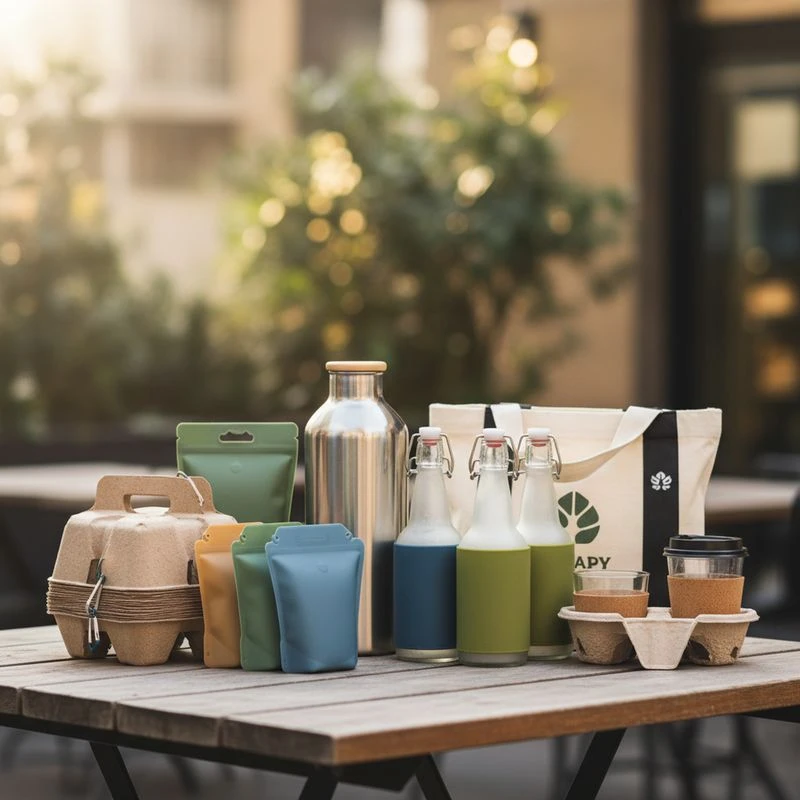
Eco reusable custom packaging for beverage companies works best when it is designed around a real reuse journey rather than a vague environmental claim. The pack should protect the drink, suit the way it is sold and used, communicate the brand clearly, and have a practical route for being retained, refilled, returned or repurposed.
For UK beverage brands, the strongest approach is usually to reduce unnecessary material first, choose components that can withstand their intended use, and make reuse instructions clear. A reusable bottle alone is not enough: closures, labels, outer boxes, transit protection and disposal information all need to support the wider packaging system.
Reusable Packaging
Reusable packaging is packaging intended to stay useful beyond one initial purchase. In beverages, this can mean a durable drinking vessel, a refillable bottle, a returnable container, a keepsake presentation box, or robust transit packaging used repeatedly within a supply chain.
The word “reusable” should describe a credible use case. A sturdy-looking carton is not necessarily reusable, and a recyclable bottle is not automatically designed for repeat use. Before choosing materials or print finishes, define what reuse means for the product.
Choose the right type of reuse
A beverage business may use one or more of the following approaches:
| Reuse approach | What it involves | Suitable situations | Key considerations |
|---|---|---|---|
| Consumer repurposing | The customer keeps the bottle or box for another purpose | Gift drinks, premium launches, limited editions | The pack needs lasting appeal and practical secondary use |
| Refill-at-home | The customer refills a container themselves | Concentrates, powdered drinks, selected wellness products | Opening, resealing, hygiene guidance and durability must be considered |
| Managed return | Containers are collected, checked and reused in a defined system | Closed-loop hospitality, workplace or local delivery models | Collection, cleaning, sorting and loss management need a workable plan |
| Reusable presentation packaging | A gift box, case or sleeve is retained after purchase | Corporate gifts, seasonal sets and premium retail | The pack should be sturdy, easy to open and useful after gifting |
| Reusable B2B transit packaging | Crates, dividers or protective packs circulate between business locations | Wholesale and repeat fulfilment | Compatibility with handling, storage and identification is essential |
A managed return scheme can be attractive, but it is operationally demanding. It requires an agreed process for collection, inspection, cleaning, storage and redistribution. It may not suit a product with fragmented distribution or an audience unlikely to return containers.
Consumer reuse is usually simpler to introduce, but it depends on giving people a reason to keep the pack. A well-made bottle, useful case or attractive gift box can support this, provided that claims stay proportionate and the intended secondary use is clear.
Start with the usage journey, not the material
A practical reusable-packaging brief should answer these questions:
- Who will reuse the pack? Consumers, retailers, hospitality teams, distributors or your own fulfilment operation?
- How often is reuse realistic? Avoid assumptions that every pack will be reused many times.
- What will the pack contain? Still, carbonated, acidic, alcoholic, dairy-based and powdered drinks create different packaging demands.
- How will the product be handled? Consider shelves, chilled storage, online dispatch, gift presentation and event use.
- What happens after the final use? Identify the most likely end-of-life route for every component.
- What information is needed? Refill instructions, care guidance, separation guidance, batch coding and legally required information may all need space.
This process helps prevent a common mistake: specifying a highly durable container without a viable plan for cleaning, refilling, returning or recycling it.
Beverage Bottles
Bottle choice affects shelf appearance, perceived value, transport protection, closure performance and the likelihood of reuse. There is no universally best material. The right choice depends on the beverage, commercial model and customer experience you are trying to create.
Comparing reusable bottle options
| Bottle format | Potential strengths | Limitations to plan for | Best suited to |
|---|---|---|---|
| Glass | Clear or coloured display, premium feel, familiar for many drinks | Breakage risk, weight and additional protection needs | Gift drinks, premium still beverages and presentation-led ranges |
| Stainless steel | Durable, long-lasting appearance and suitable for drinkware-style reuse | Opaque surface, higher material input and closure compatibility considerations | Refill-oriented products, merchandise and insulated drink formats |
| Aluminium | Light in weight, opaque branding surface and recognisable drinks format | Can dent; internal lining and product compatibility require confirmation | Selected ready-to-drink beverages and promotional formats |
| Durable plastic polymer | Lower breakage risk and flexible shape options | Scratching, odour retention, recycling route and food-contact suitability must be assessed | Sports, travel, children’s or on-the-go formats where appropriate |
The material is only one part of the specification. The bottle neck, cap, tamper evidence, liner, label adhesive and any decorative coating must work together. A component that looks sustainable in isolation can create problems if it prevents easy separation, affects recycling, or fails during chilled storage and handling.
Match the bottle to the drink
A reusable beverage container should be evaluated against the product’s actual requirements. Ask the supplier or technical team to confirm suitability for relevant conditions, including:
- Carbonation and internal pressure
- Acidity, alcohol content or ingredients that may affect packaging
- Light sensitivity and the need for an opaque barrier
- Hot filling, pasteurisation or chilled storage where applicable
- Opening and resealing frequency
- Temperature changes during use
- Cleaning methods expected in the proposed reuse model
- Food-contact suitability for the product and intended market
- Compatibility between the closure, seal and bottle finish
Do not assume that a bottle suitable for water is suitable for every beverage. Likewise, a reusable-looking cap may not provide the required seal for a carbonated drink, and a decorative finish may not withstand repeated washing.
Design for the full pack, not just the bottle
Beverage packs often include more than a bottle. The wider system may contain a neck tag, shrink sleeve, paper label, tamper band, gift carton, divider, mailing box or display tray.
Review each part separately:
- Can the consumer understand which pieces are retained, removed or separated?
- Does the outer box protect the bottle without excessive void fill?
- Is a reusable gift box robust enough to be kept?
- Could labels be reduced, repositioned or made easier to remove where that benefits the chosen end-of-life route?
- Does the print design leave space for mandatory product information?
- Will added embellishments interfere with the intended reuse or disposal route?
The most effective design is often the one that removes a component rather than adding a new “eco” feature.
B2B Branding
For beverage companies selling through retail, wholesale, hospitality, corporate gifting or e-commerce, packaging is both a product-protection tool and a B2B brand asset. It needs to work across multiple handling points while presenting a consistent identity.
Reusable custom packaging can make the brand more memorable, but branding should not undermine functionality. A bottle that is difficult to clean, a box that is awkward to reclose or a label that obscures important information can reduce the value of the design.
Build a durable visual identity
For a pack intended to be kept, consider design elements that will remain relevant after the first purchase:
- A clear brand mark that is recognisable at small and large sizes
- A restrained colour palette that works across bottles, cartons and shipping packs
- Product information that is separate from permanent branding where practical
- Refillable or seasonal labels that can be changed without replacing an entire outer pack
- Artwork that remains legible after handling, condensation or repeated use
- A consistent finish across individual bottles, multipacks and gift sets
Avoid making the design so campaign-specific that customers have little reason to retain it after a short promotion. Timeless brand assets are often more suitable for reusable formats than one-off messaging.
Use outer packaging strategically
Custom boxes are particularly useful where the drink is gifted, sold in multipacks or sent directly to customers. They can provide protection, product education and a premium opening experience without permanently decorating every bottle.
When specifying custom printed beverage packaging boxes, clarify:
- Bottle dimensions, weight and number of units per box
- Whether bottles need dividers or inserts
- Storage orientation and stacking requirements
- The level of protection needed for direct dispatch
- Whether the box will be retained as a gift case or used once for transit
- Required print areas for product details, handling instructions and brand messaging
- Whether inserts, ribbons, magnets or coatings genuinely add value
A reusable gift box should have a practical purpose after opening, such as storage or presentation. If it is likely to be discarded immediately, a simpler, material-efficient carton may be the better choice.
Keep claims precise
Environmental language is scrutinised by customers and business buyers alike. Terms such as “green”, “planet-friendly” and “zero waste” are broad and can be misleading when unsupported.
Use specific, verifiable descriptions instead. For example:
- “Designed to be retained and reused”
- “Refillable bottle format”
- “Outer carton designed for storage”
- “Packaging uses fewer separate components than the previous format”
Any environmental, material, food-contact or recycling claim should be reviewed against the applicable UK requirements and supported by evidence relevant to the finished pack. Check claims for the complete packaging system, not only one material or component.
Eco Design
Eco design for beverage packaging means making deliberate choices about material use, functionality, reuse potential and end-of-life handling. It does not mean adding more layers, textures or features simply to create a sustainable appearance.
A useful priority order is:
- Prevent unnecessary packaging.
- Reduce material while maintaining safe product protection.
- Design components for realistic reuse where appropriate.
- Make separation and disposal understandable.
- Choose print and finishing choices that fit the intended recovery route.
Reduce complexity before adding features
The simplest design is not always the lightest-looking one. A pack must still protect the beverage and arrive in saleable condition. However, many formats can be improved by examining where complexity has built up.
Look for opportunities to:
- Eliminate redundant sleeves, tags or double boxes
- Reduce empty space within multipacks and gift sets
- Use right-sized inserts rather than oversized void fill
- Avoid mixing materials where there is no functional reason
- Select closure and label formats with the likely recycling route in mind
- Use clear reuse or disposal instructions rather than relying on symbols alone
- Design one outer format that can serve several product variants
Material reduction should never compromise product integrity. Damage, leakage or spoilage can create more waste than a carefully considered protective component. The goal is appropriate protection, not minimum material at any cost.
Consider the practical life cycle
A reusable pack is not automatically the lower-impact option. Its value depends on whether it is actually reused and how it is transported, washed, stored and eventually recovered.
When comparing concepts, assess the likely whole journey:
- Raw material and component sourcing
- Manufacturing and printing requirements
- Product filling and packing
- Storage and distribution
- Consumer use, care and reuse behaviour
- Return or refill logistics, if applicable
- Separation, recycling or disposal after final use
For a returnable format, operational questions are especially important. Who owns the container? Is there a deposit or other incentive? How are damaged units handled? Can the container be reliably identified? Is there sufficient storage space for empties? These are commercial and operational decisions, not merely packaging decisions.
Make instructions easy to follow
People are more likely to reuse a pack when they understand how. Keep care guidance short and visible, particularly where the product is designed for refilling or repeated use.
Useful information may include:
- Whether the pack is intended to be retained
- How to clean or care for it, where relevant
- Which elements should be removed before disposal
- Whether labels, caps and outer components have different disposal routes
- Where to find product-specific refill or return details
Instructions should be checked for legibility at the final print size. Small text, low-contrast artwork and crowded layouts reduce their usefulness.
Innovation
Innovation in beverage packaging should solve a practical problem: better protection, easier reuse, clearer brand communication, more efficient packing or more straightforward recovery. Novelty alone is not a reason to add complexity.
Useful areas for packaging innovation
Modular presentation systems
A durable outer case can support different bottle sizes, seasonal products or corporate gift combinations by using replaceable inserts. This may reduce the need to create an entirely new box for every variation, but the inserts must fit securely and remain easy to separate.
Refill-aware labelling
Permanent bottle branding combined with a changeable product label can suit refill concepts. Confirm that label placement, adhesive choice and removal method support the chosen cleaning and reuse journey.
Digital product information
A QR code can direct customers to care instructions, ingredient information, refill details or brand storytelling. It should complement, not replace, essential on-pack information that must be available at the point of purchase.
Standardised bottle families
Using a consistent bottle footprint across a range may simplify secondary packaging, shelf presentation and inventory management. It can also make it easier to design reusable crates, dividers or presentation boxes, provided each product remains safely contained.
Lightweight protective structures
Well-designed dividers and inserts can offer protection without relying on heavy, oversized outer cartons. Samples should be assessed with the real bottle, closure and intended shipping configuration rather than as flat packaging alone.
Avoid innovation that creates a new problem
Common pitfalls include:
- Adding mixed-material decoration that conflicts with recycling or separation goals
- Choosing a reusable vessel without thinking through cleaning and hygiene
- Making a bottle too heavy or awkward for the intended customer
- Using a premium box where basic transit protection is all that is needed
- Designing a return scheme before confirming collection and handling capacity
- Applying generic environmental claims without product-specific substantiation
- Focusing on a single component while ignoring the full pack and fulfilment journey
A concept should be judged by how well it works in everyday use, not only by how it appears in a product photograph.
A practical specification checklist
Before approving eco reusable custom packaging, document the following:
- Product type, fill volume and storage conditions
- Bottle material, colour, finish and neck specification
- Closure, tamper-evidence and sealing requirements
- Primary reuse goal: retain, refill, return or repurpose
- Outer-pack purpose: retail, gifting, transit, display or all of these
- Required protection during handling and dispatch
- Artwork, brand colour and mandatory information areas
- Label, adhesive and finishing requirements
- Intended disposal or recovery guidance for each component
- Compatibility checks for beverage contents and production conditions
- Applicable UK packaging, labelling and environmental claim requirements to verify
- Sampling and approval criteria before production
Frequently asked questions
Is recyclable packaging the same as reusable packaging?
No. Recyclable packaging is intended to be processed into material for future use after disposal. Reusable packaging is designed to remain in use in its existing form. A pack can potentially support both aims, but each requires different design decisions.
Are glass bottles always the best reusable option?
Not always. Glass can suit premium presentation and some beverage types, but weight, breakage risk, transport protection and the intended reuse model must be considered. A different material may be more suitable for a product used on the move or in high-impact environments.
Can a beverage gift box be considered reusable?
It can be, if it has sufficient durability and a clear secondary purpose, such as storage, display or presentation. Simply calling a box reusable does not make it likely to be retained. Design, construction and usefulness matter.
What should be tested before placing an order?
Confirm the final pack works with the actual bottle, closure, product conditions, filling process, storage environment and intended handling journey. Review print legibility, fit, opening experience, protection and any reuse instructions before approving full production.
The right eco-reusable packaging starts with a precise brief: define the intended reuse, select components that fit the beverage and distribution model, and keep claims clear and supportable. When you are ready to develop the outer packaging, XGolden Print can help turn agreed bottle dimensions, artwork and protection requirements into a custom box specification.
