
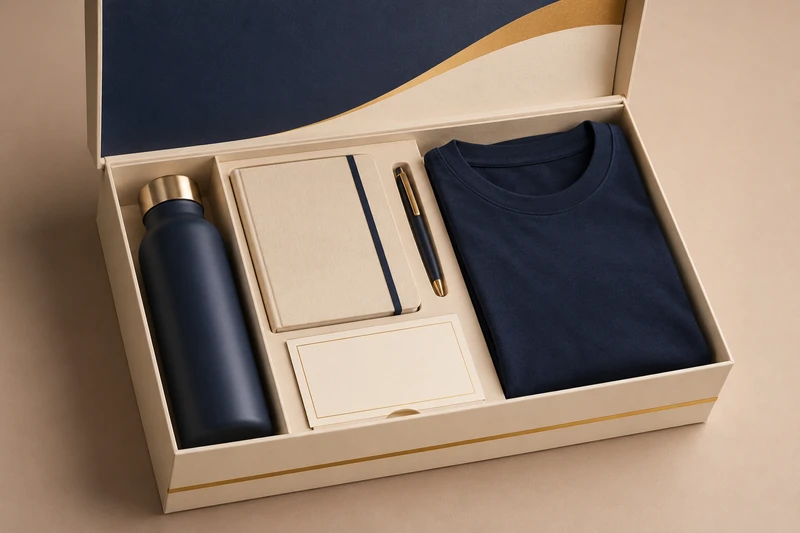
Employee welcome boxes are empty branded boxes designed to present and organise the gifts an employer has selected for a new starter. The most effective format begins with the actual contents: their dimensions, weight, fragility, quantity and required order of reveal. A box that looks polished but does not hold each item securely can make packing and handover harder than necessary.
For HR teams, branded-gift buyers and e-commerce teams in the United Kingdom, an onboarding box may be handed over in an office, sent to a home address, or prepared for an event. Each route affects the box structure, insert layout and outer packing plan. XGolden Print designs and produces custom paper packaging boxes, gift packaging, labels and stickers, supporting structural design, material selection, artwork, printing, finishing, fitted inserts and sample approval before production.
An employee welcome box is presentation packaging rather than a complete transport-protection system. It should be planned alongside any protective outer carton, void fill and handling process needed for remote distribution. XGolden Print packaging can be specified for customer-supplied gifts; confirm who will source, assemble and pack the contents before finalising the project.
Define the gifts before choosing a welcome box
Start an employee welcome box brief with a complete contents list, not a preferred box style. Record every item intended for the onboarding kit, including its packed dimensions and whether it arrives in its own retail packaging.
Typical employee welcome-box contents can include:
- Branded notebooks, pens and desk stationery
- A welcome letter, handbook or team message
- Lanyards, badge holders or access-card sleeves
- Small technology accessories, such as cables or adapters
- Apparel, such as a folded T-shirt or sweatshirt
- Drinkware supplied by the buyer
- Small desk accessories or branded gifts
- Voucher cards, information cards or event itineraries
The list should distinguish between the item itself and any packaging already around it. For example, a folded garment occupies a different volume from a garment in a bag, while a mug or bottle may require its own protective packaging before being placed in a presentation box.
Measure the largest item first, then the full arrangement. Include height, protruding parts, lids, handles and any existing retail carton. A welcome box built around a notebook and pen may be compact and shallow. A kit containing apparel, drinkware and printed materials is a separate, larger packaging requirement that needs its own dimensions, structure and insert plan.
It is also useful to decide what the recipient should see first. A personalised card on top can create a clear opening moment. A notebook beneath it, followed by neatly separated accessories, keeps the kit legible rather than crowded. This sequence informs the depth of the box, the placement of dividers and the design of fitted inserts.
| Employee welcome-box use | Typical contents | Main packaging requirement | Suitable planning option |
|---|---|---|---|
| Desk-ready starter gift | Notebook, pen, card, small accessories | Organised presentation of small components | Shallow box with compartments or fitted insert |
| Branded event handout | Printed materials, small gift, badge items | Fast issue and clear identification | Simple structured box with variant card or label |
| Remote new-starter kit | Mixed gifts supplied by the buyer | Presentation box planned with separate outer-packaging process | Secure internal layout and agreed packing responsibilities |
| Apparel-led onboarding gift | Folded clothing, card, small accessories | Adequate internal footprint and controlled opening sequence | Separately specified larger box and insert layout |
| Drinkware-inclusive kit | Customer-supplied drinkware plus paper items | Item-specific protection and spacing | Separate project specification; confirm dimensions and packing method |
The table is a planning guide, not a fixed catalogue. Final material suitability, dimensions, inserts, finishes, sample terms and schedules should be confirmed for the individual project.
Separating stationery, drinkware and apparel
A mixed employee welcome kit needs separation because its contents behave differently during packing and handling. Paper items can bend, apparel can shift, and heavier or rigid customer-supplied gifts can put pressure on cards, notebooks and smaller accessories.
Stationery and printed onboarding materials
Notebooks, pens, cards and small desk accessories suit a tidy compartmental layout. Their presentation benefits from an insert or divider that stops items collecting in one corner when the box is moved. Consider whether pens should sit in a dedicated channel, whether cards need a top layer, and whether the employee’s name must remain visible during packing.
Avoid creating tight cut-outs before confirming tolerances across all sourced items. A change in notebook thickness, pen clip or badge-holder size may alter the fit. If the kit has several branded components from different suppliers, keep a record of the final packed dimensions rather than relying on product descriptions alone.
Customer-supplied drinkware
Drinkware changes the brief substantially. A bottle, cup or mug can be much heavier than stationery and may include handles, lids or irregular forms. It should not be assumed that a stationery-style box or insert will be suitable for drinkware.
For a drinkware-inclusive employee welcome box, provide the dimensions and weight of the actual packed item, state whether it has its own carton, and explain how it will be protected before the welcome box is placed into any outer shipping packaging. The inner presentation box can organise the gift set, but it is not automatically a substitute for a transport-protection solution.
If labels or stickers are part of the kit, specify the actual container surface: for example, a bottle, jar, box or bag. Confirm the label dimensions, shape, placement, application method and intended conditions before production. A label designed for a flat box panel is not automatically suitable for a curved bottle.
Apparel and larger soft goods
A folded T-shirt, hoodie or tote bag needs area rather than a small, deep compartment. Specify whether the garment is folded, wrapped, bagged or accompanied by a size card. For kits containing multiple apparel sizes, the box must allow for the largest packed variation, or the brand may need different box sizes.
A common mistake is selecting a compact employee welcome box based on an attractive unboxing layout, then adding apparel late in the process. This can lead to a compressed pack, creased printed matter and a less considered opening experience. Specify a larger kit separately from small office-gift packaging, with the intended folded garment dimensions and all accompanying components.
Office handover and remote delivery are different uses
An office handover allows the welcome box to be presented directly to a new colleague. In this setting, the emphasis may be on the opening experience, desk-ready organisation and visible branding. The box still needs to tolerate normal handling, but it may not face the same journey as a kit sent individually to a home address.
Remote delivery introduces another layer of planning. The employee welcome box needs to work inside an outer shipping solution, with a defined packing sequence and appropriate separation from the exterior packaging. The outer packaging, any protective materials and the courier process are distinct from the branded presentation box.
Before choosing a structure, answer these questions:
- Will the box be handed over at an office, issued at a recruitment event or sent to individual addresses?
- Who places the selected gifts inside the box?
- Does each kit need an outer carton, and who provides it?
- Are all variants packed at one location or distributed across several teams?
- Will employees receive a named card, size-specific apparel or department-specific materials?
- Is the box reused as desk storage after opening, or is it intended primarily for gifting?
Remote kits also need a practical packing workflow. The packer should be able to identify the correct contents, place them in the intended order, add personalised materials and close the box consistently. Where several suppliers provide gifts, agree whether components arrive pre-packed or loose, and who checks the final set.
Do not assume that the presentation box alone will protect a mixed kit through delivery. Discuss the full pack configuration, product weights and destination requirements as part of the project brief. This helps prevent a visually effective welcome box being asked to perform a role it was not designed to fulfil.
Small office-gift box styles as structure references
Small office gifts can be a useful starting point for exploring box structures, provided the reference is not treated as evidence of fit for an entire onboarding kit.
A stationery-kit drawer box is a relevant structural reference for a compact set of stationery or similarly small office components. The drawer opening can suit a controlled reveal of a notebook, pen, card and smaller accessories when their dimensions have been confirmed. It does not establish capacity for drinkware, clothing or a complete employee welcome kit.
Likewise, this desk-accessory lid-and-base box is a useful reference for smaller desk components. A lid-and-base construction can give a traditional gift-box opening sequence and clear external branding area. It should be specified separately if the kit includes heavier items, tall components or apparel.
For an employee welcome box, structure selection should follow the pack layout:
- Drawer boxes can suit a staged reveal and compact, arranged contents.
- Lid-and-base boxes can suit a straightforward gift presentation and top-layer message card.
- Magnetic closure boxes can be considered where the opening and closing action is part of the intended gifting experience.
- Rigid boxes can be considered for a more substantial presentation format, subject to the final contents and project specification.
The aim is not to choose the most elaborate format. It is to choose a box that gives the gifts adequate space, allows reliable packing and supports the intended employee experience. Explore relevant gift packaging options once the content list and packing route are known.
Personalised cards and checks for kit variants
Personalisation often makes employee welcome boxes more useful, but it introduces variant control. A card with a new starter’s name, an office-specific guide, a department message or an apparel size can create several versions of what appears to be one kit.
Map the variants before artwork is approved. A simple variant matrix can list the box artwork, card version, contents, apparel size, optional item and packing destination for each kit type. This reduces the risk of a personalised card being placed in the wrong box or a standard card being used where a named message was intended.
For United Kingdom buyers, artwork should be reviewed for the actual audience and use. This can include British English spelling, internal contact information supplied by the employer, event details and any employee-facing instructions. Keep variable data separate from permanent box artwork where it helps the packing workflow. A consistent outer box may be paired with a variable card, sticker or insert sheet, depending on the project.
Labels and stickers can also support identification when appropriately specified. For example, a sticker on an outer pack may identify a kit variant, while a label on an internal envelope can distinguish a size-specific garment or department insert. Confirm whether labels are required on rolls or sheets, their agreed dimensions and shape, and the surfaces to which they will be applied.
Build checks into the packing process:
- Match the personalised card to the recipient or kit reference.
- Check apparel sizes against the packing list.
- Confirm all small accessories are present before closure.
- Keep heavy and fragile items in their agreed positions.
- Check that the closing method is not obstructed by overfilled contents.
- Verify any external identifier matches the enclosed variant.
These checks are especially important when the buyer or another appointed party is assembling the kits. XGolden Print can support the packaging specification, but sourcing merchandise and assembling complete employee welcome kits should not be assumed as part of the packaging supply unless responsibilities are specifically agreed.
Approving the layout and agreed packing responsibilities
Sample approval is the practical point at which an employee welcome-box concept becomes a workable packing format. Use a sample to assess the actual content arrangement, card position, insert fit, closing action and overall presentation. If the contents are not final, state which items may change and avoid treating provisional measurements as final production dimensions.
XGolden Print can support employee welcome-box projects through structural design, material selection, artwork support, printing, finishing, fitted inserts and sample approval before production. Material and finish choices should support the intended appearance and handling of the box, rather than being selected in isolation. Confirm the suitability of proposed materials, inserts and finishes against the individual contents and use case.
Agree responsibilities in writing before production, including:
- Who supplies each gift and the final packed dimensions
- Who supplies approved artwork, names or variable-data files
- Who receives and checks samples
- Who assembles the kits and carries out variant checks
- Whether the welcome box is for office handover, event gifting, online orders or remote delivery
- Who provides outer packaging and any additional protective materials
- The required delivery date and final destination
For a larger onboarding kit, request a separate custom specification rather than adapting a small desk-gift reference beyond its intended use. XGolden Print can help develop the structure and presentation through its custom box service when supplied with the content dimensions, layout priorities and artwork direction.
To discuss employee welcome boxes with XGolden Print, share the dimensions and weight of the customer-supplied gifts, planned quantity, artwork, kit variants, required delivery date and destination. This gives the packaging brief a sound basis for evaluating box structure, inserts and the agreed packing process.
