
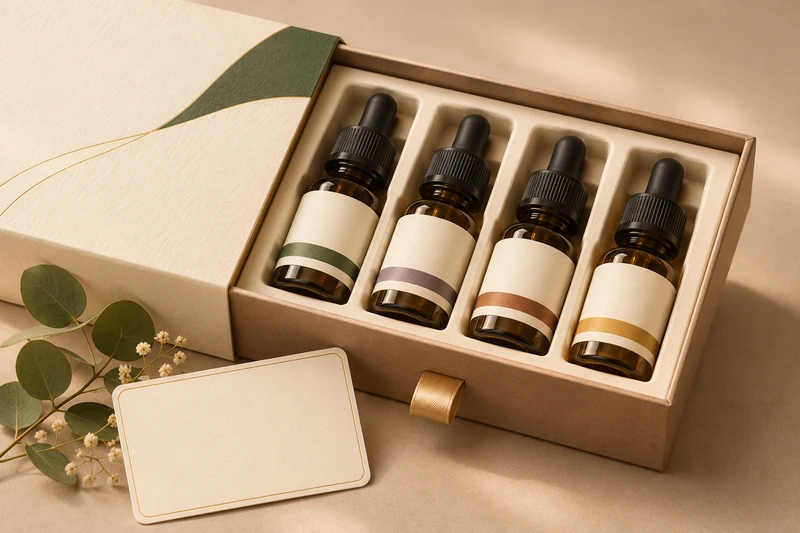
Essential oil boxes turn a group of individual bottles into one considered retail or gifting product. For a multi-bottle collection, the outer box needs to present each oil clearly, keep bottles in separate positions and allow the recipient to remove one bottle without disturbing the rest.
For brand owners, retailers and e-commerce teams in the United Kingdom, the best starting point is the filled bottle rather than a standard box size. Bottle diameter, total height including the dropper, label position and the number of oils in the set all affect the insert and outer pack. XGolden Print designs and produces custom paper packaging boxes, gift packaging, labels and stickers, supporting the brief from structural design and material selection through to artwork, fitted inserts, printing, finishing and sample approval before production.
When individual oils become a gift collection
A single essential oil bottle may need only a label and a simple secondary carton. A collection has a different job: it should make several bottles feel like one product range, whether it is sold as a discovery set, seasonal gift, starter collection, corporate gift or event favour.
Essential oil gift boxes can suit sets containing oils with different names, blends or intended moments of use. The box should help the buyer understand the collection without making unsupported claims about the contents. Product names, scent descriptions supplied by the brand, bottle volume, directions, ingredient information and required warnings are content decisions for the brand to provide in its artwork.
A well-planned set can improve presentation at several points:
- Retail shelves: the front panel identifies the collection while a side, back or inside panel carries the required range information.
- Online orders: a gift-ready outer presentation can give the recipient a more deliberate opening experience after transit packaging has been removed.
- Gift sets: a coordinated box, insert and printed information card can make the selection feel complete.
- Corporate and event gifting: a shared outer design can carry event or campaign branding while each bottle remains individually named.
- Product launches and limited collections: an outer box can bring together several scents or variants that may also be sold separately.
The gift box is secondary packaging. It does not replace the primary glass bottle, cap, dropper assembly or any contact layer that the oil itself requires. Nor should retail essential oil boxes be treated as a complete transport-protection system. Brands should plan suitable outer shipping protection separately for dispatch, particularly where filled glass bottles are sent through an online-order fulfilment process.
Bottle count and closure height shape the box
The required bottle count is the first structural decision, but it is not enough to say “a six-bottle set”. Two bottles with the same nominal volume can differ in width, shoulder profile and closure height. A pipette dropper, tamper-evident feature, spray top or screw cap may change the clearance needed above and around the bottle.
Before specifying essential oil boxes, measure a completely filled and closed example of every bottle in the range. Where bottles vary, provide the largest diameter and tallest overall height, not only the dimensions of the shortest or smallest container.
Record the following in the packaging brief:
- Bottle diameter or width at its widest point.
- Overall bottle height, measured from the base to the top of the closed dropper or cap.
- Bottle shape, including round, square, rectangular or shouldered forms.
- Closure type and any parts that project beyond the glass.
- Bottle weight when filled, plus the combined weight of the full set.
- Number of bottles in each set configuration.
- Whether bottles are all identical or include different sizes and closure heights.
- Any additional items, such as a card, leaflet, measuring accessory or branded message.
A box that is too shallow can press against droppers when closed. A box with oversized compartments may let bottles shift and make the set look untidy after handling. Both issues are resolved through the actual bottle dimensions, the intended insert construction and a physical sample review rather than assumptions based on a generic bottle category.
The exterior dimensions should follow the interior layout, not the other way round. For example, a compact row of bottles may create a long, narrow gift box, whereas a grid layout may offer a more balanced shelf-facing format. The preferred arrangement depends on the number of oils, the opening style, the space needed for artwork and how the recipient will access each bottle.
| Essential oil set use | Packaging requirement | Suitable planning option |
|---|---|---|
| Small discovery collection | Clear presentation of a limited number of bottles | A compact insert with one position per bottle and space for a small information card |
| Larger retail range | Easy browsing of several named oils | A grid or row layout with readable labels and a clear outer range name |
| Premium gift collection | A deliberate unboxing sequence | A rigid gift box with fitted insert, coordinated artwork and optional printed card |
| Corporate or event gifting | Shared campaign identity with individual product names | Branded outer box, separate bottle positions and a supplied message or information insert |
| Online gift order | Presentable secondary packaging after shipment | Retail or gift box planned alongside a separate dispatch-protection process |
Material choice also needs to serve the application. The board, outer construction, insert material and finish should be considered with the filled-set weight, intended handling and desired presentation in mind. XGolden Print can support material selection, but the final construction and suitability should be confirmed for the individual project.
Separate positions and readable oil names
Each bottle in a multi-oil collection needs a distinct position. Separate cavities help maintain the visual order of the set, reduce bottle-to-bottle contact within the presentation box and make individual removal easier. The appropriate insert layout depends on the bottle profile, total weight and opening method.
A practical insert should support access as well as display. If the fit is very tight, the recipient may struggle to grip a short bottle or may pull on its dropper. If it is too loose, bottles can appear misaligned. Consider how fingers will reach the bottle: a cut-out, finger notch or other access feature may be worth discussing during structural design.
The front-facing orientation of labels is equally important. If the bottles are intended to be seen when the box is opened, decide which direction each bottle should face in its compartment. A round bottle may rotate freely unless the insert shape and fit help guide its position. For a set where names are part of the experience, a layout that presents each label consistently is usually more useful than simply fitting the maximum number of bottles into the smallest footprint.
Check the following before artwork is finalised:
- Are the bottle labels visible immediately on opening, or is the outer box expected to carry the main product information?
- Does each compartment accommodate the same label-facing direction?
- Is there enough room around the bottles to lift them out without scraping labels?
- Are variant names legible at the intended retail viewing distance?
- Will a bottle label be obscured by the insert edge?
- Is the collection arranged in a sequence, such as daytime to evening, floral to woody, or by another brand-defined grouping?
- Does the outer box distinguish the set from individual oils clearly?
If labels and stickers are part of the project, XGolden Print can specify them for bottles, jars, boxes and bags with custom dimensions, shapes and agreed roll or sheet formats. For bottle labels, provide the container dimensions, available label panel, application method and artwork orientation. Confirm that the label format works with the actual bottle surface and filling workflow; this should not be assumed from a digital bottle image alone.
A drawer-box style for dropper-bottle sets
A drawer box can work especially well for an essential oil gift set because it separates the outer sleeve from the bottle tray. The sleeve provides a broad branded surface, while the drawer can reveal all bottles together as it is pulled open. It also gives the brand a natural place to add an information card above, below or alongside the bottles, subject to the final layout.
The DB-13 essential oil bottles drawer box is an existing XGolden Print drawer-box example relevant to dropper-bottle packaging. It is a useful starting point when considering this opening style, not a fixed specification for every collection. The precise bottle count, box size and insert layout must be developed from a new brief and checked with a sample.
Drawer-style essential oil boxes are particularly worth considering when the opening experience is part of the gift value. A recipient can pull out the tray, view the whole range and remove bottles one at a time. This style may also help a retailer display the collection as a premium item, provided the external artwork communicates the range clearly before opening.
Other gift box formats can be appropriate too. A rigid box may suit a presentation-led set, while a magnetic closure box or lid-and-base box may support a different opening sequence. The most suitable structure depends on bottle dimensions, set weight, desired retail appearance and the role of the box in the recipient experience. Explore XGolden Print’s gift packaging options where a collection needs coordinated presentation beyond a standard outer carton.
Do not choose a drawer box purely for appearance. The drawer needs enough structural consideration for the filled tray, the insert and the intended handling. Likewise, decorative finishes should support clear brand recognition and artwork legibility rather than obscure small product names or critical information.
Cards and product instructions supplied by the brand
A multi-bottle collection often needs more explanation than an individual essential oil. A card, folded leaflet or printed panel can introduce the collection, explain the brand’s own usage directions and identify individual oils. It may also be useful where the bottle label cannot comfortably accommodate all the brand-supplied copy.
Decide early whether the printed information is:
- placed in a dedicated compartment;
- laid flat above the insert;
- positioned beneath the bottle tray;
- attached to the inside of the lid or sleeve;
- supplied as a separate loose item for packing.
This decision affects the box depth, insert shape and packing sequence. A card placed on top of bottles can change the first visual impression; a card stored beneath the insert creates a later reveal but may be less convenient for everyday reference. There is no universal answer—the intended opening experience should guide the choice.
For United Kingdom retail or online presentation, make sure artwork supplied for the essential oil box and any accompanying card is ready for the destination and audience. This includes confirming the language, product names, variant details and any brand-required information before approval. XGolden Print can provide artwork support, but the brand remains responsible for supplying and approving its content.
Avoid treating the outer box as the only source of identification. Each bottle should remain identifiable when removed from the set. Conversely, do not rely solely on small bottle labels when the outer pack must communicate the collection on a shelf, in a product photograph or when given as a gift.
Checking a complete filled-bottle sample
A complete filled-bottle sample is the most useful checkpoint for custom essential oil boxes. Review the actual bottles, closures, labels, insert, cards and outer box together. A flat artwork proof cannot show whether a dropper clears the lid, whether labels face forward, or whether an individual bottle can be removed comfortably.
A sample review should assess the set in the same condition in which it will be packed and presented. Include each bottle variant, especially if closure heights or labels differ. If the project includes a card, leaflet or promotional insert, include the final or representative version at the intended thickness.
Use this checklist during review:
- Confirm every filled bottle sits in its intended compartment.
- Check that dropper tops and caps have sufficient clearance when the box closes.
- Open and close the box repeatedly to assess practical access and presentation.
- Remove bottles from each position, including those nearest the edges and corners.
- Check that labels face the planned direction when bottles are inserted.
- Review whether the insert edges cover important bottle-label information.
- Verify that the card or leaflet fits without bowing, crushing or disrupting the layout.
- Inspect the exterior for consistent product naming, variant information and artwork placement.
- Consider the packed-set weight for retail handling and gifting.
- Plan separate outer protection for shipping the finished product, where needed.
Sample approval before production gives the project team a chance to correct the layout, dimensions or artwork before committing to production. It is also the point to confirm project-specific material suitability, finish choices, insert details, order quantity, pricing, schedule and delivery arrangements.
For a bespoke collection, XGolden Print can bring together structural design, materials, printing, finishing and fitted inserts as part of the packaging development process. Our 27 years of experience, 15,000 square metre factory, 500+ employees and 10M+ production capacity provide relevant production context, but the final essential oil packaging specification should always be based on the individual bottles and brief.
To discuss custom essential oil boxes and custom box options, send XGolden Print the filled-bottle dimensions and weights, bottle count, closure details, intended insert layout, artwork, quantity, required delivery date and delivery destination.
