
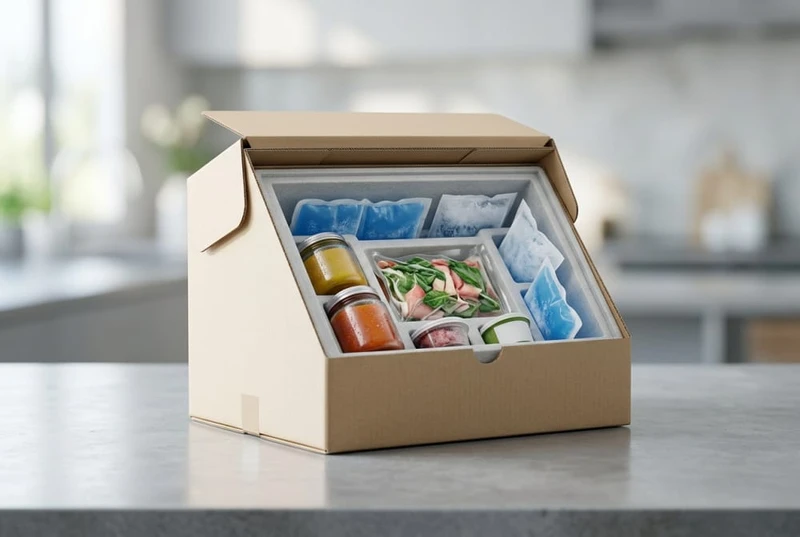
In the United Kingdom, cold-chain food packaging has moved from being a back-room logistics detail to a front-line business decision. Retailers, online grocers, meal subscription brands, dairies, and frozen food manufacturers all face the same reality: one temperature failure can turn good stock into waste, trigger customer complaints, damage compliance records, and reduce confidence in the brand. For chilled and frozen products, the outer box is not just a shipping shell. It is part of a full protective system that must work with insulation, refrigerants, internal fitments, labels, and fulfilment speed.
The right strategy starts with product temperature range, journey length, handling conditions, and delivery format. A same-day chilled grocery order in London needs a different packaging build from a frozen prepared meal parcel going from Birmingham to Inverness. A dairy shipment moving through a regional distribution hub near Manchester has different risk points from a direct-to-consumer meal kit leaving a warehouse outside Bristol. In each case, the package needs to support thermal control, product stability, efficient packing, and a reliable customer experience.
For brands seeking tailored protection, custom-format shipping boxes for chilled and frozen foods can help align board grade, dimensions, print, and pack-line performance with real transport conditions. Clear pack communication also matters, which is why many operators combine box design with durable custom sticker solutions for cold-chain handling to improve receiving, storage, and expiry control. The goal is not simply to ship cold products. It is to ship them consistently, commercially, and at scale across the UK.
How chilled foods, frozen foods, and short-delivery formats differ
Chilled foods, frozen foods, and short-delivery formats may all sit within temperature-sensitive distribution, but they behave very differently in transit. Chilled food usually has a narrower safe range and can be especially vulnerable to time-temperature abuse. Fresh dairy, meal kits, fresh meat, ready-to-cook ingredients, and convenience items often need to stay within refrigerated conditions while avoiding freezing damage. Frozen foods usually have more thermal resilience over short periods, but they still require strong protection against thawing, refreezing risk, condensation, and freezer burn.
Short-delivery formats, including local grocery drops, urban rapid delivery, and same-day dispatch, introduce another layer of complexity. Because transport windows are shorter, some businesses assume they can reduce packaging performance. In practice, this is only partly true. The shorter route may lower refrigerant demand, but rapid fulfilment often means higher order variability, mixed product baskets, courier hand-offs, and less controlled vehicle environments. A chilled order may sit in a rider bag, a van cage, or a flat hallway for an unexpected period. The packaging still has to tolerate real-world delay.
In UK cities such as London, Leeds, Glasgow, and Liverpool, urban delivery density can support shorter lead times, yet congestion and failed first-time delivery rates can quickly consume that time advantage. Meanwhile, routes into coastal and rural areas from hubs near Felixstowe, Southampton, or East Midlands Gateway may expose parcels to longer dwell periods and more transfer points. For this reason, packaging design should be based on actual lane mapping, not best-case assumptions.
For chilled foods, common priorities include maintaining 0°C to 5°C or another product-specific range, preventing leaks, separating wet and dry components, and preserving product presentation. For frozen foods, priorities often include keeping the payload below target thresholds, limiting cold loss during picking and final-mile exposure, and using internal layouts that stop packs from shifting as dry ice or gel systems settle. For short-delivery models, packaging needs to reduce complexity at the packing bench, keep cube efficiency high, and maintain protection without making the parcel too bulky or too costly.
| Format | Typical temperature target | Typical delivery window | Main packaging concern | Common refrigerant approach | Operational note |
|---|---|---|---|---|---|
| Chilled dairy | 2°C to 5°C | 24 to 48 hours | Temperature drift and crush risk | Gel packs | Needs moisture-resistant inner setup |
| Fresh meal kit | 0°C to 5°C | 24 to 36 hours | Mixed contents and separation | Gel packs with liners | Fast packing is critical |
| Frozen prepared meals | Below -18°C target | 24 to 72 hours | Thawing during dwell time | Dry ice or high-load gel system | Requires stronger insulation |
| Rapid grocery delivery | Product dependent | 1 to 6 hours | Handling variation | Light gel support or reusable totes | Low complexity matters |
| Wholesale chilled foods | 0°C to 5°C | Same day to next day | Stacking strength | Vehicle refrigeration with box support | Outer box may be secondary |
| Frozen retail replenishment | Below -18°C | 1 to 3 days | Product stability | Insulated shipper with refrigerant | Transit testing is essential |
The table shows that packaging choices depend on a combined view of product sensitivity, transit time, and fulfilment model. Brands that treat all cold-chain products the same often overpack low-risk orders and underprotect high-risk ones. The more precise approach is to build packaging profiles by SKU family, lane, and season.
Matching outer box strength with insulation and inner packing needs
A cold-chain shipping box performs best when the outer board, insulation layer, and internal fitments are designed as one system rather than separate purchases. Outer box strength matters because cold shipments often carry unusual weight for their size. Gel packs, liners, dairy bottles, and frozen trays can create concentrated loads, while moisture, condensation, and warehouse stacking place additional stress on the corrugated structure. If the box fails under compression or softens from moisture, thermal protection is not the only issue; leakage, damage claims, and pallet instability follow quickly.
In practice, the right board grade depends on product mass, box footprint, expected stacking height, transport method, and whether the shipper is going through parcel networks or dedicated grocery distribution. Double-wall corrugated board is common for heavier chilled or frozen formats, but not every parcel needs the same construction. Over-specifying the board can raise costs and reduce packing efficiency. Under-specifying it can lead to burst seams, corner collapse, or warped lids that increase air exchange.
Insulation selection then changes the loading pattern. Wool liners, paper-based insulation, foam systems, reflective liners, and moulded inserts each influence internal dimensions, packing speed, condensation control, and disposal experience. Inner fitments also matter. Dividers can keep dairy pots upright, meal kit ingredients separated, and frozen trays stable. Pads or wraps may absorb moisture, while top-fill pieces can reduce empty headspace that otherwise accelerates thermal loss.
One common mistake is selecting insulation first, then trying to fit it into a generic outer carton. A better approach is to define pack-out geometry from the product inward: product footprint, refrigerant placement, insulation thickness, void fill need, then carton dimensions and board grade. This avoids wasted space and improves temperature retention without making the parcel unnecessarily large. It also helps at busy fulfilment benches where seconds per order affect labour cost.
In our own workshop environment, technological capability matters here. Advanced converting equipment allows tighter control over box dimensions, slotting accuracy, and repeatability, which is especially useful when liners and inserts must fit consistently. Material handling and inspection technology also support more dependable performance from run to run, reducing variation that could otherwise affect thermal packing integrity.
| Outer box factor | Why it matters | Typical risk if ignored | Best fit for chilled | Best fit for frozen | Comment |
|---|---|---|---|---|---|
| Board grade | Supports weight and stacking | Collapse or seam split | Single or double wall by load | Usually double wall for heavier packs | Match to distribution route |
| Moisture resistance | Condensation weakens fibre | Soft walls and pallet failure | High importance | High importance | Essential in humid conditions |
| Box size accuracy | Improves insulation fit | Air gaps and thermal loss | Critical | Critical | Custom sizing reduces voids |
| Corner strength | Protects stacking load path | Crush damage | Important | Important | Helpful for courier networks |
| Closure design | Keeps parcel secure | Opening in transit | Important | Important | Tape and lock style matter |
| Internal fitments | Control movement and separation | Leaks and breakage | Very important | Very important | Supports speed and protection |
The explanation from this comparison is simple: cold-chain packaging works best when mechanical strength and thermal performance are designed together. Outer box strength cannot compensate for poor insulation layout, and excellent insulation cannot rescue an underbuilt carton.
Packaging configurations for meal kits, dairy goods, and frozen prepared foods
Meal kits, dairy products, and frozen prepared foods represent three of the most common but operationally different categories in UK cold-chain fulfilment. Meal kits often combine chilled proteins, vegetables, sauces, recipe cards, and ambient items in one order. This means the package must separate categories, support easy picking, and prevent contamination or crush damage. Many meal kit brands prefer modular internal layouts, where ingredients are grouped by meal or by temperature sensitivity. A right-sized corrugated outer box combined with insulation and compartmentalised fitments helps keep operations organised and the customer unboxing experience clear.
Dairy products require a different emphasis. Milk bottles, yoghurt pots, dessert cups, cheese, and cultured products can be dense, slippery, and sensitive to both impact and upright positioning. Leaks create hygiene and reputational issues fast. For dairy, the best setup often includes a stable base, moisture-conscious fitments, strong side-wall support, and labels that remain readable in condensation-prone settings. Products moving through supermarket distribution around hubs such as Daventry or Wakefield may prioritise stacking and shelf-ready transfer, while direct delivery dairy brands need stronger parcel-ready shippers.
Frozen prepared foods, including ready meals, bakery items, and bulk freezer packs, generally need the most robust thermal design. The package must retain low temperatures through longer routes, especially when going north from central England to Scotland or to more remote parts of Wales and Cornwall. Frozen products also benefit from close-fitting interior geometry to minimise dead air volume. In some cases, packers use top and side refrigerant placement to create more even hold times, though the correct arrangement depends on product density and line speed.
Manufacturing capability becomes especially relevant in these categories. A supplier with flexible production can support short-run trials for new meal kit formats, medium runs for regional dairy launches, and high-volume output for national frozen brands without forcing one standard solution onto every account. The ability to handle both small-batch custom work and larger production schedules helps brands manage seasonal peaks, promotions, and new product introductions more smoothly.
| Product type | Typical packaging layout | Main internal feature | Main box requirement | Common issue | Recommended focus |
|---|---|---|---|---|---|
| Meal kits | Mixed-compartment insulated shipper | Dividers and grouped ingredients | Fast assembly and clear fit | Cross-contact and crush | Organisation and speed |
| Dairy bottles | Upright support with absorbent layer | Bottle separators | Strong vertical compression | Leakage | Stability and moisture control |
| Yoghurt and desserts | Tray-set with top cushion | Nest-fit insert | Protection from top load | Lid damage | Product restraint |
| Frozen ready meals | Tight insulated shipper | Close cavity placement | Low air volume | Partial thawing | Thermal retention |
| Frozen bakery | Layered inner pads and outer shipper | Tray spacing | Shock resistance | Cracking and crumbs | Product presentation |
| Cheese assortments | Compact chilled parcel | Moisture barrier and separators | Right-sized dimensions | Odour transfer | Segregation and airflow control |
This table highlights how each product family drives a different pack-out logic. The box style, internal structure, and insulation choice should be product-led rather than chosen from a generic catalogue.
Using stickers for handling instructions, storage information, and expiry control
Stickers play a practical role in cold-chain packaging that is often underestimated. In chilled and frozen logistics, labels are not just branding elements. They communicate handling instructions, storage temperatures, batch identity, date coding, and receiving priorities. If a parcel reaches a depot in Milton Keynes, a retail back room in Sheffield, or a customer doorstep in Edinburgh, the sticker system helps everyone know what the package is, how it should be handled, and how quickly it needs attention.
Handling labels can include “Keep Refrigerated”, “Keep Frozen”, “Perishable”, “This Way Up”, and customer-facing delivery guidance. Storage note stickers can remind staff to transfer products immediately to chilled or frozen storage and can identify packs that include dry ice or cooling media. Expiry control stickers help with FEFO processes, making it easier for warehouse teams and store staff to rotate stock correctly. For direct-to-consumer brands, stickers can also guide the customer after delivery, reducing misuse and complaints.
However, not every sticker material performs well in cold and damp conditions. Adhesive failure, smudging, and edge lift are common problems when labels are applied to cold surfaces or exposed to condensation. That is why material and adhesive choice must align with the application environment. A dispatch label on a dry outer carton may need a different construction from a date-control label applied near a chilled liner or a moisture-prone inner tray.
Service capability is important here. A responsive packaging partner can help align sticker formats, print legibility, and application methods with the customer’s actual workflow, rather than supplying a one-size-fits-all label. Good support includes sampling, revision speed, and practical guidance on where label use may interfere with sealing, scanning, or temperature-sensitive materials.
| Sticker type | Main purpose | Where applied | Cold-chain risk addressed | Material consideration | Operational benefit |
|---|---|---|---|---|---|
| Handling sticker | Warns carriers and receivers | Outer box | Mishandling | Readable print on corrugated board | Improves parcel treatment |
| Storage note sticker | Gives temperature instruction | Outer or inner pack | Delay in cold storage | Moisture-resistant face stock | Faster receiving action |
| Expiry control sticker | Shows date or batch | Inner case or unit pack | Rotation errors | Clear print and stable adhesive | Supports FEFO |
| Orientation sticker | Keeps liquids upright | Outer carton sides | Leakage | High-contrast design | Reduces spillage risk |
| Courier alert sticker | Flags urgency | Shipping face | Dwell time | Durable during abrasion | Highlights perishability |
| Consumer instruction sticker | Explains immediate storage after receipt | Top flap or insert | Post-delivery spoilage | Easy-to-read finish | Reduces avoidable complaints |
The explanation from this table is that sticker systems are part of temperature risk management. A well-designed label programme improves compliance, operational clarity, and customer handling without adding major cost.
Shipping-ready packaging for online grocery and direct-to-consumer delivery brands
Shipping-ready packaging is especially important for online grocery and direct delivery operations because the pack often functions as both the warehouse shipping unit and the final customer-facing presentation. There may be no repacking stage. That means the box must survive conveyor handling, van loading, hand delivery, and doorstep exposure while still protecting chilled or frozen contents.
For online grocery brands serving major UK population centres such as London, Birmingham, Manchester, and Newcastle, shipping-ready design usually emphasises dimensional efficiency, quick closure, and dependable labelling surfaces. The package must fit shelf and bench operations upstream, then integrate with parcel or van delivery downstream. For direct-to-consumer frozen brands, the shipping-ready shipper often includes branded print, reinforced handles or lift zones, thermal inserts, and a simple unboxing flow that reassures customers the product has been packed professionally.
One of the most useful strategies is to reduce the number of separate components that the packing team must assemble. If the outer box arrives pre-configured for a known liner or insert format, the picker spends less time improvising. This can improve order accuracy during peak periods such as Christmas, summer barbecue promotions, and January healthy eating campaigns. Right-sized custom boxes also reduce void space, helping both thermal performance and transport efficiency.
In the UK market, sustainability expectations are also shaping shipping-ready design. Buyers increasingly ask whether insulation is recyclable, whether the corrugated content includes recycled fibre, and whether the pack can be flattened easily by households. The best answer is not always the lightest or the most paper-heavy option; it is the one that balances thermal reliability, ease of disposal, and actual end-of-life behaviour in local waste systems.
This line chart illustrates a realistic upward demand trend in UK cold-chain packaging, driven by e-commerce grocery, meal subscriptions, premium chilled delivery, and stronger compliance expectations. By 2026, many brands are expected to place more emphasis on traceability, recyclable formats, and packaging that supports mixed-temperature order fulfilment.
Where packing speed and thermal protection conflict in real operations
One of the most common tensions in cold-chain packaging is the trade-off between fulfilment speed and thermal protection. In theory, the most thermally robust pack may include thick insulation, multiple refrigerant layers, top pads, internal separators, and exact-fit components. In practice, every extra part can slow down the packing line, increase training requirements, and raise the chance of assembly errors. For high-volume grocery dispatch or fast-moving meal kit operations, complexity can become the enemy of consistency.
Real projects often show this conflict in several places. First, pickers may skip or misplace internal fitments when order pressure rises. Second, a thermally optimised box may be too slow to erect or seal compared with a simpler format. Third, refrigerants that deliver excellent hold time may be awkward to load in a fast-paced environment. Fourth, a highly tailored pack can struggle when order contents vary beyond the expected SKU mix.
Operations in regional hubs such as Northampton, Doncaster, and Rugby often need packaging systems that maintain protection while allowing simple standard work. That may mean using fewer but more intelligently designed parts. It may also mean creating two or three standard shipper families rather than dozens of micro-configurations. The best solutions reduce decision-making at the bench. If the packer can identify the right format quickly and complete it with minimal handling steps, throughput and thermal consistency both improve.
Case work across the UK frequently shows that moderate optimisation can outperform extreme optimisation. A slightly less insulated but much more repeatable packing process may deliver better real-world results than a highly engineered pack that staff struggle to assemble correctly during peak demand. This is why pilot testing should include labour observation, error rates, and assembly timing rather than temperature data alone.
The bar chart shows relative demand by sector. Online grocery and frozen meals are among the strongest drivers of custom cold-chain packaging demand in the UK, but meal kits and dairy continue to require highly specific solutions because of their product diversity and handling sensitivity.
Testing checkpoints before launching a cold-chain packaging programme
No cold-chain packaging programme should launch on assumptions alone. Testing is the stage where design intent meets real transport conditions. At a minimum, brands should test for thermal hold performance, box integrity, compression strength, drop resistance, moisture exposure, and pack-out repeatability. Testing should reflect seasonality as well. A pack that succeeds in February may not perform the same way in July, especially on routes through warmer urban depots or exposed last-mile networks.
Thermal testing should simulate realistic ambient profiles, dwell times, and loading patterns. If a parcel is likely to move from a chilled pick area to an ambient sortation area, then into a van and onto a doorstep, the test profile should reflect that sequence. Mechanical testing should include not only isolated drops but also stack pressure and vibration, especially for mixed-content parcels. It is also wise to test the worst-case combinations: maximum payload weight, longest route, and the highest expected ambient temperature band.
Brands should also run packing-line trials. These identify whether the packaging can be assembled quickly, whether labels scan correctly, whether inserts shift, and whether staff make avoidable mistakes. A technically strong design that fails during daily operations is not ready for launch. Customer open-and-store tests can be valuable too, particularly for direct delivery brands where the consumer must interpret the package correctly after receipt.
By 2026, testing expectations in the UK are likely to strengthen further as sustainability claims, EPR-related packaging scrutiny, and retailer performance standards become more demanding. More buyers will ask for evidence that the packaging works thermally, performs operationally, and aligns with waste reduction targets. Documentation and version control will therefore matter as much as the physical pack itself.
This area chart reflects the rising shift toward recyclable or lower-plastic cold-chain packaging formats in the UK. The trend is being shaped by retailer policy, consumer preference, procurement standards, and packaging reform discussions that are expected to intensify through 2026.
| Testing checkpoint | What to measure | Why it matters | When to run it | Common failure | Launch decision use |
|---|---|---|---|---|---|
| Thermal hold test | Internal temperature over time | Confirms product safety window | Prototype and final validation | Insufficient hold duration | Approves refrigerant and insulation |
| Compression test | Stack resistance | Protects warehouse and transit loads | Before full production | Corner collapse | Approves board grade |
| Drop test | Impact resistance | Reflects courier handling | Prototype stage | Leaks or seam split | Approves closure and fitments |
| Moisture exposure | Board and label performance | Cold packs create condensation | During material selection | Softening and label peel | Approves coatings and sticker stock |
| Packing-line trial | Assembly time and error rate | Shows operational fit | Pilot run | Missed component steps | Approves work instructions |
| Customer receipt test | Condition on arrival | Validates final-mile experience | Pre-launch live trial | Confusing storage instructions | Approves consumer communication |
The explanation here is that testing should connect product safety, packaging durability, and operational practicality. Launching without all three creates avoidable risk.
What to assess in a supplier for custom chilled-logistics packaging
Choosing a supplier for custom chilled-logistics packaging is about more than unit price. A useful supplier should understand temperature-sensitive distribution, corrugated performance, label application, and the pace of fulfilment operations. They should be able to discuss route profiles, material options, print constraints, production planning, and quality control in practical terms. In the UK market, where lead times, retailer requirements, and sustainability pressures vary by sector, a supplier needs to help customers make decisions that hold up in real shipping conditions.
Technological capability is one of the first things to assess. A packaging workshop equipped with modern machinery can usually offer better dimensional consistency, cleaner converting, and more reliable repeatability across runs. For chilled logistics, that matters because liner fit, closure performance, and sticker placement all depend on accuracy. Manufacturing capability comes next. A supplier should be able to support both smaller customised batches and larger production volumes without compromising quality checks. That flexibility is valuable for product launches, regional pilots, and national scale-up.
Service capability is just as important. Many cold-chain packaging projects need revisions after transit tests or pilot launches. A strong supplier responds quickly, helps interpret results, and adjusts specifications efficiently. Clear communication on lead times, sampling, material alternatives, and inspection standards can save weeks during rollout. Final inspection discipline also matters, since defects in boxes or stickers can multiply quickly when hundreds or thousands of chilled parcels are being assembled every day.
UK buyers should also look for local-market awareness. A supplier that understands how parcels move through Heathrow-linked logistics, Midlands distribution corridors, Scottish delivery lanes, or supermarket networks around the M62 can give more useful recommendations than one offering only generic export packaging advice. They should be comfortable discussing 2026 trends as well: recyclable insulation, lower-waste configurations, digital traceability support, and packaging choices influenced by changing environmental policy and retailer scorecards.
This comparison chart shows the practical capability areas buyers often use to judge a cold-chain packaging supplier. Quality control, technical precision, and sector understanding typically rank highest because packaging errors in chilled logistics create immediate commercial consequences.
UK market context, industries, and practical applications
The UK cold-chain packaging market is being influenced by several overlapping forces: growth in online grocery, consumer demand for convenience, pressure to reduce food waste, and closer scrutiny of packaging sustainability. Trade hubs and logistics corridors shape these decisions. Businesses moving goods through London and the South East may focus on high-density delivery and premium presentation. Operations around Birmingham and the Midlands often prioritise centralised fulfilment and national reach. Ports such as Southampton, Felixstowe, and Liverpool can influence import-related packaging needs, particularly where chilled foods enter broader domestic distribution.
Industries using cold-chain packaging extend beyond mainstream food retail. They include speciality food clubs, dairy subscription services, chef-prepared meal companies, sports nutrition brands, pet food suppliers with frozen lines, and healthcare-adjacent nutrition shipments. Each sector has slightly different expectations for branding, documentation, and delivery promise. Applications range from business-to-business case supply to fully branded direct-to-consumer parcels designed for doorstep arrival.
Case experience across these industries usually points to the same lesson: success comes from matching packaging detail to operational reality. A premium artisan dairy producer in Somerset may need a smaller run of customised boxes with strong brand presentation and reliable moisture performance. A frozen prepared meal company shipping nationally from the Midlands may need robust volume production, standardised box families, and tight dimensional control for automated packing benches. A meal kit brand launching in London and expanding to Bristol and Manchester may need phased testing and flexible reorder support.
Buying advice, local sourcing questions, and company fit
When buying cold-chain packaging in the United Kingdom, start with the basics: what must the product temperature do, for how long, through which routes, and under what handling conditions? Then ask whether the proposed box system improves both protection and packing speed. If the supplier cannot explain why a board grade, insulation thickness, or internal arrangement is suitable, the solution is probably not mature enough. Ask for samples, test plans, and evidence of production consistency.
Local sourcing has practical value. Shorter lead times, easier communication, and more relevant knowledge of UK logistics conditions can reduce rollout risk. Buyers should ask where the supplier’s production strengths lie, how they manage quality inspection, whether they can support sticker and box requirements together, and how they handle changes after testing. A supplier with professional production teams and attention to detail from material selection to final inspection is usually better placed to support chilled logistics than one focused only on generic carton output.
Our company approach fits this need by combining advanced workshop equipment with a professional production team, allowing us to support high-quality paper boxes, gift-style presentation formats where appropriate, stickers, and practical packaging solutions for demanding shipping uses. We place strong emphasis on material choice, converting accuracy, and final inspection, so customers receive packaging that matches their operational requirements rather than a generic stock item. We also support both smaller customised quantities and larger-volume production, which is helpful for pilot launches, regional testing, and scaled national supply within the UK market.
Frequently asked questions
What is the main difference between chilled and frozen shipping boxes?
Chilled boxes are usually designed to maintain refrigerated conditions for a defined short-to-medium transit period, while frozen boxes require stronger thermal retention to keep products below frozen thresholds for longer or more variable journeys.
Can one box format work for meal kits, dairy, and frozen meals?
Sometimes, but usually not well. These categories have different weight distribution, leak risk, and thermal needs. Most brands benefit from at least two or three packaging families.
Are stickers really that important in cold-chain logistics?
Yes. Handling, storage, and expiry stickers help reduce receiving delays, stock rotation mistakes, and customer confusion after delivery.
How should UK brands prepare for 2026 packaging trends?
Focus on recyclable or lower-waste materials where performance allows, stronger test documentation, closer alignment with environmental policy, and packaging formats that support traceability and efficient fulfilment.
What should I ask a supplier before ordering?
Ask about board specification, insulation compatibility, moisture performance, production flexibility, quality control, lead times, and support during transit testing and rollout.
Why choose custom packaging instead of stock boxes?
Custom packaging reduces void space, improves insulation fit, supports branding, and often speeds packing because the format is designed around the actual product and shipping process.
