
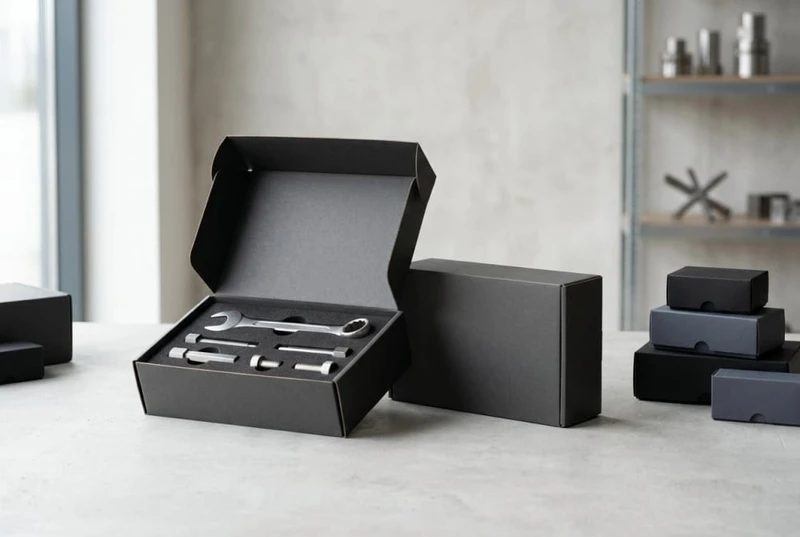
For tools and hardware, packaging has to do far more than hold a product. In the United Kingdom market, buyers expect boxes that protect metal parts from damage, keep kits complete, support warehouse identification, and present a reliable brand image across industrial supply chains. Whether products move through Birmingham distributors, London retail networks, Manchester e-commerce fulfilment, or export routes through Felixstowe and Southampton, the right packaging structure reduces claims, supports stock accuracy, and helps professional buyers trust what they receive.
Custom boxes are especially valuable for industrial tools, maintenance parts, fixings, replacement components, and mixed-product kits because these categories face very different handling conditions. A single spanner in a retail setting may need shelf impact and anti-tamper features, while a multi-part maintenance kit for B2B delivery may need layered inserts, barcode stickers, transit strength, and fast identification in warehouse bins. Businesses looking for durable, well-finished custom box solutions often find that structural decisions have a direct effect on picking speed, returns, and repeat orders.
This guide explains how custom packaging improves both protection and commercial presentation for hardware lines in the UK. It covers market expectations, key product formats, purchasing advice, sector applications, visual positioning, and practical design choices for industrial distribution and retail display. It also includes data tables and charts to help compare options in a realistic way.
Direct answer: why custom packaging matters for industrial tools and hardware
Custom packaging improves tool and hardware performance in the market by solving three problems at the same time: protection, organisation, and presentation. Metal products are heavy, dense, and often sharp-edged, so generic packaging can collapse, scuff, or allow internal movement. That leads to damaged finishes, mixed components, incomplete kits, and poor shelf perception. In B2B channels, these issues are not seen as minor cosmetic faults. They are often read as signs of weak process control.
In the United Kingdom, many industrial buyers judge packaging as part of the supplier’s operating standard. If replacement parts arrive in inconsistent cartons, if labels are hard to scan, or if kits contain loose items without inserts, purchasing teams may assume that quality assurance is equally inconsistent. By contrast, a well-designed packaging system signals dependable counting, stable manufacturing, and easier onward handling.
Customised boxes also allow businesses to create a practical range architecture. A hand tool line can use one visual language, one barcode logic, one family of insert depths, and one case-pack system across multiple SKUs. That consistency helps wholesalers, merchants, and service engineers manage stock more effectively. It is also one reason many firms source matching printed boxes and custom packaging stickers together, so every unit, carton, and shelf location follows the same identification method.
Market context in the United Kingdom
The UK hardware and industrial supply market combines retail visibility with strong B2B distribution requirements. Tool brands sell through trade counters, builders’ merchants, specialist engineering suppliers, maintenance contractors, automotive channels, and e-commerce platforms. Each route places different demands on the pack.
In London and the South East, presentation can matter more because retail competition is high and premium positioning needs to be obvious from the shelf. In the Midlands, where logistics, warehousing, and manufacturing remain strong, stackability, case efficiency, and barcode clarity are often prioritised. In port-linked trade flows through Felixstowe, Liverpool, and Southampton, packaging also needs to survive container handling, pallet movement, and long-distance distribution with minimal repacking.
UK buyers are also increasingly attentive to sustainability, but in practical terms. They do not simply want lighter board or more recycled content if it compromises durability. Most procurement teams want a balance: strong outer packaging, right-sized inserts, reduced void space, and more efficient pallet density. From 2026 onward, this balance is likely to become even more important as policy pressure, reporting expectations, and warehouse automation all push packaging toward smarter, traceable, lower-waste designs.
| UK channel | Main packaging priority | Typical product types | Common risk | Packaging response | Commercial effect |
|---|---|---|---|---|---|
| Builders’ merchants | Fast identification | Hand tools, fasteners | Wrong item picked | Large side labels and colour coding | Fewer picking errors |
| Industrial distributors | Stack strength | Repair parts, kits | Transit crush | Stronger board grades | Lower claim rates |
| Retail chains | Shelf appeal | DIY tools, boxed sets | Low-value appearance | High-quality print and structure | Better conversion |
| E-commerce fulfilment | Parcel resistance | Replacement components | Movement in box | Protective inserts | Reduced returns |
| MRO supply | Kit completeness | Maintenance sets | Missing items | Compartment inserts | Higher trust |
| Export distribution | Pallet efficiency | Mixed hardware lines | Wasted space | Optimised case dimensions | Lower logistics cost |
The table shows that the packaging need changes by route to market, but all channels benefit when structure, identification, and presentation are developed as part of one packaging system rather than as separate decisions.
This line chart reflects a realistic upward trend in demand for custom industrial packaging as more UK suppliers seek stronger transport performance, cleaner presentation, and better warehouse traceability.
Product types and packaging requirements
Tool and hardware packaging is not one category. It includes hand tools, power tool accessories, spare parts, replacement components, fixings, service kits, installation sets, and mixed maintenance packs. Each type behaves differently in storage and transit. Dense steel parts can burst weak corners. Small components can go missing if insert planning is poor. Premium hand tools need a finish that looks professional on the shelf and when opened by the end user.
Single-item boxes are often best for pliers, adjustable spanners, cutting tools, torque accessories, and specialist engineering tools where shape retention and print quality matter. Window patches can work in retail, but for heavy products many distributors prefer closed cartons with a strong product image and full specifications on the outside. Spare parts usually require compact cartons or labels paired with bin-ready identification. Kits and sets need the most planning because every cavity, count, and movement point matters.
| Product category | Recommended box style | Insert need | Label need | Key protection issue | Best channel fit |
|---|---|---|---|---|---|
| Hand spanners and pliers | Rigid folding carton | Optional card fitment | Retail barcode | Surface scuffing | Retail and trade |
| Drill bit and accessory sets | Lid-and-base box | High | SKU and count label | Part loss | Retail and e-commerce |
| Replacement bearings and seals | Small tuck-end carton | Low | Warehouse sticker | Misidentification | B2B distribution |
| Fastener assortments | Partitioned carton | High | Location code label | Mixing sizes | Industrial supply |
| Service maintenance kits | Corrugated presentation box | Very high | Audit and batch label | Missing parts claims | MRO and OEM |
| Replacement machine components | Heavy-duty corrugated box | Medium | Traceability sticker | Impact damage | Export and domestic B2B |
This comparison makes clear that the pack format should match handling conditions and SKU complexity. When businesses use generic packaging across all product types, they usually overpay in some areas and under-protect in others.
Buying advice for procurement teams and brand owners
When sourcing packaging for industrial tools in the UK, buyers should evaluate more than unit price. Total cost includes transit loss, rework, repacking, claims, warehouse labour, and customer perception. A lower-cost carton that causes even a small increase in damage or picking errors can quickly become more expensive than a better-engineered alternative.
Buyers should review board grade, closure style, print method, insert design, label area, pallet stacking behaviour, and how the pack performs in realistic handling conditions. It is also important to ask whether packaging can be standardised across a product family. Standard dimensions may reduce tooling complexity and simplify inventory management.
Another practical point is order flexibility. Some packaging partners are strong in long production runs but less useful for pilot batches, seasonal demand changes, or range expansion. For industrial product lines, flexible production matters because SKUs may evolve with machine upgrades, specification changes, or customer-specific kits. That is why many UK buyers prefer workshops that can support both short customised runs and larger scale repeat production without sacrificing consistency.
| Buying criterion | Why it matters | Question to ask supplier | Risk if ignored | Good indicator | Value outcome |
|---|---|---|---|---|---|
| Board strength | Prevents crush and burst | What grade suits product weight? | Transit claims | Compression guidance | Lower damage cost |
| Insert accuracy | Keeps parts complete | Can cavities match each SKU? | Missing parts | Sample fit test | Fewer complaints |
| Print consistency | Supports brand quality | How is colour controlled? | Generic look | Repeatable proofs | Stronger brand image |
| Label compatibility | Improves scanning | Where can stickers be applied? | Warehouse delays | Flat label zones | Faster operations |
| Production flexibility | Supports changing demand | Can you handle short and long runs? | Supply bottlenecks | Mixed batch service | Better stock planning |
| Inspection process | Confirms pack quality | How are finished boxes checked? | Inconsistent deliveries | Final QC routine | More reliable supply |
This buying framework is especially useful for engineering suppliers, tool importers, and trade brands that need packaging to perform operationally as well as visually.
Industries and applications across the UK
Industrial packaging for hardware is used across construction, engineering, automotive aftermarket supply, marine servicing, facilities maintenance, rail support, utilities, aerospace subcontracting, and general manufacturing. In Coventry and Birmingham, engineering and automotive links often favour durable, coded packaging that works in parts environments. In Aberdeen, marine and energy support applications may require moisture-aware presentation and robust transport performance. In Leeds and Sheffield, industrial merchants often value stack-efficient cartons and highly legible labels for rapid issue to site teams.
Applications also differ. Some boxes are designed for point-of-sale display. Others are designed for internal warehouse movement, field service vans, or export master carton systems. A replacement valve component for a service engineer needs clear identification and compact protection. A mixed repair kit for a plant shutdown needs count security and fast visual confirmation that no item is missing.
This bar chart illustrates how packaging demand is spread across sectors, with construction, maintenance, and automotive channels representing a significant share of ongoing packaging requirements for tool and hardware products.
Case studies and practical scenarios
A UK distributor selling maintenance kits for industrial pumps faced repeated customer complaints because small sealing rings and fasteners were packed loose inside a generic carton. The items arrived complete most of the time, but movement inside the box made it difficult for receiving teams to confirm counts quickly. The distributor moved to a custom corrugated box with a die-cut insert and an external batch label. Claims dropped, and warehouse teams could identify missing items before dispatch.
Another example involved a hand tool importer supplying trade counters across Manchester, Bristol, and Glasgow. The product quality was strong, but the boxes looked inconsistent across the range because dimensions, fonts, and print density varied between SKUs. Buyers perceived lower value, particularly beside more unified competitor packaging. By switching to a custom range architecture with common side panels, colour blocks, and standardised front layouts, the brand improved display consistency and made replenishment easier.
A third scenario concerned spare parts sold through warehouse bins. The previous packaging relied on handwritten or poorly placed labels. Staff regularly scanned the wrong side, and cartons tore after repeated handling. A revised small-box system used smooth label zones, reinforced edges, and standard barcode placement visible from shelf front and side. Picking speed improved and error rates reduced. This type of gain often matters more in B2B channels than visual decoration alone.
Local suppliers and what UK buyers usually expect
UK buyers often compare local and overseas packaging suppliers based on lead time, structural support, proofing accuracy, communication speed, and the ability to maintain quality across repeat orders. Local supply can simplify urgent changes and shorten replenishment time, while international manufacturing may offer wider production capacity and better economics for larger runs. The right choice depends on volume, complexity, and planning discipline.
What buyers generally want is not simply a low quote. They want dependable dimensions, clean print, protected corners, organised inserts, and labels that fit their warehouse systems. They also want suppliers who understand the difference between selling a boxed set in a retail environment and shipping industrial replacement components through carton-based distribution. A supplier that treats both as the same packaging problem often causes avoidable friction later.
| Supplier factor | Local UK strength | International strength | Main trade-off | Best suited to | Buyer note |
|---|---|---|---|---|---|
| Lead time | Often faster for repeats | Longer freight window | Speed versus scale | Urgent replenishment | Check buffer stock needs |
| Structural customisation | Good collaboration | Broad capability | Access versus coordination | Complex kit packaging | Request samples first |
| Large-run economy | Moderate | Often stronger | Cost versus responsiveness | Stable high-volume SKUs | Confirm landed cost |
| Short-run flexibility | Often strong | Varies by factory | Minimums versus efficiency | New product trials | Ask about batch options |
| Communication | Simple time zone alignment | Process-driven support | Convenience versus coverage | Projects with many revisions | Approve artwork carefully |
| Quality consistency | Depends on plant | Depends on controls | Inspection discipline matters most | All channels | Review QC process, not location alone |
The key lesson from this comparison is that buyers should assess capability and process control rather than assuming one supply route is always better.
Our company and how we support UK packaging needs
For UK businesses that need dependable packaging for tools, hardware, spare parts, and kit sets, our role is to turn packaging from a basic container into a practical part of the product system. We support projects where protection, presentation, and stock control need to work together across retail, industrial, and trade channels.
In terms of technological capabilities, our workshop uses advanced production equipment to support accurate box making, label application planning, and consistent finishing. This matters for hardware packaging because small structural deviations can affect insert fit, stackability, and barcode readability. We focus on controlled production standards so the finished package performs as expected across repeated runs.
In terms of manufacturing capabilities, we handle both smaller customised batches and larger-volume orders for paper boxes, gift-style presentation boxes, stickers, and broader packaging solutions. That flexibility helps brands launching a new product line, importers testing revised pack structures, and established suppliers scaling a successful SKU family. Because industrial products often change by size, count, or component mix, adaptable manufacturing is a practical advantage.
In terms of service capabilities, we work with close attention to detail from material choice through to final inspection. UK buyers often need packaging that reflects exact product requirements rather than a generic stock solution. We support that by focusing on specification fit, consistent quality checks, and responsive project handling, so packaging is aligned with both product demands and channel expectations.
Box structures for hand tools, kits, spare parts, and replacement components
Box structure should be chosen according to weight, product geometry, count sensitivity, and channel use. For hand tools, cartons need enough rigidity to prevent edge wear and enough internal stability to stop repeated movement. Long narrow cartons can work well for pliers, chisels, and spanners when paired with card retainers or folded tabs that keep the tool centred. For heavier products, reinforced end closures may be needed.
Kits and sets require the most precise structure because missing contents quickly become a claims issue. Lid-and-base boxes, crash-lock cartons with internal trays, and corrugated mailer-style formats are common choices depending on whether the kit is retail-facing or distribution-led. For spare parts and replacement components, compact cartons with standardised footprints can simplify bin storage and shelf replenishment. If a product family shares similar dimensions, a modular sizing system can improve purchasing efficiency.
Where export or repeated handling is involved, double-wall corrugated or upgraded board grades may be justified. Structure is not only about protection but also about handling logic. Can the box be stacked neatly? Can staff read the SKU from the side? Can the customer open it without damaging the contents? Good structure answers all of these at once.
How B2B buyers read packaging quality differently from general consumers
General consumers often respond first to shelf appeal, colour, and clarity of product information. B2B buyers read packaging more diagnostically. They notice whether dimensions are efficient, whether labels are standardised, whether corners hold up in transit, and whether product families appear controlled. To them, packaging quality often signals supplier reliability.
In industrial procurement, a clean and well-structured pack suggests that the supplier is serious about stock discipline and repeatability. If the barcode is crooked, the box size is excessive, or the insert fails to secure parts, many buyers infer that similar weaknesses may exist in packing accuracy or manufacturing process control. This is one reason why visually modest but technically well-executed packaging can outperform flashy retail-style designs in trade channels.
In the UK, this perception is particularly strong with distributors, OEM support teams, and maintenance buyers who receive thousands of SKUs. They do not want unnecessary visual noise. They want confidence that the pack will protect the item, be easy to identify, and fit into their storage system without confusion.
Sticker applications for barcodes, bin systems, and warehouse picking accuracy
Stickers are often treated as a minor accessory, but in hardware logistics they can be central to stock accuracy. Barcode labels, shelf-location markers, bin identifiers, serial number stickers, and batch labels all depend on good placement and compatible packaging surfaces. If the box has too much texture, too little flat area, or poor panel logic, labels wrinkle, scan badly, or become hidden in storage.
For spare parts and replacement components, it is often useful to design front and side label zones from the start. A side label supports shelf reading in narrow racking, while a front label helps receiving teams and order packers. In multi-component kits, a second sticker may show batch number, pack date, or internal QC information. This helps traceability when claims arise.
Warehouses in major UK hubs such as Daventry, Milton Keynes, and East Midlands logistics corridors rely on speed and repeatability. Packaging that accepts labels consistently can improve picking flow significantly. It also helps when stickers are matched to brand colours and category coding, making it easier to distinguish tool classes or product families at a glance.
Durability and stackability choices that support efficient storage and transport
Durability is not simply a matter of using thicker material. It means selecting a structure and board grade suited to the product’s weight, corner stress, and handling frequency. A spare metal component may need strong edge compression in a small box. A boxed tool set may need a lighter but more stable format with excellent lid fit and reduced internal movement.
Stackability matters just as much in B2B supply. Boxes that waste pallet space or collapse under moderate load create inefficiency throughout the chain. This is especially important in carton-based distribution through regional depots and merchant networks. If dimensions are rationalised, the business can improve pallet fill, reduce dead space, and increase storage density.
In UK transport conditions, where products may move from import container to central warehouse to local branch to van delivery, packaging often experiences repeated handling rather than one simple journey. Designs that support corner strength, stable stacking, and clear orientation markings usually perform better than visually attractive but structurally weak options.
This area chart shows a realistic trend shift toward packaging decisions that combine strength, lower waste, and transport efficiency instead of treating sustainability and durability as separate aims.
Insert planning for kits and sets where missing parts create claims
Insert planning is one of the most commercially important details in hardware packaging. If a service kit includes ten small components and one arrives displaced, hidden, or missing, the customer may reject the whole pack. In sectors such as maintenance, utilities, and engineering support, that can delay work and damage supplier trust.
Effective insert design starts with exact part dimensions, expected handling, and opening behaviour. Cardboard fitments work well where sustainability and cost control matter, while foam or formed inserts may be used for more delicate or premium sets. For industrial kits, visual accountability is often more important than luxury. Each item should have a clear, stable cavity, and the empty space should make absence immediately visible.
Another useful approach is layered information. The insert secures the item physically, while the box exterior lists count, contents, or kit revision. Combined with batch stickers, this creates a stronger claim defence because the supplier can show that packing was structured and verifiable rather than random.
| Insert option | Best use | Strength | Cost level | Visual count control | UK channel suitability |
|---|---|---|---|---|---|
| Folded card fitment | Light tools and accessories | Moderate | Low | Good | Retail and trade |
| Die-cut corrugated insert | Heavy kits | High | Moderate | Very good | B2B and export |
| Partition grid | Assorted fasteners | Moderate | Moderate | Very good | Industrial supply |
| Foam insert | Premium sets | High | Higher | Excellent | Presentation-led products |
| Moulded pulp insert | Sustainable positioning | Moderate | Moderate | Good | Eco-conscious ranges |
| Layered tray system | Multi-level repair kits | High | Higher | Excellent | Complex MRO kits |
This table shows why insert choice should follow the risk profile of the kit. The more expensive the claim or the more critical the component count, the more valuable clear insert planning becomes.
Retail display packaging compared with carton-focused distribution packaging
Retail display packaging needs to attract attention, communicate product value quickly, and support secure presentation on shelf or peg. It often uses stronger graphics, clearer front-of-pack messaging, and formats designed for customer handling. Distribution packaging, by contrast, is more concerned with stacking, identification, and efficient shipping.
For hardware brands selling through both channels, the challenge is to preserve brand consistency while adapting the structure. A retail box may use enhanced print, product visuals, and opening features. The distribution version may use simpler graphics, stronger corrugated construction, and enlarged labels. These do not need to feel like separate brands. A disciplined packaging system can keep colours, typography, icons, and product coding aligned.
Many UK businesses benefit from designing primary and secondary packaging together. This reduces conflict between display needs and logistics needs. It also helps avoid the common problem of using retail packs that look strong but perform badly in warehouse handling.
Visual mistakes that make hardware packaging look low-value or generic
Some packaging fails not because the product is poor, but because the visual design suggests low control or low relevance. One common mistake is overusing generic industrial graphics with no range logic. Another is relying on weak print contrast, crowded text blocks, or stock imagery that does not match the actual product. In hardware, buyers notice when the pack feels templated rather than engineered.
Inconsistent dimensions across a product family can also make shelves or bins look disorganised. So can mixed label placements, low-resolution logos, or unclear hierarchy between SKU name, specification, and barcode. Another damaging mistake is copying consumer packaging styles that do not suit trade buyers. Excessive shine, visual clutter, or decorative effects may reduce credibility in B2B channels.
High-value hardware packaging usually looks controlled, legible, and intentionally structured. It does not need to be luxurious, but it should feel exact. Consistent side panels, clean product data, strong material quality, and sensible colour coding can elevate perceived value significantly without unnecessary complexity.
How custom packaging can strengthen consistency across industrial product lines
For industrial brands, packaging consistency is not only a branding issue. It helps internal operations, distributor confidence, and end-user recognition. When boxes across a product line share dimensional logic, print zones, and label conventions, stock is easier to store, count, pick, and replenish. Customers also learn to identify the brand quickly, even when product categories differ.
A strong custom packaging programme can create a repeatable framework: standard box families, common insert principles, side-panel coding, batch label positions, and visual hierarchy for all technical details. This is especially useful for growing ranges that include hand tools, replacement components, and maintenance kits under one brand umbrella. Instead of every product being packed differently, the business develops a recognisable packaging language.
That consistency matters in trade environments from Birmingham merchant counters to Leeds warehouses and London distribution centres. It also strengthens export readiness, because a unified packaging system is easier to document, reproduce, and scale.
2026 trends in industrial tools and hardware packaging
Looking toward 2026, three trends are likely to shape packaging decisions in the UK: smarter traceability, practical sustainability, and policy-aware material choices. Traceability will expand beyond simple barcode use to include more integrated identification across unit packs, inner cartons, and master cases. This supports warehouse automation, stock accuracy, and claim investigation.
Sustainability will become more precise and less cosmetic. Buyers will ask whether the packaging uses material efficiently, ships densely, and avoids overpacking, not just whether it contains recycled content. Right-sized boxes, recyclable inserts, and modular systems will become more common as companies try to reduce waste without sacrificing protection.
Policy and reporting expectations will also influence packaging specifications. Businesses will increasingly prefer packaging partners who can help them balance durability with material discipline, especially where public procurement, large retail compliance, or corporate sustainability reporting is involved. The winning solutions are likely to be those that combine structural performance, traceability, and a cleaner material profile in one commercial package.
This comparison chart shows why custom packaging usually delivers stronger all-round performance than generic stock packaging when evaluated against practical industrial criteria rather than box cost alone.
Frequently asked questions
What box type is best for heavy hand tools?
For heavier metal tools, strong folding cartons or corrugated boxes with reinforced closures are usually best. The right choice depends on weight, product shape, and whether the item is sold in retail or trade distribution.
Do industrial buyers care about visual design?
Yes, but they care about it differently from general consumers. They look for consistency, clarity, durability, and signs of process control rather than purely decorative packaging.
Why are stickers so important for hardware packaging?
Stickers support barcode scanning, warehouse bin systems, batch control, and traceability. Good sticker placement can improve picking speed and reduce identification errors.
Are inserts really necessary for kits?
If the kit contains multiple parts, inserts are often essential. They secure items, make missing components visible, and reduce claims caused by movement during transport.
Can one packaging style work for retail and B2B?
Usually a shared packaging system works better than a single identical box. The visual language can remain consistent while the structure changes to suit shelf display or distribution efficiency.
What should UK buyers ask a packaging supplier first?
Ask about board grade, insert options, production flexibility, label compatibility, quality inspection, and whether the supplier can support both trial quantities and repeat volumes.
Final advice for businesses selling tools and hardware in the UK
For industrial tools and hardware, packaging should be treated as a commercial system, not a finishing touch. The best custom boxes improve protection, reduce warehouse mistakes, support transport efficiency, and present the product as dependable and professionally managed. In the United Kingdom, where trade channels, industrial buyers, and retail expectations all intersect, that combination matters more than ever.
Companies that invest in better structure, stronger inserts, practical sticker planning, and a more consistent visual language usually gain more than better-looking boxes. They gain smoother distribution, clearer stock control, lower claims, and a stronger market position across multiple channels. For hand tools, spare parts, service kits, and replacement components alike, custom packaging is often one of the most direct ways to improve both operational performance and buyer confidence.
