
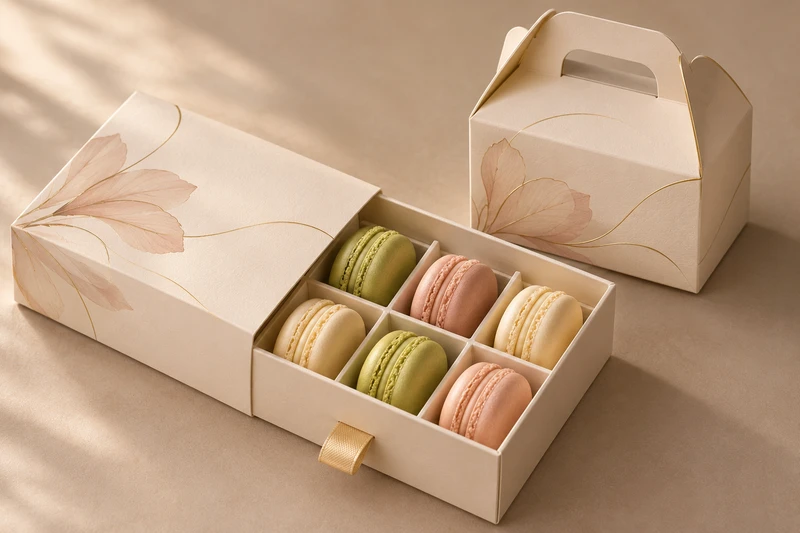
Macaron boxes need to do more than hold a set number of sweets. For bakery takeaway, the box must support a repeatable packing routine and give customers a practical way to carry delicate shells home. For gifting, it also needs to create a considered reveal, keep flavours identifiable and present the assortment as a premium product.
For bakeries, retailers and gifting teams in the United Kingdom, the starting point is an empty box designed around the actual macarons: their diameter, finished height, filling, decoration and arrangement. XGolden Print designs and produces custom paper packaging boxes and gift packaging, supporting packaging briefs through structural design, material selection, artwork support, printing, finishing, fitted inserts and sample approval before production.
Gift sets and takeaway orders use the box differently
A takeaway macaron box is usually selected for speed, clarity and straightforward carrying. Staff need to load the macarons consistently, close the pack without disturbing the contents and hand over an order that looks tidy. The customer should be able to open it without crushing adjacent pieces or losing the flavour information.
A gift-set macaron box has a different job. The opening sequence, lid style, internal layout and branded artwork can all contribute to a more deliberate presentation. It may hold a curated flavour collection, sit alongside a card or other gift item, or be part of a seasonal, corporate or event-gifting programme.
The same outer dimensions do not necessarily suit both applications. A box made for a quick bakery counter order may prioritise easy access and efficient filling. A gift box may allow more space for a presentation tray, printed message, ribbon detail or a fuller unboxing experience. Neither option automatically provides protection for parcel distribution; retail and gift presentation should be planned separately from a complete transport-protection system.
| Use case for macaron boxes | Main packaging requirement | Useful layout or presentation option | Important point to confirm |
|---|---|---|---|
| Bakery takeaway order | Fast filling, secure closure and clear flavour details | Single-layer tray with a practical opening format | Actual macaron dimensions and normal order combinations |
| Counter-ready gift assortment | Premium reveal and orderly product display | Fitted tray, branded sleeve or lidded box | How the customer removes each macaron |
| Corporate gifting | Coordinated branding and repeatable presentation | Gift box planned around macarons and accompanying items | Final contents, insert layout and recipient message |
| Wedding or special-event favours | Compact presentation and flavour or dietary signposting | Small-format box with event artwork | Quantity per box, name/date artwork and packing workflow |
| Online order packed by the seller | Presentation inside a wider dispatch arrangement | Gift box used within a separately specified outer pack | Handling route, outer packaging and completed-order checks |
For a mixed product gift, do not assume a macaron tray can be adapted after the box is approved. If the set includes items such as tea, confectionery gifts or a printed message card, the whole internal arrangement should be planned together. XGolden Print can support custom box design for briefs where the box structure and contents need to work as one presentation.
Choosing the number and arrangement of macarons
The right piece count begins with the customer’s actual product rather than a standard capacity claim. A macaron’s stated diameter alone is not enough: filling depth, piped details, shell irregularity, toppings and the way the product sits in a tray all affect the space required.
Provide measurements for a finished macaron, ideally including:
- maximum diameter across the shell and decoration;
- total height when filled;
- approximate weight of one finished item;
- whether shells vary between flavours or seasonal designs;
- whether macarons are packed individually, in paper cases, or directly into a tray;
- the preferred piece count for each SKU;
- whether one box must accommodate several assortment sizes.
This information helps determine whether macarons should sit in a single line, several rows or a more compact grid. A single-layer arrangement can make flavour selection visible and simple at the counter. A multi-row layout can create a more compact footprint, but the spacing and access method need closer attention so customers can remove one macaron without knocking another.
It is often better to develop separate box sizes for genuinely different order types than to rely on one oversized format. Empty space can let products move during ordinary handling, while a tightly specified box may make packing slower if the tolerances are unrealistic. The aim is a practical fit: enough space for placement and removal, without treating the product as though every shell is identical.
For an assortment sold in changing flavour combinations, decide early whether the interior must accept any flavour in any position or whether each position is assigned. A fixed pattern can support a polished presentation, while a flexible pattern can simplify bakery operations. Neither choice is inherently better; the decision depends on how staff pick, fill and check an order.
Before production, confirm capacity using real finished macarons. Product samples are particularly useful where fillings, garnish or shell sizes differ through the range. A structural sample can reveal whether the proposed arrangement is easy to fill and whether the stated piece count remains appropriate in day-to-day use.
Plan for the packing sequence, not just the finished photograph
A macaron box can look orderly in artwork approval yet be awkward on a busy counter. Map the actual sequence:
- Select the box and insert or tray.
- Place macarons in their intended order.
- Add any flavour card, message card or other non-food component.
- Close the box without catching the contents.
- Apply any required outer label or tamper-evident element specified for the order.
- Place the finished box into the seller’s wider carry bag or dispatch packaging where needed.
This exercise identifies whether a lid, sleeve, drawer or magnetic closure is compatible with the way staff will load the product. It also helps prevent flavour information being covered by a closing flap or label.
Tray spacing around fragile shells
Macaron shells are delicate, so a tray or insert should be designed around controlled placement and practical removal. The important dimension is not simply the gap between cavities. It is the combined relationship between cavity size, shell shape, filling height, neighbouring macarons and the clearance beneath the lid.
Too little spacing can cause shells to touch when staff load the tray or when a customer takes one out. Excessive spacing can make the assortment look sparse and may allow movement. The correct balance needs to be assessed with actual finished goods, not a paper-circle approximation.
When discussing tray spacing, include the following in the packaging brief:
- internal box length, width and usable height;
- the maximum finished product dimensions, including toppings;
- number of rows and pieces per row;
- distance needed to grip a macaron without touching its neighbour;
- whether the tray is separate, fixed in place or removable;
- whether a divider, recess or another insert approach is required;
- clearance between the highest point of the macarons and the closed lid;
- whether a card, flavour guide or protective layer will sit above the products.
A fitted insert can organise the presentation and help maintain position within the retail box. However, its precise construction, material suitability and fit must be confirmed for the individual project. Do not assume that any paperboard tray is appropriate for direct food contact merely because it is used inside a food gift box.
The box should also be tested as a completed order. That means checking the macarons after the normal handling expected between packing and handover, and—where the seller plans to send orders—after the intended outer-pack process. A presentation box alone is not a substitute for a fully specified delivery system.
Drawer and magnetic macaron-box examples
Box opening style changes both the customer experience and the bakery’s packing method. Two XGolden Print product styles can be relevant starting points, but their capacity and fit must be confirmed with the actual macarons.
The DB-317 macaron drawer box is a drawer-box style. A drawer can support a staged reveal: the outer sleeve stays in the hand while the tray slides out to show the assortment. This can suit a gift set where presentation is a central part of the purchase. Consider how far the drawer needs to open for the customer to see and remove the macarons, and whether a tray, flavour guide or insert remains correctly positioned during opening.
The MC-211 macaron magnetic closure box is a magnetic gift-box style. This format can suit a more formal gift presentation, particularly when the box is intended to feel like a keepsake-style outer gift pack. The closure and lid opening should be checked against the internal product height and loading method. A magnetic closure is not, by itself, evidence of a particular capacity, product protection level or food-contact suitability.
Both styles should be evaluated through a sample approval process based on the intended macaron configuration. Ask practical questions: Can staff fill it efficiently? Does the customer see the flavours clearly? Is the tray stable when the box is opened? Does the closed box leave suitable clearance above the finished macarons?
For a broader assortment programme, gift packaging options can be planned around multiple products, coordinated branding and the intended opening experience. This is especially relevant where macarons form one part of a corporate gift, wedding welcome box or seasonal confectionery set.
Flavour identification and gift presentation
Flavour identification is a functional part of macaron packaging, not only a design detail. Similar-looking shells may contain very different fillings, and a customer should be able to identify the selection without opening every compartment or relying on memory.
Choose the information system to match the retail format:
- Flavour card: useful for a curated assortment, with the flavours listed in display order.
- Numbered or lettered tray positions: appropriate when each place in the layout has a fixed flavour.
- Exterior label: useful when the assortment varies by order and the information needs to be applied during packing.
- Printed box artwork: suitable for a stable, repeat product range, but less flexible when flavours change often.
- Separate insert: can give more room for brand story, ingredients supplied by the food business, serving notes or event messaging, where required.
For UK-facing packaging, artwork should be prepared for the language and information the bakery or brand needs customers to see. Leave space for variable details when product selections change, and establish who applies those details and at which stage of packing. A fixed print design is efficient for information that does not change; a label or card may be more suitable for rotating flavours and short-run occasions.
Gift presentation can also be strengthened by coordinating the outer box, tray, flavour card and any accompanying message. Avoid allowing decoration to undermine usability. A dark printed interior may make flavours harder to distinguish visually, while a large card placed above the macarons may complicate access. The most successful gift box makes the assortment feel intentional while still allowing customers to select and remove a piece cleanly.
XGolden Print can support artwork alongside the box structure, helping buyers consider how printed elements relate to opening, product visibility and the planned insert. Final artwork, dimensions and print choices should be agreed against the particular brief.
Food-contact and completed-order handling checks
Empty macaron boxes are packaging, not the macarons themselves. A finished packaging specification should clearly distinguish the outer presentation box, any internal tray or contact layer, and any separate primary wrap or food-contact component used by the bakery.
If macarons will touch an insert, liner or other packaging component directly, discuss the intended contact arrangement at the outset. Food-contact suitability is project-specific and must be confirmed for the selected materials, construction and use. Do not assume suitability from appearance, from a similar box style or from the fact that a format is described as macaron packaging.
It is also important not to overstate what a box can do. A paper gift box does not automatically control temperature, preserve freshness for a defined period or protect a completed order through every stage of delivery. The food business should establish its own product-handling, storage and fulfilment requirements.
Before approving production, complete a practical check covering:
- the real finished macaron size, height and variation;
- intended direct-contact and non-contact layers;
- tray fit, lid clearance and ease of removal;
- closure operation once the box is filled;
- flavour information and any variable-order labelling;
- normal counter handling and customer carry-out;
- the planned outer packaging if orders are dispatched;
- artwork position, legibility and approval;
- final quantity, delivery date and destination.
XGolden Print brings 27 years of experience to custom paper packaging, with structural design, material selection, artwork support, printing, finishing, fitted inserts and sample approval available for relevant packaging projects. For a macaron-box enquiry, share the finished product dimensions, preferred piece count and arrangement, quantity, artwork, required delivery date and destination. We can then discuss a custom packaging box brief suited to your gift-set or bakery takeaway application.
