
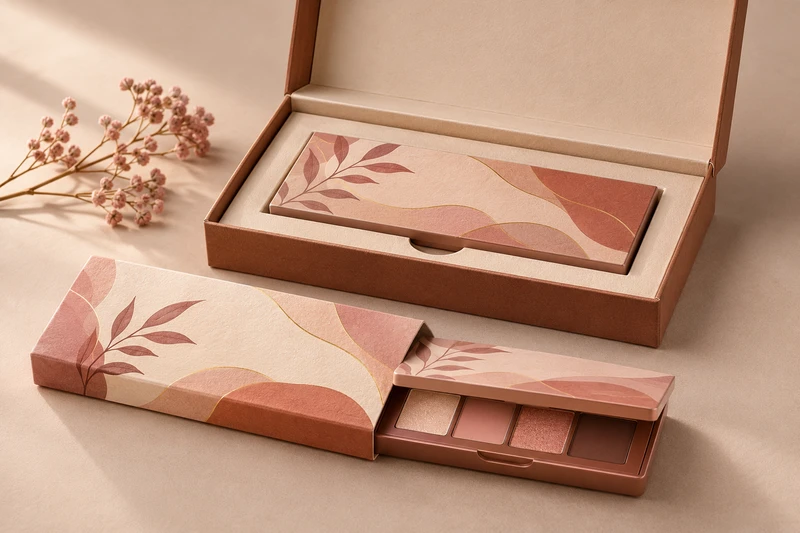
Makeup palette boxes are outer packs for a completed cosmetic palette: the finished product a customer sees on a shop shelf, receives in an online order or opens as a gift. They should be specified around the palette’s true dimensions, lid edge, corners and method of removal—not treated as a generic flat carton.
For beauty brands, retailers and product teams in the United Kingdom, the central decision is whether the pack needs simple branded coverage, a more considered unboxing experience, or a format that helps organise a palette within a wider gift set. XGolden Print designs and produces custom paper packaging, including rigid boxes, lid-and-base boxes, drawer boxes and magnetic closure boxes, with structural design, artwork support, inserts and sample approval available for an individual project.
Outer boxes and palette components are different products
A makeup palette box is not an empty refillable palette, a cosmetic compact or the primary component that holds pans, powders or creams. It is the outer packaging specified for the finished palette after the cosmetic product and its own compact or case have been completed.
This distinction matters at the briefing stage. The outer box must work with the palette component already selected by the brand. Its requirements may include:
- the finished palette’s length, width and closed height;
- the position and profile of the compact lid, clasp or opening edge;
- corner shape, raised decoration or surface details;
- the need to remove the palette without digging beneath it;
- the weight of the assembled product;
- retail-facing information and shade or variant identification;
- presentation as a standalone purchase, a gift item or part of a set.
Do not assume an outer box changes the function of the palette itself. For example, whether an internal mirror, closure or cosmetic formula is suitable remains a product-component question for the relevant brand. Likewise, an outer makeup palette box is not automatically a complete solution for transport risks through an entire distribution journey. Retail and gifting packaging can support orderly presentation and handling, but any protection required for storage, fulfilment or shipment needs to be considered as part of the full packing system.
A useful brief names the item clearly: “outer presentation box for one finished pressed-powder palette” is much more actionable than “makeup packaging”. It helps distinguish the required box from the cosmetic compact and from any separate e-commerce mailing pack.
What a finished palette needs from its packaging
The best makeup palette boxes make the finished palette easy to identify, hold and remove while giving the brand enough surface area for considered presentation. Because palettes are often flat and relatively broad, a box that is only measured by its internal length and width can look right on paper yet be awkward in use.
Account for lid edges and corners
Measure the real, fully assembled palette rather than an early drawing or an individual pan tray. The external measurement needs to include any lip around the lid, hinge line, clasp, rounded corners, raised logo or other feature that affects the widest or tallest point.
Internal corner clearance deserves attention. A tightly squared box around a palette with rounded or slightly prominent corners may make insertion and removal difficult. Conversely, excessive space can make the contents appear undersized and less deliberate. The right allowance is a structural decision to review against the actual palette during sampling.
The lid edge also affects orientation. Consider which side should face the customer when the box is opened, where a person naturally grips the product and whether the compact can be lifted without pressing against its lid or corner. An insert, recess or controlled clearance may help define that movement, but the appropriate approach depends on the actual palette and chosen box construction.
Plan for the purchase occasion
A single-palette retail launch may need a compact outer box with clear front, back and side panels. A limited-edition gift may place more value on the reveal when the lid is lifted. A beauty set could need a larger format that positions the palette with other finished customer products, such as skincare items, fragrance or accessories, in a coordinated layout.
| Use case for makeup palette boxes | Primary packaging requirement | Points to define in the brief | Suitable packaging direction |
|---|---|---|---|
| Standard retail palette | Clear identification and consistent shelf presentation | Palette orientation, retail copy, shade or variant marking, barcode area | Custom outer box selected around the palette dimensions |
| Premium or seasonal palette | A stronger opening experience | Lid movement, removal access, visible branding and insert requirement | Lid-and-base, rigid or magnetic closure box, subject to project requirements |
| Online order presentation | Neat pack-out within the wider fulfilment system | Outer box fit, packing sequence and separate transit packaging requirements | Presentation box combined with a separately planned shipping solution |
| Palette in a beauty gift set | Defined layout for several products | Every item’s dimensions and weight, opening sequence, insert layout | Custom gift packaging with fitted insert options |
| Event or corporate gifting | Coordinated branding across a selected set | Recipient-facing artwork, quantities, contents and intended presentation | Gift box format planned around the complete set |
The table describes possible directions, not fixed specifications. Material selection, insert design, finishes, production terms and testing should be confirmed for the individual project.
Keep primary, presentation and transit layers separate
There may be several packaging layers around one palette:
- The palette component holds the cosmetic product.
- The outer makeup palette box presents and identifies the finished palette.
- The gift or set box, where applicable, combines multiple products.
- The transport pack manages the requirements of storage, fulfilment and delivery.
These layers can be designed to work together, but they do different jobs. Asking an elegant retail box alone to serve as a full transport-protection system can create avoidable uncertainty. If online orders are part of the plan, document the anticipated packing workflow: whether the palette box goes into a mailer, whether void fill or other outer protection is used, and whether a gift message or other item is packed alongside it.
Comparing a sleeve with a presentation box
A sleeve and a presentation box can both be used as outer packaging for a completed palette, but they create different interactions.
A sleeve is a general packaging alternative: a printed outer piece that a finished palette slides into or out of. It can leave part of the component visible and provide a direct, compact branded surface. The open ends, amount of exposed palette and direction of removal all need careful consideration. A sleeve should not be selected merely because the palette is flat; check that the compact can be gripped and withdrawn without scraping its corners or catching its lid edge.
A presentation box encloses the palette more fully. It can offer a more deliberate reveal, especially for premium editions, gifting or retail where the unboxing sequence is part of the product story. The box must still be straightforward to open and the palette must be easy to remove once open. A fitted insert may be appropriate where it supports layout and handling, but should be developed around the real item rather than assumed from a product photograph.
| Consideration | Sleeve | Presentation box |
|---|---|---|
| Product visibility | May leave parts of the palette component visible | Generally encloses the palette more fully |
| Opening interaction | Palette slides out | Customer opens the chosen box structure, then removes the palette |
| Artwork area | Focused external panels | More surfaces may be available, depending on the structure |
| Gift presentation | Simple branded wrap | Can create a more considered opening experience |
| Fit checks | Opening width, slide direction and grip access | Internal clearance, lid function, corners and removal access |
Neither option automatically provides a particular level of impact protection, mirror protection or shipping performance. Those outcomes cannot be assumed from the format alone and should be evaluated with samples and the wider packing system where relevant.
For a box-only project, buyers can explore custom box formats with XGolden Print. For multi-product launches, seasonal kits or event presentation, custom gift packaging may be a more relevant starting point.
The LB-304 lid-and-base format
The LB-304 makeup-palette lid-and-base box is a relevant style example for brands considering a separate lid and base for a finished makeup palette. In this format, the lid lifts away from the base rather than relying on a hinged compact component or a sleeve construction.
For a flat palette, this structure can suit retail or gifting where the opening moment is important. The base can be planned around the palette’s footprint, while the lid provides an exterior surface for branding and campaign artwork. The palette’s orientation in the base should be decided early: the correct direction may depend on the compact’s front, clasp position, branding and how the customer is expected to lift it out.
LB-304 should be treated as a structural reference, not as a claim that every palette will fit it without adaptation. A suitable internal size, material choice, insert arrangement, decoration and clearance all need confirmation against the project. It is also important not to infer that a lid-and-base format protects a mirror or withstands particular handling conditions without sample testing.
When reviewing a lid-and-base option, ask these practical questions:
- Does the palette sit level in the base?
- Is there sufficient corner clearance without making the fit look loose?
- Can a customer lift the palette out without pressing on the lid, clasp or decorative surface?
- Does the lid lift and replace comfortably with the selected internal arrangement?
- Does the pack still present well after the palette is removed and returned?
- If it is part of a set, is the palette’s position clear alongside the other products?
These questions turn a visual concept into a pack that can be evaluated by product development, retail and fulfilment teams.
Artwork space and shade identification
Makeup palette boxes need to do more than carry a logo. Their artwork should help the customer recognise the palette, distinguish a shade family or edition and understand the intended product presentation. In a retail setting, the front panel may need to work quickly from a shelf or display. For gifting, the artwork may be more focused on the collection, occasion or coordinated set.
Plan the artwork around the actual construction rather than treating every external face as interchangeable. On a lid-and-base box, the lid, base sides and underside may each have different roles. On a sleeve, the joining area and open ends influence where information can sit cleanly. Keep essential content away from areas that could be obscured by structural joins, folds or the chosen opening arrangement.
For United Kingdom-facing ranges, provide final customer-facing copy in the required English wording before artwork approval. If a palette is sold in several colourways, finishes or editions, establish a controlled method for identifying each variation. That might mean different artwork versions, a dedicated identification area or a label specification. The best choice depends on the range, the final artwork and the packing process.
A practical artwork checklist includes:
- product and collection name;
- brand marks and visual hierarchy;
- shade, edition or variant identifier;
- retail-facing information required by the brand;
- barcode or other stock-identification area where needed;
- orientation markers for packers, if useful;
- the same branding logic across a palette box and any gift-set packaging.
XGolden Print can support artwork as part of the packaging process, alongside structural design, material selection, printing and finishing. Finishing should be selected because it supports the intended visual and tactile presentation, not simply because it appears on a reference image. Confirm how the artwork, material and finish work together on a project sample.
Fit and handling checks with the real palette
A finished palette—not only an outline drawing—is the most useful reference for specifying a box. Sampling provides the opportunity to review whether the structure performs as intended before production, including fit, access, opening and visual alignment.
Start by supplying the external dimensions of the closed palette in millimetres: length, width and height. Add its weight, photographs from each side and any features that change the outline, such as a clasp, curved corners, hinge or raised areas. If the palette is expected to sit in an insert, share the preferred orientation and whether the customer should lift it from a particular side.
Then examine the sample as a user would:
- Place the real palette into the box in the intended direction.
- Remove it repeatedly without forcing the lid edge or corners.
- Open and close the outer pack as it would be handled in retail or gifting.
- Check that printed artwork remains correctly oriented when the customer first sees the pack.
- Review how the box is packed by the team assembling the product.
- Place the presentation box within the intended outer fulfilment pack if online orders are planned.
- Record any adjustment needed to clearance, insert layout, opening access or artwork position.
This is also the stage to avoid common problems. An insert opening that is too close to a compact’s edge can make the palette difficult to lift. A box that looks proportionate in a digital mock-up may feel over-large when opened. A palette packed in the opposite direction from the artwork can weaken the reveal. Identifying these issues with the real product is more reliable than making assumptions about fit.
XGolden Print offers structural design, material selection, fitted inserts, sample approval before production, printing and finishing for custom paper packaging projects. With 27 years of experience, a 15,000 square metre factory, 500+ employees and 10M+ production capacity, we can support packaging briefs that need a considered route from structure and artwork through to production. Exact materials, order quantities, sample terms, schedules and other project conditions should be confirmed for the specific requirement.
To discuss makeup palette boxes with XGolden Print, share the finished palette dimensions and weight, quantity, artwork, required delivery date and delivery destination. Include whether the box is for retail, a gift set, online order presentation or event gifting, plus any preferred structure such as a lid-and-base box or sleeve.
