
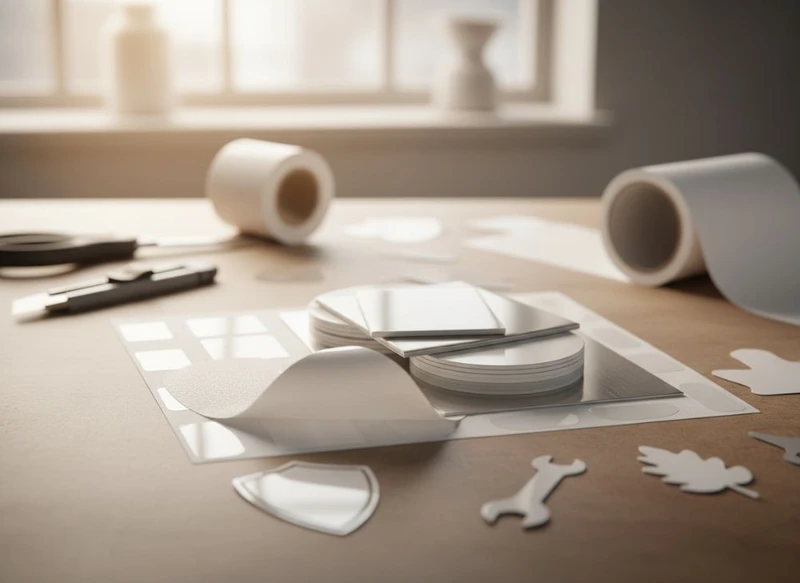
Successful label sticker printing starts with the conditions the label must withstand: the product surface, handling, moisture, temperature changes, application method and intended lifespan. Select the material and adhesive as a matched pair, then choose a finish and print process that protect the design without making application unnecessarily difficult.
For most product labels, a practical specification includes the label size and shape, substrate, adhesive type, finish, colour requirements, artwork format and application method. Confirm the full combination with your printer before production, particularly where labels will meet oils, water, chilled surfaces, textured packaging or frequent handling.
Selecting Durable Sticker Materials for Your Product
The material determines how a sticker looks, feels and performs in use. Paper labels provide a familiar, tactile appearance and suit many dry, indoor products. Film labels are generally the better choice where flexibility, moisture resistance or greater resistance to scuffing is important.
Choose the material around the product environment rather than appearance alone.
| Material | Typical appearance | Suitable uses | Points to check |
|---|---|---|---|
| Uncoated paper | Natural, writable and understated | Dry goods, craft products, short-life promotions | Can mark, absorb moisture or tear more easily |
| Coated paper | Smooth, crisp printed finish | Retail labels, cartons, jars and general product packaging | Check suitability for damp or refrigerated conditions |
| Textured paper | Premium, tactile or handmade effect | Gifts, speciality foods, candles and boutique ranges | Fine text and very detailed artwork may reproduce less sharply |
| White polypropylene film | Clean, flexible and durable | Bottles, jars, toiletries and regularly handled products | Confirm adhesive compatibility with curved containers |
| Clear polypropylene film | “No-label” style where the pack remains visible | Transparent jars, bottles and windowed packaging | White ink may be required for strong colour opacity |
| Metallic or foil-effect stock | Reflective, decorative finish | Premium products, limited editions and gifting | Colour appearance changes according to the underlying surface |
| Vinyl or specialist outdoor film | Robust and flexible | Equipment, outdoor items and longer-term identification | Specify actual exposure conditions and required lifespan |
Match the material to the packaging surface
Labels adhere differently to glass, coated board, untreated paper, metal, rigid plastic and flexible plastic. A label that performs well on a smooth glass jar may not bond equally well to a low-energy plastic, rough board or a container with condensation.
Before committing to a full run, identify:
- Surface energy and texture: Smooth, clean surfaces are usually simpler to label than rough, fibrous or heavily textured materials.
- Container shape: Tapered bottles, tight curves and squeezable packs need a flexible facestock that can conform without lifting.
- Product contact: Labels used on the outside of packaging face different requirements from labels that may directly contact a product. Confirm applicable requirements for the intended use.
- Storage and use conditions: Chilled, frozen, humid, oily or outdoor environments may call for a film material and specialist adhesive.
- Expected life: A short-term event label and a long-life asset label should not be specified in the same way.
Paper can be the appropriate, cost-conscious choice for a dry carton or gift box. A film label may be more suitable for a bathroom product, chilled drink bottle or reusable container. If the label is part of a complete presentation, coordinate its stock and finish with the material chosen for custom packaging boxes so the brand looks intentional across the full pack.
Consider the finish as part of durability
Finishes affect both appearance and protection:
- Gloss laminate or varnish can make colours appear more vivid and help protect against everyday rubbing.
- Matt laminate or varnish gives a restrained, contemporary surface and can improve readability under bright light.
- Soft-touch laminate creates a velvety feel but should be assessed for marks, handling and the intended product setting.
- Spot UV highlights selected details such as a logo or pattern against a matt background.
- Foil details add a metallic accent but require artwork designed for the process.
- Embossing or debossing adds physical depth, best reserved for simple, well-defined design elements.
A finish is not a substitute for choosing a suitable base material. For example, coating a paper label may improve surface protection, but it does not automatically make it appropriate for prolonged wet exposure.
Understanding Permanent vs. Removable Adhesives
The adhesive decides whether a label stays in place, peels away cleanly or can be repositioned during application. It is as important as the printed face material, yet is often left unspecified until late in the process.
A permanent adhesive is intended to form a lasting bond. It is commonly used for product branding, ingredient or care labels, barcode labels and labels that should remain on the pack throughout its normal use. “Permanent” does not mean it will adhere to every surface in every condition. Temperature, contamination, moisture, surface texture and application pressure all affect the result.
A removable adhesive is designed to be taken off with little or no residue under suitable conditions. It can suit price labels, temporary campaigns, promotional messages and reusable containers. Its clean-removal performance can vary by substrate, time applied, temperature and exposure, so it should be tested on the actual pack material.
A repositionable adhesive allows limited adjustment during application before it develops a more stable bond. This may help where labels are applied manually to large or curved products.
Adhesive selection checklist
Ask these questions before choosing:
- What is the container made from: glass, board, metal, plastic or another substrate?
- Is the surface smooth, curved, textured, coated, recycled or untreated?
- Will the label be applied in a cold, warm, damp or dusty environment?
- Is the product refrigerated, frozen, stored outdoors or exposed to water?
- Must the label remain in place for the product’s whole life?
- Does it need to be removed without visible residue?
- Will labels be applied by hand or through an automatic applicator?
- Is the label likely to meet oil, cleaning products, friction or sunlight?
Common adhesive mistakes
A frequent error is specifying adhesive by name alone without defining the application and service conditions. A “permanent” label applied to a cold or wet bottle, for example, may need a different adhesive from one applied to a clean, dry bottle at room temperature.
Other avoidable mistakes include:
- Applying labels to dusty, greasy or wet surfaces.
- Using a rigid paper label on a squeezable or highly curved pack.
- Assuming removal will be clean from every type of plastic or coated surface.
- Ignoring the difference between application temperature and in-service temperature.
- Selecting a large label for a narrow curved container, increasing the chance of edge lift.
If clean removal or demanding conditions are essential, request material and adhesive samples for a representative trial. A short compatibility check is more useful than judging the construction from a digital mock-up alone.
The Benefits of Roll Labels for High-Volume Application
Roll labels are supplied wound onto a core rather than as individual stickers or sheets. They are an efficient format for repeated application, especially where a production line, label dispenser or semi-automatic applicator is involved.
Their principal benefit is consistency. Labels can be presented in a controlled direction, with defined spacing between each label, helping an applicator feed and place them repeatedly. Roll labels also reduce the need to separate individual stickers by hand.
Roll labels are often appropriate for:
- Product bottles, jars and tubs.
- Retail-ready packs requiring repeated labelling.
- Barcode, batch or variant labels.
- Promotional labels applied across a product range.
- High-quantity e-commerce or fulfilment preparation.
Roll specifications that affect application
Do not order roll labels based only on label width and height. For machine application, the printer or applicator may need further details, including:
- Core diameter.
- Maximum outer roll diameter.
- Winding direction.
- Label orientation on the backing.
- Gap between labels.
- Label pitch.
- Whether labels are supplied inside or outside wound.
- Required unwind direction.
- Applicator method and dispensing edge.
These details are not interchangeable. A roll can contain correctly printed labels but still be impractical if it unwinds in the wrong direction or exceeds the machine’s roll capacity. Obtain the equipment requirements before finalising artwork or production.
For a small manual run, sheet stickers may be easier to handle. For regular, repeated use, rolls usually provide a tidier and more workable format. Businesses developing a broader range can explore custom stickers and labels alongside their packaging specification.
Which Printer Type Is Best for Custom Stickers?
There is no universal best printer type. The suitable method depends on quantity, artwork complexity, material, colour expectations, variable information and finishing requirements.
Digital printing
Digital printing is well suited to short runs, multiple product variants, design changes and personalised or variable data. It can be a practical option when a business needs several designs without the set-up associated with traditional print plates.
It is often worth considering for:
- Limited product launches.
- Seasonal artwork.
- Testing several label designs.
- Multiple flavours, scents or sizes.
- Labels with variable names, codes or numbering.
Check which materials, ink systems and finishing options are available for the chosen digital process. Very large solid colour areas, special colours or highly specific colour matching may need particular attention.
Flexographic printing
Flexographic printing is commonly selected for longer, repeat runs of roll labels. Once prepared, it can be efficient for consistent designs produced at volume and can support a broad selection of materials and finishing options.
It may be suitable where:
- The artwork is stable and unlikely to change frequently.
- The order quantity is substantial.
- A repeatable brand colour is important.
- Roll labels will be applied in a regular production process.
It involves set-up considerations, so it may be less flexible than digital printing for very small quantities or frequent artwork amendments.
Screen printing and specialist decoration
Screen printing, foil application, embossing, tactile varnishes and other specialist processes can create an elevated visual result. These are most effective when they support a clear design idea rather than adding decoration indiscriminately.
Use a specialist process when it serves a purpose: tactile wayfinding, premium gifting, a distinctive logo treatment or a contrast between matt and gloss surfaces. For example, a foil logo can complement gift packaging designed for a premium unboxing experience.
How to choose
Use this simple decision framework:
- Choose digital when flexibility, variants or shorter quantities are the priority.
- Consider flexographic printing for established, repeat roll-label designs and larger volumes.
- Add specialist finishes when tactile or visual differentiation supports the product position.
- Ask for a production proof or representative sample when colour, material feel or finish is commercially important.
Ensuring Colour Accuracy on Your Label Sticker
Colour is influenced by artwork, print process, ink, material, finish and viewing light. A colour that looks bright on a backlit screen can appear different on a warm-toned paper stock, transparent film or metallic substrate.
The most reliable approach is to define which colours are critical and build the artwork for print from the outset.
Prepare artwork with print in mind
For stronger colour control:
- Use the correct colour mode requested by the printer, commonly CMYK for standard full-colour work.
- Provide specified brand colours where a particular shade matters.
- Keep important text and logos clear of trim edges.
- Use vector artwork for logos, line art and text wherever possible.
- Embed or supply linked images at suitable resolution.
- Convert or provide fonts as required by the artwork workflow.
- Identify any white ink, foil, varnish or spot-finish areas clearly in separate artwork layers where requested.
Colour reproduction is affected by the label stock. Uncoated papers tend to absorb ink differently from glossy coated paper, while clear and metallic films need deliberate artwork planning. A white underprint may be necessary behind colours on clear or metallic material to prevent them from appearing translucent or altered by the pack beneath.
Approve against a physical reference where necessary
Screen previews are useful for checking layout, not for making final colour decisions. If a brand colour is particularly important, ask what proofing or approval options are available and inspect a physical sample under the lighting in which the product will normally be viewed.
Be precise about what requires close matching. It may be the main logo colour, a distinctive product range colour or a shade that must coordinate with printed boxes. Less critical background variations may not need the same level of control.
Troubleshooting Common Label Printing Issues
Most label problems can be traced to artwork setup, material choice, adhesive compatibility or application conditions. Addressing them early prevents expensive rework and inconsistent presentation.
Labels lifting at the edges
Likely causes: A curved or textured surface, an unsuitable adhesive, inadequate application pressure, a rigid material on a flexible pack, or labels applied in unsuitable conditions.
What to do: Use a more conformable film where appropriate, reduce the label size on tight curves, check the adhesive specification and ensure surfaces are clean and dry before application. Test the actual label on the actual container.
Bubbles, creases or wrinkles
Likely causes: Applying a flat label across a severe curve, incorrect label shape, fast manual application or uneven pressure.
What to do: Adjust the label shape, use a smaller format or flexible film, and apply gradually from one edge. For machine application, review the applicator settings and label dispensing arrangement.
Small text or barcodes are difficult to scan
Likely causes: Text is too small, line weight is too fine, contrast is poor, the material texture interferes with sharpness, or a barcode is placed over a fold, curve or decorative finish.
What to do: Increase type size and line weight where possible, retain strong contrast, keep codes away from edges and avoid placing them over seams or heavy texture. Verify barcode readability with the scanning conditions expected in use.
Colours look dull or different from the design
Likely causes: RGB artwork supplied for print, unsuitable material, no white underprint on clear or metallic film, or a finish changing the apparent depth of colour.
What to do: Prepare print-ready artwork, specify important colours, review the substrate and approve a physical sample where needed.
Labels do not dispense cleanly from the backing
Likely causes: The label format, die-cut profile, adhesive construction or roll specification is unsuitable for the application method.
What to do: Share the details of the dispenser or applicator before ordering. Confirm label gap, roll direction, core size and the complexity of the die-cut shape.
Waterproof and Weather-Resistant Sticker Options
“Waterproof” and “weather-resistant” should describe the complete label construction, not just the face material. The material, adhesive, ink or toner, protective finish, surface preparation and exposure conditions all contribute to performance.
For labels likely to meet water or humidity, a film facestock such as polypropylene is often a better starting point than standard paper. A protective laminate or suitable varnish may add resistance to rubbing and splashes. The adhesive must also remain compatible with the product surface under expected conditions.
For more demanding exposure, clarify the real environment:
- Will it face occasional splashes, repeated washing or continuous moisture?
- Is it used indoors, in direct light or outdoors?
- Will it contact cleaning products, oils or solvents?
- Does it need to survive refrigeration or freezing?
- Is the label applied before or after the container is chilled?
- Is it exposed to abrasion during transport, display or normal use?
Avoid relying on a broad description such as “waterproof” without agreeing the exposure that matters. A label suited to a damp bathroom may not be suitable for prolonged outdoor exposure, repeated immersion or chemical contact. Request a material recommendation based on the actual product and verify suitability before full production.
Die-Cut Precision: Making Complex Shapes Possible
Die-cutting cuts the label shape through the face material while leaving the backing liner intact. It enables circles, ovals, rounded rectangles, custom contours, seals, tabs and designs that follow a logo or illustration.
A custom die-cut shape can make a label more recognisable, but it should remain practical to print, handle and apply.
Design rules for effective die-cut labels
Keep these principles in mind:
- Avoid extremely narrow points, tiny internal cut-outs and fragile projections.
- Use rounded corners where possible to reduce lifting and snagging.
- Leave a sensible clear area between important artwork and the cut line.
- Avoid placing fine lettering directly against the edge.
- Ensure the label shape works around the container’s curves and seams.
- Consider how a user will lift the label if it is intended to be peeled away.
- Confirm whether the design requires a standard or bespoke cutting tool.
Complex shapes can increase set-up, waste and application difficulty. A simpler contour often delivers the same brand impact with better reliability, especially for roll labels used at speed.
Bleed, trim and safe area
Artwork for die-cut labels normally needs three clearly managed zones:
- Bleed: Background colour or imagery extending beyond the cut edge, preventing unwanted white slivers after trimming.
- Trim or cut line: The intended final shape of the label.
- Safe area: A margin inside the trim line where important text, barcodes and logos should remain.
Exact allowances vary by process and supplier. Ask for the preferred artwork template before finalising the design rather than assuming one measurement applies to every label format.
A Practical Label Sticker Specification Checklist
Before requesting a quotation, proof or production sample, prepare the following information:
- Label dimensions and required shape.
- Quantity and number of artwork versions.
- Product and packaging surface material.
- Application method: hand-applied, dispenser or automatic applicator.
- Sheet or roll format, plus roll specifications if applicable.
- Required adhesive behaviour: permanent, removable or repositionable.
- Storage, application and in-use conditions.
- Material preference, if known.
- Desired finish and any special effects.
- Print colours, critical brand shades and white ink requirements.
- Barcode, variable data or legal information that must remain legible.
- Print-ready artwork or support needed to prepare it.
- Any target-market labelling, product-safety or sector-specific requirements to verify.
A clear brief helps prevent unsuitable material choices and makes comparisons between suppliers more meaningful. XGolden Print can support custom printed packaging and labels, drawing on 27 years of experience in printing and packaging production. For context on the business, see about XGolden Print.
The best next step is to list the product surface, application conditions and desired finish, then compare label constructions against those requirements. Where adhesion, colour or durability is critical, approve a physical sample on the finished pack before moving to a full production run.
