
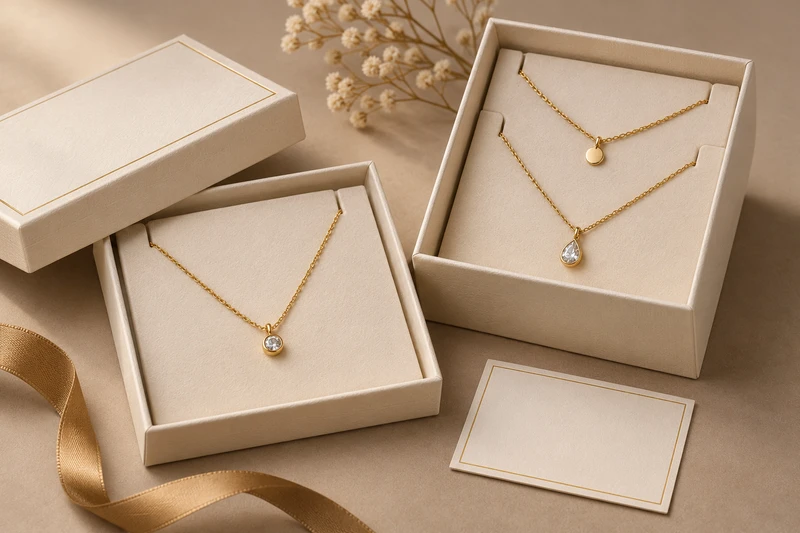
Necklace boxes should be planned around the way each necklace sits, rather than around a standard jewellery-box size. A pendant needs enough depth for its profile and a display position that keeps the focal piece visible. A long chain needs a controlled route behind or around the insert. Layered necklaces need separate paths so chains do not cross unnecessarily before the customer opens the box.
For jewellery brands, retailers and e-commerce teams in the United Kingdom, the right necklace presentation box supports an orderly retail reveal, gift-ready appearance and a more repeatable packing process. XGolden Print designs and produces custom paper packaging boxes, including rigid, drawer, magnetic closure and lid-and-base formats, with structural design, material selection, artwork support, fitted inserts and sample approval available for the individual project.
| Necklace application | Main packaging requirement | Suitable layout considerations |
|---|---|---|
| Single pendant necklace | Pendant remains central and visible | Recessed display area, appropriate box depth and chain slots |
| Fine long-chain necklace | Chain needs a deliberate route | Rear routing channel, controlled exit points and accessible fastening |
| Layered necklace set | Multiple chains need separation | Separate slots, distinct routing paths and space between necklace levels |
| Gift-set necklace | Presentation and removal matter equally | Care-card position, lift access and coordinated gift packaging |
| Online jewellery order | Retail box needs support within despatch packaging | Presentation box specified separately from outer protective packaging |
The necklace is the customer’s product; the packaging brief should therefore begin with its actual dimensions, profile, clasp type and intended presentation position. A generic insert drawing may not suit every pendant, chain thickness or layered arrangement.
A pendant and a layered necklace need different layouts
A single pendant necklace and a layered necklace may be sold in similarly sized necklace boxes, but they place different demands on the insert.
For a pendant necklace, the pendant is usually the visual anchor. The chain should lead the eye towards it rather than obscure it. The insert may need a central display position, paired chain slots and enough surface area for the pendant to rest without being pushed against the lid. If the pendant is wide, raised or unusually shaped, the display area should be developed around its actual outline rather than assumed from the chain length alone.
A layered necklace is more complex because it contains several visible elements and often more than one chain length. The buyer needs to decide whether the jewellery will be presented:
- fully arranged as a layered composition;
- with each necklace secured in its own route;
- as a set that customers remove together; or
- as individual pieces within one shared gift box.
Separate chains should not simply be placed under one broad retaining band. Where necklaces cross at the insert, the presentation can look untidy and removal may become awkward. A layered-necklace insert can instead use separate slots, channels or fixing points developed for the supplied chain configuration.
The key point is not to promise that any insert will prevent tangling. Chain movement depends on the jewellery construction, fastening method, handling and the final pack-out process. A practical insert design can control the initial arrangement, but the completed layout should be checked with the actual jewellery before production.
Start with the finished jewellery, not only a product photograph
Product images are useful for discussing visual direction, but they do not provide enough information for structural decisions. Before selecting necklace boxes, prepare:
- necklace length or lengths;
- chain thickness and flexibility;
- pendant width, depth and overall profile;
- clasp and extender position;
- number of chains in a layered set;
- whether necklaces are packed open, fastened or partly secured;
- any care card, authentication card or gift message to be included;
- the intended retail, gifting or online-order presentation.
For a range with several necklace variants, identify whether one box and insert must accommodate all of them. A universal format can simplify stock management, but it may leave smaller pendants looking lost or larger pieces sitting too close to the lid. Separate inserts, or a carefully planned shared structure, should be assessed against the product range.
Box depth and the pendant’s display position
Box depth is a presentation decision as much as a dimensional one. A shallow necklace box can create a neat, low-profile retail format for a fine pendant, while a deeper structure may be needed where the pendant projects above the insert surface or where the chain, card and fitting arrangement require more space.
The pendant should have a defined display position. It may sit centrally below the chain, slightly lower to leave room for branding, or within a shaped area that frames its outline. The best position depends on what the customer sees when the lid is lifted and how the necklace will be removed.
When specifying depth, consider the combined arrangement rather than the pendant in isolation:
- Measure the pendant’s highest point, including any raised setting or layered component.
- Allow for the insert construction and the way the chain sits beneath, behind or across it.
- Include the thickness of any care card or printed information placed inside the box.
- Check clearance between the jewellery and the closed lid using a physical sample.
- Confirm whether the box will be packed inside an outer mailer or other despatch packaging.
An overly shallow box can put unwanted pressure on the display layout. An unnecessarily deep box can make a delicate pendant appear less considered and may affect shelf presence. Neither outcome can be judged reliably from an empty box mock-up.
Retail display and gift presentation
For shop-floor presentation, the interior of necklace boxes often needs to communicate the product range clearly at first opening. This may mean placing a logo under the lid, positioning the pendant consistently across styles, or using colour and print choices that coordinate with the wider jewellery collection.
For gifting, the opening sequence may take priority. A lid that lifts cleanly, an insert that presents the necklace immediately and a discreet place for a message card can all contribute to the experience. The external artwork can also be planned with the recipient in mind, while retaining the product name, SKU or other operational information where the retailer needs it.
Artwork for United Kingdom sales should be reviewed in the language, copy hierarchy and version required for the specific range. This includes checking that any product naming, care information or gift message supplied by the brand fits the available internal and external print areas.
Routing long chains behind the insert
Long chains require a planned route. Simply folding a chain behind an insert can produce inconsistent results because the clasp, extender and pendant may settle differently from one packed box to another.
A common layout starts with the pendant displayed on the insert face while the remaining chain passes through slots or openings and is arranged behind the insert. The clasp may be secured at a designated point, or the chain may follow a route designed to reduce loose movement in the presentation box. The appropriate approach depends on the necklace’s construction and the packing method the brand intends to use.
Routing should be considered alongside the assembly process. Ask who will pack the necklace, how many handling steps are acceptable, and whether the team can repeat the arrangement accurately across a product run. An intricate route can look refined in a sample but may not be the most practical choice if it relies on extensive manual adjustment for every unit.
Useful questions for a long-chain necklace box brief include:
- Does the pendant remain on the front face while the chain is routed behind?
- Does the chain need one route or separate paths for an extender and clasp?
- Are slots positioned away from delicate decorative sections?
- Can the packer reach the fastening point without disturbing the display area?
- Is the insert easy for the recipient to understand when removing the necklace?
- Does the layout remain presentable after the box has been opened and closed in normal use?
The insert should be developed around actual samples of the jewellery wherever possible. A chain that appears fine in an artwork drawing may have a clasp, tag or extender that changes the space requirement significantly.
A lid-and-base style and a layered-necklace rigid style
The box structure should match the necklace layout and the intended opening experience. XGolden Print can support custom box projects with structural design, material selection, artwork support, printing, finishing, fitted inserts and sample approval before production.
For a traditional presentation format, the LB-311 necklace lid-and-base box is a relevant style reference. A lid-and-base structure can suit a single pendant necklace where a clean lift-off reveal is wanted. Its final dimensions, insert design, materials and finish should still be developed around the specific jewellery rather than assumed from the style name.
For jewellery ranges built around multi-chain presentation, the RB-311 layered-necklace rigid box is a useful rigid-box style reference. A rigid format can provide a considered setting for a layered necklace, particularly where the insert needs defined areas for several chains. Whether it suits a particular product depends on the chain layout, pendant depth, desired card placement and the brand’s handling process.
Material and finish decisions should support the brief
Material selection and finishing are not separate decoration choices. They affect the perceived weight of the box, the way artwork appears and the practical fit with the insert construction. A brand may prefer a subdued finish for fine jewellery, stronger contrast for a gift collection or coordinated packaging across necklaces, watches and other accessories.
The project specification should confirm the proposed materials and finishes rather than rely on generic assumptions. Suitability, appearance and construction details need to be reviewed against the individual necklace box project.
For brands building a wider launch or seasonal range, gift packaging can be planned around multiple products, coordinated branding and the intended opening experience. A necklace box may form one part of that system, alongside a gift card, outer sleeve or packaging for related jewellery products.
Care cards and removal access for gifts
Care cards and gift messages are small additions that can affect the whole necklace-box layout. If a card is placed directly over the pendant, the recipient must remove it before seeing the jewellery. If it is tucked behind the insert without an accessible edge, it may be missed or difficult to retrieve.
Decide what should happen first when the box opens:
- Should the recipient see the necklace immediately?
- Should a printed message be revealed before the jewellery?
- Does the care card need to remain with the item after purchase?
- Is there a gift-set card that identifies several pieces?
- Does the retailer need a product code or variant label in a discreet position?
A small finger space, ribbon pull or lifted insert edge may help with removal access, but the appropriate method should be tested with the actual necklace and card stack. The jewellery should be removable without asking the recipient to pull sharply on a chain or pendant.
Care cards can provide brand-supplied guidance for the jewellery, while requirements for tarnish control, abrasion resistance or damage protection should be assessed separately. If the product requires a particular contact layer, storage method or protective measure, the jewellery brand should specify that requirement so it can be considered during packaging development.
For event gifting, such as weddings, corporate occasions or launch events, the box may need space for a personalised card or coordinated printed artwork. Confirm whether each unit carries the same message or requires variable details, as this affects the artwork and packing plan.
Checking presentation after normal handling
A necklace box should be reviewed as a complete packed presentation, not only as an empty printed sample. Before approving production, check the box with the finished necklace, insert, cards and any other supplied components in place.
The review should cover normal actions such as opening the box, lifting the insert if applicable, removing the necklace and closing the box again. Check whether the pendant remains in its intended position, whether long chains emerge neatly from their routes and whether layered pieces still look clearly separated.
This review is also the point to assess practical matters that can be missed in a digital proof:
- Is the necklace positioned consistently across repeated pack-outs?
- Does the pendant have sufficient clearance beneath the lid?
- Are slots and retaining points positioned appropriately for the chain and clasp?
- Can the recipient remove the jewellery without confusing the routing?
- Does the care card sit where intended and remain accessible?
- Is branding visible at the planned moment of opening?
- Does the presentation box need a separate outer packaging solution for storage and transit?
A retail or gift presentation box is not automatically a complete transport-protection system. For online orders, consider the necklace box as the customer-facing presentation layer and specify suitable outer packaging separately. The outer package, internal protective elements and any direct-contact layer should be assessed according to the jewellery, fulfilment process and delivery destination.
XGolden Print has 27 years of experience designing and producing custom paper packaging, gift packaging, labels and stickers. For a necklace packaging project, we can support the brief from structural layout and material selection through artwork, fitted inserts, printing, finishing and sample approval before production.
To discuss custom necklace boxes, share the necklace dimensions and chain layout, required quantity, artwork, intended delivery date and destination through our custom box packaging service.
