
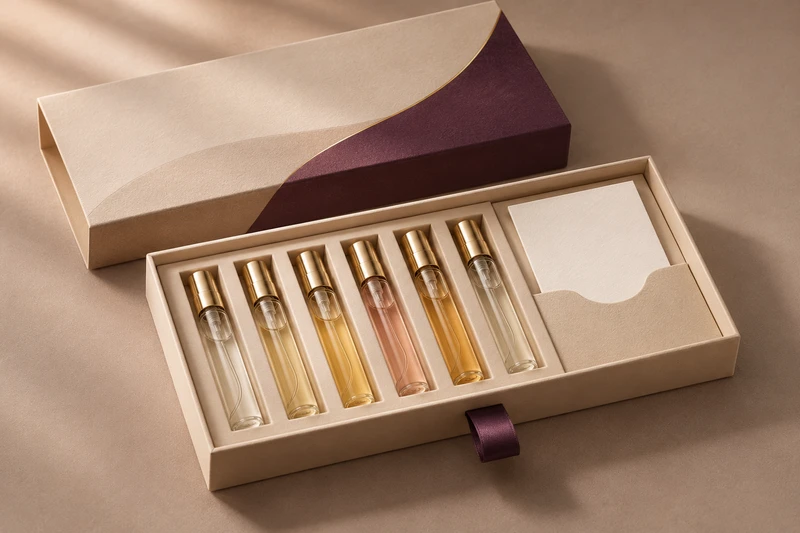
Perfume discovery set packaging gives a fragrance brand a controlled way to introduce several scents in one presentation. It can hold sample vials for trial, a curated edit for gifting, or a launch kit that explains a new collection. The best format protects the finished vials, makes every scent simple to identify and remove, and creates a considered opening sequence without confusing outer presentation packaging with transit protection.
For fragrance brands, retailers and e-commerce teams in the United Kingdom, the brief should begin with the actual vial rather than a preferred box style. Measure the finished primary containers, including caps and labels, decide how many scents belong in the set, and establish whether the pack will be sold on a shelf, sent in online orders, presented as a gift or used for a press, trade or event launch.
XGolden Print designs and produces custom paper packaging boxes, gift packaging, labels and stickers. For perfume discovery set packaging, we can support structural design, material selection, artwork, printing, finishing, fitted inserts and sample approval before production.
Discovery sets for fragrance sampling and product launches
A fragrance discovery set is usually designed around an introduction: a customer encounters a house’s core scents, a seasonal collection or a focused edit without choosing a full-size bottle first. The packaging needs to present the vials as one coherent range while letting each fragrance retain a distinct identity.
Sampling sets and launch kits can use similar box structures, but they have different communication priorities.
| Use case | Main packaging requirement | Useful layout and presentation option |
|---|---|---|
| Fragrance sampling set | Easy comparison between multiple vials | Numbered or named vial positions with a scent card |
| Retail discovery set | Clear shelf-facing identity and tidy internal presentation | Branded outer box, structured insert and legible front-panel information |
| E-commerce discovery set | Presentation that remains organised after the outer shipping pack is opened | Secure fitted insert, simple opening sequence and a separate shipping carton specified for the route |
| Product launch kit | Space for collection context, story and campaign information | Drawer or magnetic box with a card, folded leaflet or layered reveal |
| Corporate or event gifting | A considered unboxing moment and clear recipient guidance | Coordinated gift packaging, an insert for the vials and a tailored message card |
A sampling set may place the scent names, family references or numbers immediately beside each vial. A launch kit may give more room to a collection story, a campaign visual or instructions for the intended order of testing. Neither approach needs to be visually crowded. It is generally more effective to decide which information must be read before the box is opened, which is needed while selecting a vial, and which can sit on an enclosed card.
The fragrance itself remains the brand’s product. The box, insert and any labels serve its presentation, identification and handling; they do not replace the primary container that holds the perfume.
Choosing a layout around the finished vials
The finished vial is the fixed starting point for a discovery-set box. A layout based only on an approximate container size risks a poor fit once closures, labels or manufacturing variation are considered. Before requesting a quote or structural proposal, supply dimensions for the actual filled or finished vial, not merely a nominal bottle size.
For each vial, record:
- overall height, including the cap or spray component;
- widest diameter or width;
- shape, including whether the container is round, square, faceted or irregular;
- label position and any areas that should remain visible;
- approximate filled weight;
- whether the vial must sit upright;
- quantity of scents in each set;
- any variation in vial format within the range.
The insert should be planned around how the vial is held and removed. Individual recesses can keep containers separated and present the group consistently. However, a recess that grips too tightly can make a small vial difficult to lift out, while a loose recess can undermine the organised appearance of the set. The shape of the vial base, the height of the insert, and the space left around the closure all matter.
A full row of equal vials is often straightforward to read, particularly where scents are numbered. A collection with different bottle forms may need a more considered composition so that no container looks accidental or unstable. If the brand intends to include a larger hero bottle alongside smaller samples, make this clear from the outset; it changes both the internal layout and the box proportions.
Do not assume that a display insert is also a complete transport-protection solution. A fitted insert helps organise and support the product inside a presentation box, but online orders and bulk movement may require a separately specified outer shipping pack and packing method. Consider the packed set’s weight, route, handling stages and destination when planning that outer layer.
Plan the packing workflow as well as the finished layout
A viable perfume discovery set should be practical for the team assembling it. Think through the sequence: placing vials into the insert, adding any card, closing the box, and placing the finished set into its shipping packaging where required.
Questions worth resolving include:
- Are vials packed before or after an enclosed card is added?
- Does each scent have one fixed position?
- Must the packing team distinguish several language versions or scent assortments?
- Will promotional cards vary by campaign, retailer or event?
- Is the same box used for more than one edition of the set?
These decisions can prevent mismatched scent names, incorrect card inserts or awkward packing steps later. For United Kingdom retail or online campaigns, artwork should also be planned for the intended customer-facing language and channel, including any information the brand needs on the box, card or vial label.
Drawer boxes and magnetic discovery boxes
The box structure affects how the fragrance set is encountered. A drawer box reveals the vials by sliding open, while a magnetic closure box opens like a presentation case. Both can suit perfume discovery set packaging when specified around the actual contents and desired opening experience.
XGolden Print’s DB-301 perfume-vial drawer box is an example of a drawer-box structure for perfume vials. A drawer format can separate the outer sleeve from the internal tray, offering a staged reveal and a defined place for a vial insert. Its suitability for a particular collection, vial quantity and dimensions should be confirmed against the project brief.
The MC-301 fragrance-discovery magnetic box provides a magnetic-box example for a fragrance discovery presentation. A magnetic closure can make the opening feel more like a gift or launch case and may provide a broad interior surface for a printed message or collection card. As with any format, the final dimensions, materials, insert arrangement and closing behaviour need agreeing for the individual set.
| Box style | Best suited to | Points to specify |
|---|---|---|
| Drawer box | A sequential reveal, compact sample-vial arrangement or a set intended to be opened repeatedly | Sleeve and drawer dimensions, pull detail, tray layout, insert depth and opening clearance |
| Magnetic closure box | A premium gift or launch presentation with a lid-opening moment | Lid direction, internal message area, insert position, card placement and closure alignment |
| Lid-and-base box | A classic gift-box opening with a separate lid | Lid lift, base depth, internal presentation and whether a card sits above or beside the vials |
| Rigid box | A structured presentation where the chosen opening method is defined by the brief | Box dimensions, insert design, intended handling and external finish |
The style should follow the use case rather than fashion. A drawer can work well when customers should pull out a neatly ordered scent library. A magnetic closure may suit a launch kit where the inside lid carries an introduction to the collection. For a retailer display, the exterior should communicate the range clearly even when the box is closed; for gifting, the internal reveal may take greater priority.
Finishes are another application-led choice. They can distinguish the outer brand mark, collection name or scent system, but they should support legibility rather than obscure it. Confirm the material and finish combination for the individual project, especially where fine type, pale artwork or detailed fragrance names are important.
Making each scent easy to identify and remove
A discovery set fails its basic purpose if a customer cannot tell the scents apart or remove a vial without disturbing the rest. Identification belongs at several levels: on the exterior pack, at each insert position and on the primary container itself.
Start by choosing a clear system. The set might use scent names, numbers, colour cues, collection chapters or a combination of these. Whichever route is used, keep the same naming convention across the carton, insert card and vial labels. For example, if the insert calls a fragrance “03”, the card and vial should not introduce a conflicting title or order.
A practical hierarchy is:
- Outer box: identifies the fragrance house, collection and overall set.
- Insert or tray: shows where each specific vial belongs.
- Vial label: identifies the fragrance when it is removed from the box.
- Enclosed card: provides fuller scent notes, testing guidance or campaign context.
Labels and stickers can be specified for bottles, jars, boxes and bags, with custom dimensions, shapes and agreed roll or sheet formats. For perfume vials, the label brief should state the container dimensions, the available flat or curved labelling area, the desired placement, the artwork and how labels will be applied. A label designed for a flat box panel may not suit a small cylindrical vial.
Consider who applies the labels and at what stage. Machine application, hand application and pre-labelled containers can create different practical requirements, but the method should be confirmed with the project team. Also identify whether labels are for the vial, the outer box, a seal or a campaign sticker, because each surface and purpose calls for its own dimensions and placement.
Design access into the insert
Removal access is a structural decision, not an afterthought. A vial may need open clearance above the cap, a finger space at the side, or a shaped cut-out that lets the user lift it cleanly. The right solution depends on the vial shape, insert material, recess depth and expected user handling.
Avoid these common problems:
- placing scent names where a vial hides them once inserted;
- using only colour to identify scents when a customer needs to compare the set quickly;
- making recesses deep enough to hide the vial label;
- leaving no allowance for a cap, collar or unusual bottle shape;
- using an insert layout that looks balanced but makes the centre vial difficult to reach;
- changing vial format after the insert structure has been approved.
Send the final vial samples where possible. XGolden Print offers sample approval before production, allowing the box, insert and artwork to be checked against the agreed project specification before the main production stage.
Cards and set variations for a launch
Cards turn a group of samples into a guided fragrance experience. They can introduce the collection, explain the order in which scents might be explored, distinguish editions or carry a message for a retail, press or event audience.
The card format should fit the chosen box without causing the vials to sit unevenly or making the pack difficult to close. A single card can sit above an insert if the box depth allows. Alternatively, it may be placed in a dedicated layer, beneath the vials, or inside a lid presentation area. The intended reading moment determines the best position.
For launch kits, decide whether every recipient receives the same contents. Common variations may include:
- a core fragrance range versus a seasonal edit;
- retailer-specific artwork or an insert card;
- an event message for guests;
- a corporate gifting message;
- an online-order card that introduces a later full-size purchase;
- different scent assortments sharing one outer structure.
Where one box structure supports several versions, use a disciplined artwork and packing plan. Identify which elements stay constant—the outer box, insert or vial positions—and which vary, such as cards, labels or scent selections. This makes it easier to brief the project accurately and reduces the risk of a beautifully designed box being paired with the wrong contents.
XGolden Print can plan gift packaging around multiple products, coordinated branding and the intended opening experience. This is useful where a perfume discovery set includes more than vials, such as a printed scent guide, a branded card or a supplementary gift element. The contents, internal dimensions and final configuration should be agreed for the specific project.
Approving the complete set and its shipping pack
Approve the discovery set as a complete assembled pack, not as separate components viewed in isolation. The box may look correct when empty but behave differently once vials, labels, cards and inserts are in place. A full review should cover the customer-facing presentation and the practical path to the final destination.
Check the following before production:
- finished vial dimensions, shape, closure and weight;
- correct count and order of scents;
- vial label fit, placement and readable identification;
- insert fit, vial stability and removal access;
- card size, thickness, positioning and orientation;
- exterior artwork, including retailer or campaign variants;
- box opening and closing with all contents in place;
- the required outer shipping pack and packing arrangement;
- delivery date and destination for the completed packaging project.
Retail presentation packaging and transport protection serve different jobs. The discovery box is the branded object a customer or recipient sees and opens. A shipping carton or outer packing arrangement is intended to support the packed set during distribution. Do not assume a rigid presentation box, drawer box or magnetic closure box alone is the complete answer for every shipping route.
For online orders, it is useful to provide the delivery destination, whether sets will be sent as individual orders or in bulk, and who will pack the finished products. This information helps frame the wider packaging requirement without implying a particular delivery method or protection level before the project has been assessed.
XGolden Print has 27 years of experience in packaging production, with structural design, material selection, artwork support, printing, finishing, fitted inserts and sample approval available for relevant projects. Our custom box formats include rigid, drawer, magnetic closure and lid-and-base boxes, so the discussion can start with your vials and launch objective rather than a one-size-fits-all structure.
To discuss a perfume discovery set, share the finished vial dimensions and weights, scent quantity, artwork, preferred box style, any card or label requirements, required delivery date and destination. Explore custom box options with XGolden Print to shape the set around its actual contents and intended presentation.
