
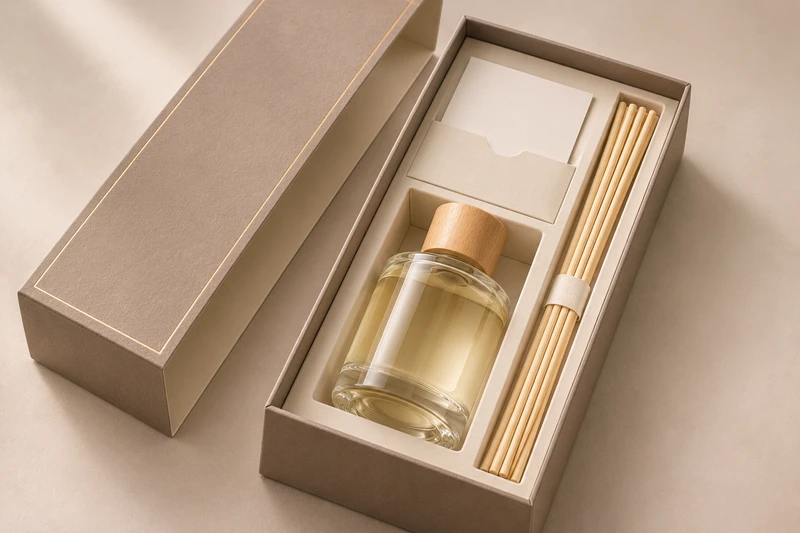
Reed diffuser boxes need to accommodate two awkwardly different components: a closed glass fragrance bottle and a long, straight bundle of reeds. The most successful layout protects the presentation of each item, makes removal intuitive and leaves enough room for clear shelf-facing branding without forcing the bottle or reeds into an unsuitable position.
For brands, retailers and e-commerce teams in the United Kingdom, the brief should begin with the actual filled bottle, closure and reed bundle rather than an assumed box size. XGolden Print designs and produces custom paper packaging boxes, gift packaging, labels and stickers, supporting projects from structural design and material selection through artwork, fitted inserts, sampling and production.
What belongs in a reed diffuser gift box
A reed diffuser gift box is outer presentation packaging for a customer’s home-fragrance product. Its contents commonly include a sealed diffuser bottle and a reed bundle, and may also include product information or a gifting message. The outer box should give these components defined positions, support a clear opening sequence and create a coherent retail or gift presentation.
The primary fragrance container remains the bottle itself. A paper box and insert are not a substitute for a bottle, cap or closure designed to contain diffuser liquid. Brands should therefore keep liquid-containment decisions separate from the reed diffuser box brief, then provide the final closed bottle for fit checks.
A typical gift set can be planned around:
- A filled, closed bottle, including its final cap, collar or other closure.
- A complete bundle of reeds in the supplied sleeve, tie or protective wrap.
- A leaflet, care card or scent story card where required.
- A gift message, seasonal presentation element or coordinated secondary product, if applicable.
- A fitted insert that holds components in their intended positions.
The product removal sequence matters as much as the external shape. If customers must pull the reeds out first, the reed channel needs a clear access point. If the bottle is intended to be the first item revealed, the reeds can sit alongside it under a shared cover or in a separate compartment. Neither approach is automatically better; the decision depends on the opening experience, component lengths and packing process.
For a retail reed diffuser, the outer carton may prioritise product identification and compact shelf presentation. For a Christmas, housewarming, corporate or event gift, the opening experience may justify a more substantial box format, a presentation tray or room for a message card. In each case, the interior must still work with the actual components rather than a visual mock-up alone.
| Reed diffuser application | Main packaging requirement | Useful layout direction | Points to confirm |
|---|---|---|---|
| Single retail diffuser | Compact presentation and clear identification | Bottle recess with a parallel reed channel | Filled bottle size, closure diameter, reed bundle length |
| Premium gift diffuser | Deliberate reveal and gifting appearance | Rigid box with separate positions for bottle and reeds | Opening direction, message card, branding areas |
| Diffuser with additional items | Clear organisation of multiple components | Divided insert or tray with each item assigned a space | All product dimensions and intended removal order |
| Online order presentation | Product organisation within the retail pack | Close-fitting insert that limits internal movement | Separate outer transit protection and packing method |
| Corporate or event gifting | Consistent branding and recipient-ready presentation | Multi-product gift layout with coordinated artwork | Quantity, names or event artwork, destination and required date |
Bottle dimensions and reed length define the layout
A reed diffuser box should be sized from the final assembled product, not from bottle capacity or a supplier image. Two bottles with the same fill volume can have very different footprints, shoulder shapes, cap heights and weights. Similarly, reed lengths are not standard: the outer bundle length, width and protective wrapping all affect the internal layout.
Start by measuring or supplying:
- Bottle width and depth at the widest point.
- Total bottle height when closed with the final cap or stopper.
- Bottle weight when filled, as this influences insert support and handling.
- Reed bundle length, including any sleeve, tag, tie or protective end treatment.
- Reed bundle diameter or width when packed as supplied.
- Any leaflet, card, decorative accessory or secondary product intended for the same box.
It is useful to identify the orientation of each component before discussing finishes or external graphics. A bottle may stand upright in a deep box, lie on its side in a drawer-style presentation, or sit in a shaped recess. Reeds may run beside the bottle, above it or in a separate long compartment. The chosen position affects the box proportions, opening direction and the customer’s first view of the set.
Avoid designing to the empty bottle where the filled and closed bottle will be heavier or taller. Likewise, do not specify a reed compartment only from the exposed reed length if the product is packed in a sleeve. The final packing format is the relevant one.
Allowance is a design question, not a guess
Internal space should be sufficient for packing and removal without leaving components loose. Too little space can make packing difficult, compress a reed bundle or create friction around the bottle. Too much space can reduce the sense of order and allow movement within the presentation pack.
The appropriate allowance depends on the bottle form, closure, insert construction, reed wrapping and how the set will be assembled. It should be confirmed during structural development and with a complete sample. XGolden Print can support this process through structural design, material selection, fitted inserts and sample approval before production.
For product ranges with more than one fragrance or bottle size, decide early whether one box structure will serve all variants. A shared format can simplify the range, but only if each bottle and reed bundle fits appropriately. If variants differ in height, shape or bundle length, separate inserts or separate box sizes may be more suitable.
Separate positions for the bottle and reed bundle
Giving the bottle and reeds separate positions is usually the clearest way to organise a reed diffuser gift box. It keeps a long, lightweight bundle from resting against the bottle and gives each item a purpose-built place in the opening presentation.
A separate bottle recess can help present the bottle label neatly when the box is opened. A separate reed channel can keep the bundle aligned and reduce the chance that reeds obstruct access to the bottle. This is especially helpful when the reeds are longer than the bottle or when the fragrance product is intended as a premium gift.
Possible layouts include:
- Side-by-side layout: bottle and reeds sit parallel in adjacent positions. This creates a broad, balanced presentation and makes both items visible at once.
- Lengthwise layout: the bottle occupies one end, with the reeds placed in a long channel alongside or beyond it. This can suit sets where reed length drives the overall box dimensions.
- Layered reveal: reeds sit in a first layer, while the bottle is revealed beneath, or the bottle is shown first with reeds in a secondary compartment. This can create a more considered unboxing sequence.
- Multi-item layout: a reed diffuser bottle and reeds are arranged with additional customer products, such as a candle or care card. Each component needs its own assigned space rather than being packed loosely together.
The choice should reflect how the product is packed and used. If staff need to place the bottle into an insert first and slide the reeds into a narrow channel afterwards, that should be practical at the intended quantity. If the recipient is expected to remove the reeds before lifting the bottle, add a sensible finger space or pull feature to the relevant compartment.
Common layout mistakes to avoid
A visually attractive render can conceal practical problems. Before approving a reed diffuser box, check for these common issues:
- Reeds are specified at a nominal length but their sleeve or label has not been included.
- The bottle recess fits an empty sample but not the final filled bottle and closure.
- Bottle and reeds share one undivided cavity, making the presentation untidy.
- The bottle cannot be lifted without tipping, pinching or removing another component first.
- A large box is used for a small set without an insert that organises the contents.
- The box is treated as the only protection for an online order, without a separate transport-packaging plan.
- Artwork is approved before final panel dimensions, insert position and opening direction are confirmed.
A fitted insert supports retail and gift presentation inside the outer box. It does not by itself define a complete transport-protection system. Brands selling reed diffusers online should plan the customer-facing box and the separate packing approach for the full delivery journey as related but distinct decisions.
Home-fragrance box styles that can inform a brief
Rigid and gift-style box structures can inform a reed diffuser packaging brief when the product needs a more substantial opening experience than a simple carton. The right structure depends on the intended layout, product access and the number of components.
A home-fragrance set box structure can be a useful starting point for discussing a grouped presentation of bottle, reeds and accompanying items. It should be developed around the actual reed diffuser components; the example does not establish a dedicated reed-diffuser construction or a particular reed length.
Similarly, a home-fragrance rigid box structure can help frame a premium presentation brief. Its suitability for a diffuser project depends on final bottle dimensions, reed bundle length, insert design and the required opening sequence.
The available packaging formats at XGolden Print include rigid boxes, magnetic closure boxes, drawer boxes and lid-and-base boxes. For reed diffuser packaging, these can serve different presentation aims:
- Rigid boxes can suit a premium bottle-and-reeds gift set where a defined interior layout is important.
- Magnetic closure boxes can support a book-style reveal for gifting, provided the box dimensions and closure arrangement work with the component layout.
- Drawer boxes can create a tray-style unboxing experience, with bottle and reeds arranged in a removable inner section.
- Lid-and-base boxes can suit a straightforward gift presentation, with the lid removal sequence considered alongside insert access.
The structure should follow the use case. A drawer box may make sense when the inner tray needs to show every component at once. A lid-and-base box may be appropriate when the brand wants a simple, ceremonial reveal. A magnetic closure format may be considered when the artwork and opening action are central to a higher-value gift presentation.
XGolden Print’s custom box service supports briefs that need a structure developed around the product rather than chosen solely from a standard external shape. Material selection, printing and finishing should then be considered in relation to handling, visual identity and the intended retail or gifting environment. Exact material suitability and finishing options need confirmation for the individual project.
Fragrance identification and shelf presentation
Reed diffuser packaging needs to tell a customer what is inside without relying on the bottle alone. In a shop, the front, side or top panel may be the first visible surface. In online listings, the outer box can also become part of the product image and gifting expectation.
Plan the hierarchy of information before artwork is finalised. A practical reed diffuser box commonly needs space for:
- Brand name and product range.
- Fragrance name or variant.
- Product quantity and any customer-provided information required for sale.
- A concise product description or scent direction, where used.
- Directions, care information or other product information supplied by the brand.
- Barcode, batch-area requirements or retailer-specific markings where relevant.
- Gift messaging, seasonal artwork or corporate co-branding.
For United Kingdom buyers, prepare artwork in the language and format appropriate to the intended sales channel, retailer or recipient. If a range will be sold through several routes, identify whether the same artwork is required for retail shelves, online fulfilment, gifting and event distribution. This avoids discovering late in the process that a barcode, variant cue or mandatory brand information has no suitable panel.
Labels and stickers can also form part of a coordinated presentation, for example on the bottle, a sealed outer box, a gift bag or an information card. XGolden Print can specify custom labels and stickers for bottles, jars, boxes and bags, with agreed dimensions, shapes and roll or sheet formats. The bottle surface, label placement, application method and intended use conditions should be confirmed before choosing the label specification.
A box should not be expected to solve primary-container identification on its own. If the bottle is displayed outside the box, its own label needs to carry the information required for that customer product and channel. Conversely, box artwork should not assume that every retail customer will see the bottle before purchase.
Reviewing the complete sample before production
A complete sample is the most useful checkpoint for a reed diffuser box because it brings together the bottle, reeds, insert, opening action and artwork in one physical review. Checking a flat artwork proof alone cannot confirm the real fit or removal sequence.
Provide final or representative components wherever possible: the filled closed bottle, the actual reed bundle in its final wrap, cards, accessories and the intended label or bottle decoration. Review the assembled sample for the questions a customer, packer and retailer would ask.
Reed diffuser sample review checklist
- Does the filled and closed bottle fit the intended recess?
- Is the bottle stable and reasonably easy to remove?
- Do the reeds fit without bending, crowding or excessive empty space?
- Is the reed bundle easy to identify and lift out?
- Does the opening sequence feel appropriate for retail or gifting?
- Are bottle, reeds and any extras clearly separated?
- Does the artwork face the intended direction when the box is closed and opened?
- Are scent variants easy to distinguish across the range?
- Can the set be packed consistently using the agreed workflow?
- Is the customer-facing gift box being kept separate from the wider transport-protection plan?
Use the sample review to resolve details that vary by project: insert construction, material selection, finishes, exact box dimensions, order quantities, pricing, sample terms and production schedule. These points should be agreed for the individual brief rather than assumed from a similar-looking box.
XGolden Print offers structural design, artwork support, printing, finishing, fitted inserts and sample approval before production for custom packaging projects. With 27 years of experience, a 15,000 square metre factory, 500+ employees and 10M+ production capacity, we can support packaging development from an approved brief through production, while project-specific requirements remain subject to confirmation.
For a reed diffuser gift box discussion, send XGolden Print the final bottle dimensions and filled weight, reed bundle length and packing format, quantity, artwork, required delivery date and destination. Explore custom gift packaging when the diffuser is part of a presentation-led set or event gift.
