
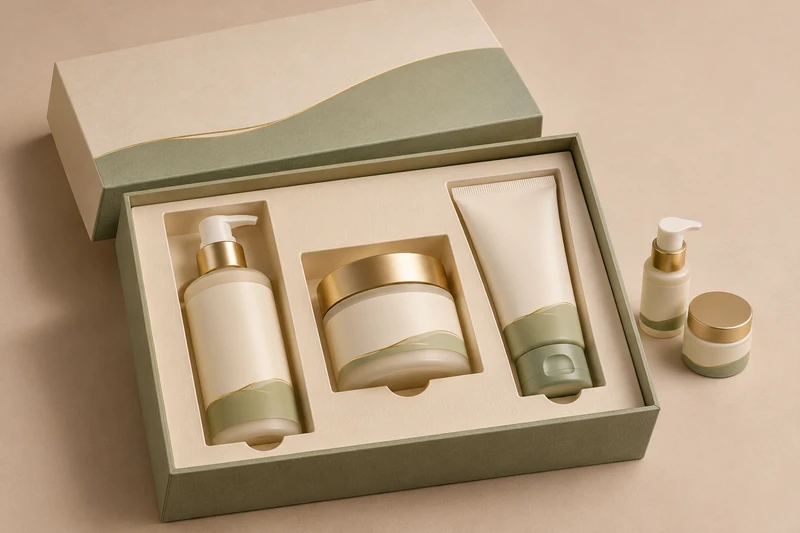
Skincare gift boxes bring a complete routine or miniature collection into one clear retail and gifting format. The best format does more than hold products: it establishes the order of use, keeps mixed bottles, jars and tubes organised, and gives each item a deliberate place when the box is opened.
For beauty brands, retailers and e-commerce teams in the United Kingdom, the starting point is the actual product range rather than a standard box size. Container dimensions, weights, closures, product labels and the intended unboxing sequence should shape the outer box and removable insert. XGolden Print designs and produces custom paper packaging boxes, gift packaging, labels and stickers, supporting skincare set briefs from structural design and artwork through to sample approval before production.
A skincare set box is retail and gift presentation packaging. It can help organise products for sale, gifting and fulfilment, but it is not automatically a complete transport-protection system. The skincare bottles, jars and tubes remain the primary containers; an outer mailing solution should be specified separately where online orders need it.
Skincare routines and mini sets that need a shared box
Skincare gift boxes are particularly useful where several products make more sense together than separately. A set may introduce a full routine, pair complementary products for a seasonal promotion, or present travel-oriented minis in a format that feels considered rather than miscellaneous.
Typical contents include:
- A cleanser, toner, serum and moisturiser arranged in use order
- A day-and-night pairing, such as a daytime cream alongside an evening treatment
- A face-care set combining a jar, pump bottle and tube
- Discovery collections with smaller-format products
- Gift sets that include a hero product with supporting products
- Corporate, event or retail gifting where coordinated presentation matters
- A refill, accessory or branded information card alongside skincare products
The shared box gives the collection a single visual identity and prevents mixed formats from appearing disconnected. It also creates a place for routine guidance, variant names and gifting messages without relying on the individual product labels to explain the full set.
Mini sets need the same planning discipline as full-size collections. A product described as a “mini” can vary substantially in diameter, height, shoulder shape and cap design. Do not select a miniature skincare gift box from a catalogue image alone. Confirm the dimensions and weights of every actual container, including its closure, before agreeing the layout.
| Skincare set use | Main packaging requirement | Suitable planning option |
|---|---|---|
| Full daily routine | Clear sequence for several mixed containers | Fitted insert with products arranged from first to last step |
| Mini discovery set | Compact presentation without loose movement | Individually sized removable insert openings |
| Retail gift set | Strong shelf-facing presentation and coordinated branding | Rigid or lid-and-base box with considered outer artwork |
| E-commerce gift order | Presentable set plus separate transit planning | Gift box for presentation, with outer protective packaging specified separately |
| Corporate or event gift | Clear branding and easy distribution | Shared box format, set card and agreed packing workflow |
| Product launch collection | Product identification across new variants | Exterior naming, insert positions and labels planned together |
A routine box should also be designed around the intended packing method. Consider whether products will be placed into the insert in one fixed order, whether a leaflet is added before closing, and whether the final pack needs a seal, sticker or sleeve. These details affect the box dimensions and the speed and consistency of packing.
Matching bottles, jars and tubes to one layout
A skincare set containing different container types needs a layout that recognises their physical differences. A tall pump bottle, low cream jar and flexible tube may all fit within the same outer footprint, yet each needs a different opening shape, depth and amount of finger clearance.
Start by recording the finished dimensions of every packed item:
- Overall height, including caps, pumps and collars
- Maximum width or diameter at the widest point
- Shape of shoulders, bases and lids
- Filled weight
- Whether the product is rigid, flexible or likely to shift under handling
- The orientation in which the product should be presented
- Any product label areas that must remain visible once placed in the insert
For tubes, consider whether the cap is at the top or bottom and whether an upright presentation makes the product easier to recognise. For jars, consider the lid diameter rather than only the body diameter. For bottles, do not overlook a pump, dropper or distinctive cap that increases the true height.
A visually balanced skincare gift box does not necessarily require identical product positions. One large jar may sit centrally while smaller bottles and tubes frame it. Alternatively, a left-to-right sequence can make the routine immediately understandable. The choice should serve the set story and practical product removal, not simply create symmetry.
Allow enough clearance for the item to be inserted without forcing it into place. At the same time, an opening that is too loose can make the contents look untidy or move during handling. The appropriate tolerance, insert construction and material selection depend on the real products and should be confirmed for the individual project.
Product access is part of the layout
A set can look refined in a closed box yet frustrate the recipient if products are difficult to remove. Build in a practical removal method during the design stage. Depending on the agreed construction, this could mean finger spaces, a lift point, a ribbon pull or an insert that can be removed before the products are taken out.
Think about the first product a customer sees and the first product they can lift out. A skincare routine is often used in a defined sequence, so an arrangement that exposes the first step clearly can make the set more intuitive.
Avoid placing bottles so tightly together that labels rub or the recipient has to grasp a product by a pump or lid. Likewise, avoid decorative cards positioned where they conceal essential item names at the moment of opening.
Routine order and product identification
A skincare gift box should explain the collection at a glance. This is especially valuable for starter sets, gift recipients who do not already know the range, and mini collections where labels may have limited space.
The opening layout can establish routine order through numbered positions, printed insert text, a routine card or simple labels such as “cleanse”, “treat” and “moisturise”. Keep the hierarchy straightforward: the recipient should be able to identify each product without turning over every container.
For a set with morning and evening variants, separate the products visually rather than relying only on small-print instructions. A divided layout, distinct printed zones or a clearly positioned information card can help distinguish the two routines. Where several products have similar bottles, make sure each item name and variant can still be identified at the point of sale and when the gift box is opened.
Labels and stickers may support identification on bottles, jars, boxes and bags. For skincare containers, define the actual surface before specifying them: a curved jar, tapered bottle and flexible tube each present different application considerations. Confirm the label dimensions, shape, placement and whether it will be supplied in roll or sheet format. The intended application method and use conditions should also be discussed, particularly where the container may be handled frequently or used in a bathroom setting.
For buyers preparing artwork in the United Kingdom, make the product-facing copy and set-level copy part of one artwork review. This reduces the risk of a box naming one variant while the containers use different product names, shades or routine terminology. XGolden Print provides artwork support, while final artwork content and the requirements for the individual product remain the brand’s responsibility.
Information to plan across the full set
Before approving a design, check that these information layers work together:
- Outer box: collection name, brand identity, gift message or product family.
- Opening view: routine sequence and immediate recognition of the products.
- Individual containers: product name, variant and own required information.
- Set card or leaflet: instructions, routine guidance or campaign detail where needed.
- Packing identification: any internal SKU, variant or assembly reference needed by the packing team.
The outer box should not be assumed to replace information required on primary containers. It is presentation packaging around customer products, while each bottle, jar or tube has its own product and label requirements.
Lid-and-base and rigid-box examples from XGolden
Box style should follow the quantity of products, desired opening experience, retail presentation and handling needs. A simple structure may suit a compact mini set; a more substantial format may suit a routine collection intended as a premium gift.
The LB-302 skincare-trio lid-and-base box is a structural example of a lid-and-base format for a skincare trio. This style separates into a lid and base, creating a deliberate reveal when opened. It can be useful where the products should be displayed together in a shallow, organised arrangement. The exact internal layout, dimensions and suitability still need to be agreed against the brand’s actual containers.
For a more presentation-led routine format, the RB-302 skincare-routine rigid box provides an existing rigid-box structural reference. Rigid boxes can support a more substantial gifting experience and a carefully arranged interior. The final capacity and container fit depend on the actual bottles, jars and tubes in your set. New layouts should always be developed from supplied product samples or confirmed measurements.
Both formats can be considered within a wider gift packaging brief, where the requirements may include several products, coordinated branding and the intended opening experience. If the project calls for another structure entirely, XGolden Print can also support a custom box brief based on the collection’s specific dimensions and presentation goals.
Retail presentation versus transit protection
A rigid box or lid-and-base box can elevate the shelf and gifting experience, but it should not be treated as a complete delivery system by default. For online skincare orders, identify separately:
- The gift box that the recipient sees
- The primary product containers and their closures
- Any packing material around the gift box
- The outer carton or mailer used for shipment
- How the packed order will be handled before reaching its delivery destination
This distinction is important for brands combining retail stock, direct-to-consumer orders and event gifting. One gift-box design may be suitable across all three channels, but the surrounding fulfilment arrangement may differ.
Inserts that support packing and product removal
A fitted insert gives each skincare item a defined position. It can prevent the set looking disordered, speed up assembly and help the recipient understand the collection. Its main job is not simply to fill empty space; it should make packing and removal practical.
A removable insert is often particularly useful for routine sets. The recipient can lift it out to access products more comfortably, inspect a card placed underneath, or retain the outer box for storage. For the packing team, a removable insert can make it easier to load the products into defined positions before the box is closed.
When briefing an insert, specify:
- The number of products and the position of each one
- The container measurements and weights
- Which product faces should be visible
- Whether products should stand upright, lie flat or be nested
- Required finger access or lift features
- Whether a leaflet, card, sample sachet or accessory is included
- Whether the insert needs to be removable
- The intended packing sequence and who will assemble the set
Material selection should serve the set’s actual needs: visual finish, support for the container shapes, ease of packing and the intended presentation. XGolden Print can advise on material selection and fitted inserts, but material suitability and final construction should be confirmed against the individual project.
A frequent mistake is designing the insert around only the main product. The smallest tube, widest cap or tallest pump may determine the workable internal dimensions. Another is allowing an information card too little space, causing it to bend or conceal the contents. Provide all included components when planning the insert, not only the skincare containers.
Approving artwork and a complete set sample
A complete sample is the most useful checkpoint for skincare gift boxes because it brings the outer structure, insert, products and artwork into one review. Looking at a flat artwork file cannot fully show whether products align, whether the copy is legible at the intended scale or whether the opening sequence feels coherent.
Before sample approval, review the set as a recipient and as a packing team member.
Recipient review
- Does the outer box identify the collection clearly?
- Is the routine order obvious on opening?
- Are all bottles, jars and tubes easy to remove?
- Are product names and variants visible where needed?
- Does the insert support the products without making access awkward?
- Does the box still present well after the products have been removed?
Packing review
- Can each item be placed in the correct position reliably?
- Is there a clear order for loading products, cards and inserts?
- Are mixed variants easy to distinguish during assembly?
- Does the set close cleanly with all agreed components inside?
- Have the full dimensions and weights been checked using the actual contents?
XGolden Print’s process can support structural design, material selection, artwork support, printing, finishing, fitted inserts and sample approval before production. For skincare sets, supply the fullest possible product information early. Actual containers or accurate measurements make it easier to assess the proposed layout, while final pricing, order quantities, finishes, sample terms and production schedules should be confirmed for the specific project.
A strong brief for skincare gift boxes includes the product list, container dimensions, filled weights, desired routine order, quantity, artwork status, intended sales channel, required delivery date and delivery destination. Share these details with XGolden Print to discuss a lid-and-base, rigid or custom skincare set box planned around your actual collection.
