
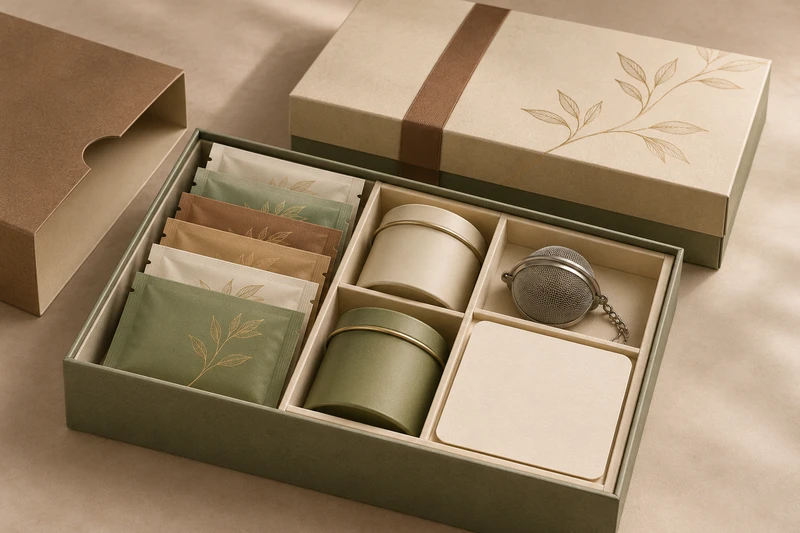
Tea sampler packaging should make a tasting collection easy to understand, open and re-pack. For tea brands, the box needs to establish a logical tasting order, keep each sealed component in its intended place and present brewing information before the recipient begins.
For packaging buyers in the United Kingdom, this applies to retail tasting collections, online gift sets, corporate gifts and event packs. XGolden Print designs and produces custom paper packaging boxes, gift packaging, labels and stickers, supporting projects from structural design and material selection through artwork support, fitted inserts, sampling and production. The tea itself remains the brand’s product: the outer gift box is a presentation and organisation format, not an aroma or freshness barrier.
A tea tasting selection needs a clear order
Tea sampler packaging is most effective when the order of tasting is designed into the physical layout. A recipient should be able to see what is included, identify where to start and understand whether the collection is arranged by tea type, flavour profile, time of day or brewing strength.
For example, a set may present lighter teas before more robust blends, or move from unflavoured options to fruit and spiced varieties. The chosen route is a brand decision, but the packaging should make it obvious through compartment order, numbered positions, printed dividers or a tasting card.
Before selecting a tea gift box structure, define the sequence that matters to the collection:
- Progressive tasting: arrange samples from delicate to fuller-bodied profiles.
- Tea family selection: group black, green, herbal and fruit teas into distinct sections.
- Day-part set: place morning, afternoon and evening teas in a clear left-to-right or top-to-bottom flow.
- Seasonal gifting: organise a limited-edition selection around the intended occasion, with a guide that explains each variety.
- Discovery collection: use a consistent sample layout with a numbered tasting guide for recipients who are unfamiliar with the range.
The opening experience should follow the same logic. A lid that reveals the whole selection at once suits a display-led gift set, whereas a drawer can make the tasting journey feel more sequential. Avoid a layout that relies only on loose printed information elsewhere in the box: if sachets are returned in the wrong position after opening, the tasting order can quickly become unclear.
For shelf-facing tea sampler packaging, consider what a retailer or recipient sees before the box is opened. The outer panel may need the collection name, number of tea varieties, product identifiers and concise product information supplied by the brand. Inside, the arrangement should continue the story rather than merely fill available space.
Sealed sachets, tins and accessories in one set
A tea tasting collection can contain individually sealed sachets, mini tins, wrapped loose-leaf portions, a tea infuser, a measuring spoon or other brewing accessories. Each item has different dimensions, weight and handling requirements, so the insert and box should be planned around the actual components rather than a generic product count.
Sealed sachets are generally the simplest format to group, but their width, stack height and seal shape can differ between varieties. Tins add concentrated weight and need defined positions to prevent movement. An accessory may be longer, deeper or more irregular than the tea packs, which can affect the box footprint and opening method.
| Tea sampler use case | Typical contents | Key packaging requirement | Suitable approach to assess |
|---|---|---|---|
| Retail tea discovery box | Sealed sachets in several flavours | Clear variety order and quick product identification | Compartments or card dividers with printed positions |
| Premium tea gift set | Sachets, tins and a brewing accessory | Balanced presentation and controlled movement | Fitted insert with separate spaces for each component |
| Online tea gift collection | Sealed tea packs and printed guide | Neat presentation after handling and straightforward packing | Structured internal layout; confirm separate transport protection needs |
| Corporate or event tea gift | Selected tea packs with branded card | Coordinated branding and easy distribution | Compact gift-box format with an insert sized to the final set |
| Loose-leaf sampling set | Sealed portions or tins | Separation between varieties and room for instructions | Individual cavities or defined channels sized to each container |
A fitted insert can provide a place for every item, helping packing teams see immediately whether a set is complete. It can also create a deliberate reveal when the box is opened. However, an insert should not be assumed to suit every component without checking dimensions, weight and how the products are loaded during packing.
The outer packaging should be designed separately from the primary tea packaging. The sealed sachet, tin or other primary container is responsible for holding the tea product. A paper gift box can organise and present the collection, but it should not be described or specified as the layer that preserves aroma, freshness or the tea itself. Where product-contact or food-related material suitability is relevant, the buyer should confirm requirements for the individual project.
For online orders, tea sampler packaging also needs to be distinguished from a complete transport protection system. A well-organised presentation box may still require appropriate outer shipment packaging and handling arrangements selected for the route, order configuration and contents. Plan the gift box for the recipient’s experience; assess transit protection separately.
Identifying flavours and brewing information
Tea sampler packaging should help recipients distinguish products without repeatedly lifting every sachet or tin from its position. The information hierarchy is especially important when collections contain similar-looking packs or multiple flavour variants.
Start with the details a recipient needs at the moment of choosing a tea:
- Tea name or flavour.
- Tea type or blend category, where relevant to the range.
- A clear identifier that matches the item in the box.
- Brewing guidance supplied and approved by the tea brand.
- Any collection-specific tasting sequence or serving suggestion.
Information can sit on the individual primary packs, on an insert card, directly beneath each compartment or in a combination of these places. The best choice depends on how much text is needed and whether the recipient can view labels without removing the product.
A useful rule is to give each item at least two ways to be recognised: its own printed primary pack and a matching position in the sampler box. If the contents are moved during packing or opened by a retailer, this reduces confusion. Where small tins or sachets need additional identification, labels and stickers can be specified for the relevant container or surface, with agreed dimensions, shapes and roll or sheet formats.
For United Kingdom-facing tea gift sets, artwork should be reviewed as part of the complete customer journey. Check that the names, brewing information, variants and any brand-supplied product wording remain legible at the final printed size. Do not leave this review until after the structural layout has been fixed: a small cavity may make an otherwise useful information panel impractical.
Common information problems include:
- using colour alone to identify varieties;
- printing names where they are covered by the insert;
- placing brewing instructions only on an outer sleeve that may be discarded;
- giving each tea a different naming style, making the collection harder to scan;
- failing to match the tasting guide order to the physical packing order.
XGolden Print can provide artwork support alongside structural design, allowing the printed hierarchy and insert layout to be developed as connected parts of the tea sampler packaging brief.
A tea-sachet drawer-box presentation
A drawer box is a practical format for a tea-sachet collection where the brand wants a controlled reveal and an interior that can hold a consistent arrangement of samples. Pulling the drawer open can expose the tasting guide, sachet rows or a compartmented insert in one action.
The DB-315 tea-sachet drawer-box style is an existing XGolden Print drawer-box reference for this type of presentation. It provides a useful starting point when considering a sachet-led collection, but its fit for a new project must be confirmed against the actual sachet dimensions, stack height, number of varieties and any added cards or accessories.
A drawer layout can be considered when the set contains:
- one sachet per tea variety, arranged in individual positions;
- multiple sachets per flavour, stacked in rows;
- a tasting card placed above the selection;
- a removable insert that separates sample groups;
- a compact gifting format where a sleeve and drawer reinforce the visual presentation.
The internal depth is a critical decision. It must allow the sachets and any insert to sit without being crushed by the drawer movement, while avoiding excessive empty volume that permits contents to shift. Measure finished, sealed packs rather than relying on flat artwork dimensions. If sachets have uneven seals, folded edges or attached strings, include these in the measurement set.
Consider how the box will be packed as well. A layout that appears orderly in a visual mock-up may be slow or error-prone if operators must insert many loose sachets in a precise order. Clear numbered positions, grouped cavities or simple row-based loading can support packing consistency. The right approach depends on the collection’s contents and packing process.
A drawer box is primarily a retail and gifting presentation choice. If the collection will be sent through e-commerce channels, assess separately how the packed gift box will be protected within the wider dispatch arrangement.
Developing a magnetic tea gift-box layout
A magnetic closure box can suit a more expansive tea gift set, particularly one that combines sample formats or includes a brewing accessory. Its hinged opening can display the collection as a complete presentation, making it relevant to premium retail sets, corporate gifting and afternoon-tea-themed collections.
The MC-307 afternoon-tea magnetic-box structure is an existing XGolden Print structure reference for an afternoon tea gift-box format. It can inform early conversations about a hinged magnetic presentation, but any new tea set arrangement needs confirmation against its final components. Do not assume a particular tin, sachet quantity, accessory or insert will fit without a component review.
A magnetic tea gift box can be planned around a central visual hierarchy:
- Lid interior: a welcome message, tasting map or brand story.
- Main tray: tea tins or sachet groups in a symmetrical or tasting-led arrangement.
- Accessory section: a defined place for an infuser, spoon or other non-tea component.
- Information card: brewing notes that can be removed and retained.
- Refill or re-use concept: only where the brand’s product and intended customer use support it.
The closure style should serve the opening experience, not substitute for proper layout planning. A large lid can create a premium reveal, but the interior still needs to control movement and make each component easy to remove. Deep cavities can make tins secure but difficult to lift; shallow cavities can make products accessible but may need closer tolerance checks. Ask for the actual height, widest point and weight of every item, including any accessory packaging.
Material selection and finishing are also application decisions. They affect the desired visual character, printed artwork and the way the box is handled, but suitability must be discussed against the individual project. XGolden Print can support material selection, printing and finishing as part of a custom packaging development process. The aim is to choose a construction and surface presentation that supports the tea set’s use, rather than selecting a finish in isolation.
For a wider range of structures, buyers can review XGolden Print’s custom box options when preparing a tea gift-box brief.
Checking set contents and packing consistency
A tea sampler box is only successful when the finished set contains the correct products in the correct positions. This matters for retail display, gifting and online fulfilment alike. A minor variation in sachet thickness, tin diameter or accessory packaging can change how the insert performs, so final checks should use representative components.
Build the packaging brief around a content schedule. For each item, record:
- product name and variant;
- sealed sachet, tin or accessory format;
- finished dimensions, including irregular edges or closures;
- unit weight;
- number of units in each set;
- required order in the box;
- visible product information;
- whether the item is removed individually or as a group;
- whether an insert card, leaflet or message card is included.
It is helpful to define the pack-out sequence too. For instance, does the packing team load the insert into the box first, place sachets in numbered compartments, add a card, then close the box? Or are tins loaded before a top layer of sachets is added? This process affects the most practical insert design and can reveal where a layout is likely to create packing errors.
Sample approval before production is particularly useful for tea sampler packaging because it allows the buyer to inspect the arrangement with the intended components. Check the following at that stage:
- Every sachet, tin and accessory fits its allocated space.
- The tasting order is clear when the box is first opened.
- Products can be lifted out without damaging adjacent items.
- Printed names and brewing information match the contents.
- The box closes as intended with the full set inside.
- The complete set looks consistent when packed repeatedly.
- Any labels or stickers align with the correct product and application surface.
- The presentation box is assessed separately from any necessary transit packaging.
XGolden Print has 27 years of experience and supports packaging projects with structural design, material selection, artwork support, printing, finishing, fitted inserts and sample approval before production. With a 15,000 square metre factory, 500+ employees and 10M+ production capacity, the company can discuss tea gift packaging requirements in the context of the individual project. Order quantities, materials, finishes, insert details, sample terms, pricing and schedules should all be confirmed for the proposed set.
To discuss tea sampler packaging with XGolden Print, share the dimensions and weights of the sealed tea products and accessories, set quantity, artwork, required delivery date and destination. Explore relevant gift packaging options as a starting point for a tailored tea tasting collection.
