
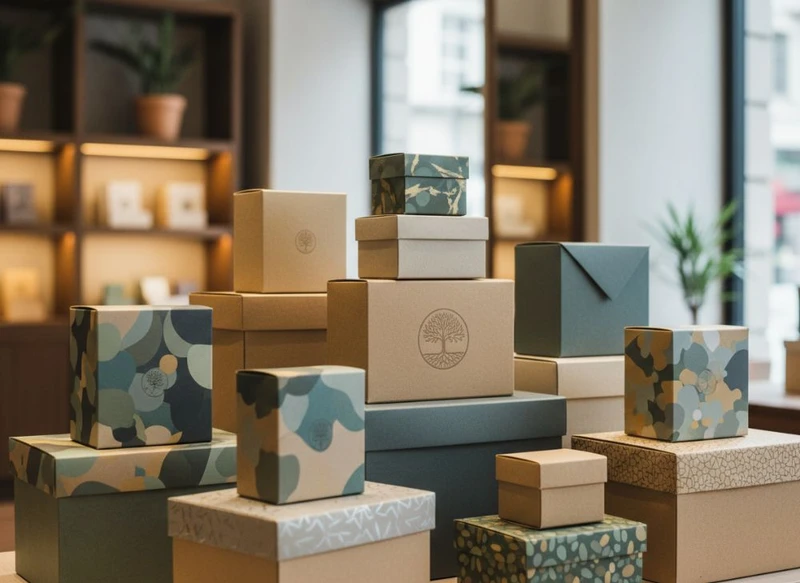
Custom paper box packaging should protect the product, make the brand recognisable and suit the way the item is sold, stored and opened. The right specification is rarely the most elaborate one: it is the box that balances strength, presentation, print finish, packing efficiency and budget for your particular product.
This ultimate guide to custom paper box packaging in 2026 explains the main decisions in a sensible order, from material and structural style to artwork, print method and ordering. Use it to create a clear brief before requesting quotations or approving a production sample.
Why Custom Boxes are Essential for Brand Growth
A custom box is a physical part of the customer experience. Before a product is handled, the packaging communicates its category, quality level and brand personality through shape, colour, texture and wording.
For retailers, a well-specified box can help products look organised and consistent on a shelf. For online orders, it can make the arrival feel more considered while protecting the item during handling. For both channels, clear on-pack information helps customers identify the product and understand how to use or care for it.
Custom packaging is particularly useful when you need to:
- Differentiate a product from similar-looking alternatives.
- Present giftable, premium or seasonal ranges more effectively.
- Keep a family of products visually consistent across different sizes.
- Add product instructions, care information, ingredients or other required copy.
- Create a more deliberate unboxing sequence.
- Reduce the need for additional labels by printing variable product details directly on the box, where suitable.
However, customisation should solve a real need. Adding extra panels, inserts, finishes or oversized dimensions can increase material use and complicate packing. Start with the product and buying journey, then add only the features that improve protection, clarity or perceived value.
For example, a compact skincare carton may need precise colour matching and concise product information, whereas a fragile gift item may benefit more from a rigid structure and a fitted insert. A simple retail sleeve might be sufficient for a durable product already contained in a branded jar or tin.
Choosing the Right Paper Stock and Material
The material choice determines how the box feels, folds, prints and withstands handling. “Paper box” covers several board types, so a supplier needs more than a request for cardboard packaging.
Common paperboard options
| Material type | Typical characteristics | Often suited to | Points to confirm |
|---|---|---|---|
| Folding boxboard | Smooth, printable paperboard that creases and folds neatly | Retail cartons, cosmetics, food-adjacent outer packs, lightweight goods | Board thickness, reverse-side appearance and suitability for the product |
| White-lined chipboard | A board with a white printable outer surface and a less refined reverse | General retail cartons and secondary packaging | Print coverage, fold performance and the finish required inside |
| Kraft board | Natural brown or white board with a more tactile appearance | Natural-looking brands, soaps, candles, subscription packs | Colour reproduction, surface variation and whether white ink is needed |
| Corrugated board | Fluted material between liner sheets, designed for greater structural strength | Postal boxes, larger products and protective transit packaging | Flute type, crushing strength needs and print surface |
| Rigid board | Dense board generally wrapped with printed paper or another covering material | Presentation boxes, premium gifts and reusable keepsake packaging | Construction method, wrap alignment, inserts and storage space |
Board weight is often expressed in grams per square metre (gsm), but gsm alone does not define box performance. A box’s strength also depends on its dimensions, folds, closure, orientation, product weight and whether it is packed tightly or loosely. Ask for the proposed material specification and assess it in the intended format rather than selecting a weight in isolation.
Match the material to the product’s risks
Identify the product’s practical demands before selecting a stock:
- Weight: Heavier items may need stronger board, a reinforced base or corrugated construction.
- Fragility: Glass, ceramics and delicate components may require an insert, divider or secondary transit pack.
- Surface sensitivity: Products with polished, painted or easily marked surfaces should not rub against abrasive board.
- Moisture and grease: Some products need a suitable barrier or a separate primary container. Confirm material compatibility for the specific application.
- Shape: Tall, narrow packs can tip over; unusually shaped items may need a tailored insert.
- Retail handling: Boxes expected to be opened repeatedly or displayed upright need durable closures and stable proportions.
A useful early test is to place a representative product into a plain mock-up at the proposed internal dimensions. Check that it can be packed consistently, removed comfortably and does not move excessively. Internal dimensions should account for the product, any wrapping, inserts and tolerances—not just the bare item measured at its widest point.
Key Design Elements for Impactful Visuals
Effective box design is easy to recognise and easy to read. It does not rely solely on decorative effects. A clear hierarchy is usually more valuable than filling every panel with graphics.
Build a clear information hierarchy
The front panel generally needs the brand, product name and the most useful purchase cue. Side and back panels can carry supporting details. Give the most important information enough contrast, space and type size to remain legible at the expected viewing distance.
A practical hierarchy often includes:
- Brand name or logo.
- Product name and variant.
- Key descriptive information that helps selection.
- Required or operational information appropriate to the product and market.
- Directions, care details, contact information or batch-related fields where needed.
Avoid treating the dieline as a flat poster. Panels meet at folds, tuck flaps may be partially hidden, and seam areas can affect what remains visible. Keep critical text away from cut lines, folds, glue areas, barcodes and openings.
Use colour and finishes purposefully
Colour can establish recognition across a range, but printed colour can vary with board surface, print process, coverage and finishing. If a particular brand shade is important, supply its colour references and discuss the best way to reproduce it on the selected material.
Common finishing choices include:
- Matt coating or lamination: A restrained appearance that can suit premium or contemporary designs.
- Gloss coating or lamination: A reflective finish that can make imagery and colour appear more vivid.
- Soft-touch finishes: A tactile surface often selected for presentation-led packaging.
- Spot varnish: Gloss applied to selected artwork areas for contrast.
- Foil blocking: Metallic or coloured foil used to highlight logos, borders or details.
- Embossing and debossing: Raised or recessed details that add tactile definition.
- Window patching: A clear window that shows the product, while introducing material and structural considerations.
Finishes should support the product position, not conceal weak artwork or poor structural design. They can also affect recyclability, scuff resistance, lead time and cost, so discuss the whole specification rather than choosing each element separately.
Prepare artwork for production
Before production, ensure the artwork file includes the correct dieline, bleed, safety margins, colour settings and image resolution for the chosen process. Text should be proofread by someone familiar with the product information; a printer can check technical setup, but responsibility for the accuracy of supplied content should be clear.
Ask to review a proof and, where appropriate, a physical sample or production-standard colour reference. Check:
- Spelling, product variants and contact details.
- Panel orientation and opening direction.
- Barcode size, placement and scan performance in the intended environment.
- Small type, fine lines and reversed-out text.
- Colour on the actual chosen board.
- Alignment of foil, varnish, embossing or windows.
- Visibility of important information after the box is assembled.
Printing Techniques: Offset vs. Digital for Boxes
Offset and digital printing can both produce high-quality custom boxes. The better choice depends on quantity, artwork complexity, colour expectations, timing and whether the design changes between versions.
| Consideration | Offset printing | Digital printing |
|---|---|---|
| Setup | Uses printing plates and has more initial setup | Does not usually require conventional plates |
| Best fit | Often considered for larger, repeatable production runs | Often useful for shorter runs, trials and versioned artwork |
| Colour handling | Can support controlled spot colours and consistent repeat work when specified | Well suited to full-colour artwork; results depend on the press and substrate |
| Artwork changes | Changes may involve additional preparation | Changes are generally simpler between versions |
| Personalisation | Less practical for individual variation | Can support variable data and multiple versions |
| Unit economics | Setup can be spread across higher quantities | Lower setup can make small quantities more practical |
These are general tendencies rather than fixed rules. Request quotations using the same dimensions, material, finish and quantity options so that the comparison is meaningful. A lower per-unit figure may not be the best overall choice if it creates excess stock, outdated packaging or storage problems.
Other print and decoration options
Flexographic printing is often used for simpler artwork on corrugated packaging, while screen printing may be considered for particular effects or materials. The right process depends on the construction and design. Ask how the selected print method works with the board, coverage, finish and desired colour appearance.
If your range has several flavours, shades or seasonal versions, plan the artwork system early. A shared layout with controlled variable fields can reduce design errors and help the range remain coherent.
Structuring Your Budget for Custom Packaging
A packaging budget should account for the complete specification, not only the quoted unit price. Small changes in material, box dimensions and decoration can materially alter the cost and operational effort.
Build your budget around these areas:
- Structural development: Dielines, prototypes and any bespoke insert design.
- Material: Board grade, thickness, print surface and protective layers.
- Printing: Number of colours, coverage, process and artwork versions.
- Finishing: Lamination, varnish, foil, embossing, windows and other treatments.
- Assembly: Flat-packed or assembled supply, glued elements and hand-applied components.
- Quantity: The relationship between order volume, setup and unit cost.
- Storage and handling: Space needed for flat or assembled boxes, plus stock management.
- Secondary packaging: Transit protection, void fill or separate mailing packs where applicable.
- Contingency: Allowance for artwork amendments, sample review and unexpected specification changes.
Spend where the customer notices or the product needs it
Put budget first into the factors that protect the item and make the packaging usable. Then prioritise the visual features customers will actually see and feel, such as a strong print surface, carefully chosen finish or well-made closure.
Common false economies include using a box that is too large, choosing an insert that does not hold the product securely, or approving artwork without checking assembled-panel placement. Conversely, expensive decoration may be unnecessary for a product sold primarily through a protective outer mailer where the retail-facing carton is rarely displayed.
Ask for tiered quotations at realistic volumes. Ordering far more than your forecast simply to reduce a unit price can tie up cash and leave you with obsolete packs after an artwork or product change.
Paper Box Styles: Which is Best for Your Product?
The best paper box style is the one that fits the product, sales channel and desired opening experience. It should also be straightforward for your team or fulfilment partner to assemble and pack.
Folding cartons
Folding cartons are supplied flat and formed into shape when packed. They are versatile, space-efficient in storage and commonly used for lightweight retail products.
Typical formats include tuck-end cartons, reverse tuck-end cartons, straight tuck-end cartons and auto-locking bases. Tuck-end boxes suit many lighter items, while more secure base constructions can be appropriate for heavier contents. Confirm whether the product’s weight and shape require a glued or locking base.
Sleeves and wraps
A sleeve slides over a tray, inner carton, jar or other pack. It can add branding without fully enclosing the product and may be a practical choice for gift sets or products with a presentation container already in place.
Sleeves provide less protection than a full box, so check whether an outer transit pack is needed for e-commerce orders.
Drawer boxes
Drawer or matchbox-style boxes use an outer sleeve and a sliding inner tray. They create a deliberate reveal and can work well for gifts, accessories and curated sets. Their two-part construction uses more material and needs accurate sizing to slide smoothly without becoming loose.
Rigid presentation boxes
Rigid boxes are constructed from thicker board and are often selected for premium gifting, presentation sets and products intended to be retained. Options include lift-off lids, hinged lids and magnetic closures. They generally require more storage space than flat-packed folding cartons and should be assessed carefully for the actual distribution journey.
For specialist formats, explore custom box packaging options with dimensions and product details already defined.
Postal and corrugated boxes
Corrugated postal boxes are designed around transit protection and convenient packing. They can be branded externally or internally, depending on the desired experience. Measure the packed product rather than the retail box alone, including protective components, to avoid excess empty space or a poor fit.
Inserts, dividers and internal trays
An insert prevents movement and creates a cleaner presentation. It may be made from folded card, moulded materials, foam or other substrates depending on the product’s needs. A paper-based insert can support a more unified material approach, but it must still provide sufficient retention and cushioning.
Avoid designing an insert solely for appearance. Test whether it holds the product in the correct orientation, can be packed efficiently and remains functional after ordinary handling.
Sustainable Packaging Solutions for Modern Brands
More sustainable paper box packaging starts with using the right amount of material and designing for the intended recovery route. Paper-based does not automatically mean every component is straightforward to recycle, especially where laminates, adhesives, foils, windows, magnets or mixed-material inserts are involved.
Useful design principles include:
- Right-size the box to reduce unused space and unnecessary board.
- Choose a structure that protects the product without excessive secondary materials.
- Prefer simple, separable components where practical.
- Use a consistent material family for box and insert when it meets performance needs.
- Avoid decorative layers that do not add meaningful function or brand value.
- Consider whether a durable presentation box is genuinely intended for reuse.
- Use clear disposal guidance only after confirming it is accurate for the full pack and target market.
If you want to use recycled content, recyclable claims, compostability claims or forestry-related statements, verify the exact material, coatings, inks, components and claim wording with relevant specialists and the packaging supplier. Requirements and collection systems vary, and broad environmental wording can be misleading when it does not reflect the finished pack.
Minimal design need not look basic. Uncoated or kraft-style board, restrained ink coverage, well-considered typography and a practical one-piece structure can create a distinctive result without relying on multiple embellishments.
How to Order Custom Paper Boxes: A Step-by-Step Guide
A detailed brief makes it easier to compare suppliers and reduces avoidable revisions.
- Define the product and sales channel. Record product dimensions, weight, fragility, primary packaging, expected handling and whether the box is for retail, gifting, subscription or postage.
- Choose the box function. Decide whether the box is a retail carton, protective mailer, presentation pack or an outer layer around another container.
- Set internal dimensions. Include the product, protective wrap, insert and clearance needed for practical packing. Specify dimensions consistently as length × width × height.
- Select a preliminary structure and board. Choose an appropriate style, then identify any closure, base or insert requirements.
- Create a packaging hierarchy. Separate critical product information from promotional copy and decorative elements.
- Prepare print-ready artwork. Use the approved dieline and include bleed, safe areas and correctly specified colours.
- Request comparable quotations. Provide the same quantity options, material, dimensions, print, finish, assembly requirement and delivery format to each supplier.
- Review a proof or sample. Assess fit, opening, print, colour, finish, readability and packing process before committing to full production.
- Confirm commercial details. Check quantities, tolerances, lead times, payment terms, artwork approval process, packing format and what happens if the specification changes.
- Inspect the first delivered batch. Compare the boxes with the approved specification and retain a reference sample for repeat orders.
A simple brief can prevent many common mistakes. Include photographs of the product, measured dimensions, estimated quantity, intended use, desired board appearance, print colours, required finish and any non-negotiable functional requirement.
Frequently Asked Questions
What is the best board for custom product boxes?
There is no single best board. Folding carton board is often suitable for lightweight retail packs, corrugated board is commonly chosen where added transit protection is needed, and rigid board suits presentation-led packaging. The correct choice depends on the product weight, dimensions, handling and finish.
Should boxes be supplied flat or assembled?
Flat-packed cartons can save storage space and may be assembled during packing. Pre-assembled boxes can simplify presentation packing but occupy more space. Compare the storage, assembly time and packing workflow before deciding.
Can a paper box be used as a postal box?
Some paperboard cartons can be posted inside an outer protective pack, but they may not be strong enough to serve as the only transit packaging. Assess the product, route, packing method and expected handling, and test the complete packed order.
Are stickers useful alongside printed packaging?
Yes. Stickers can be useful for short-run variants, batch details, seals, seasonal messages or product updates where reprinting a complete carton is impractical. Browse custom printed stickers when a label may be the more flexible option.
A well-planned paper box specification combines product protection, clear communication and a design that is realistic to produce repeatedly. For presentation-led ranges, custom gift packaging may help narrow down suitable structures. When you are ready to develop a brief, XGolden Print can provide custom packaging and printing solutions; its experience includes 27 years in the sector.
